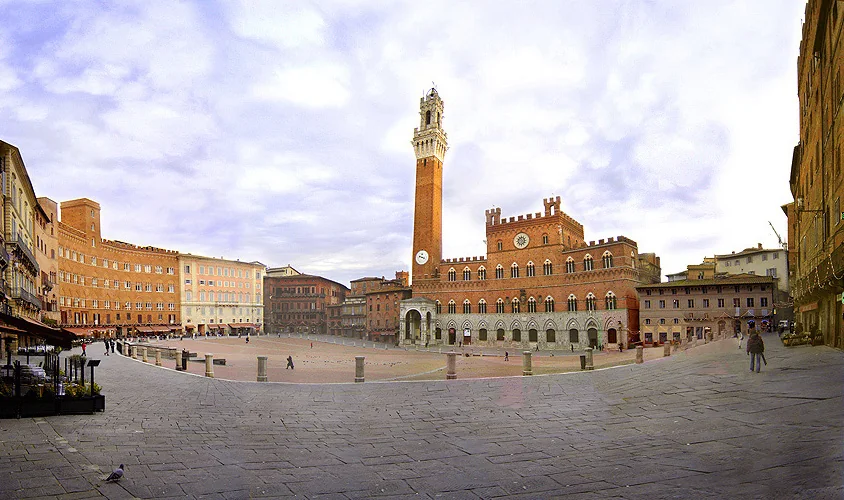
Palio di Siena: What Actually Happens, and Whether to Go
What happens across the Palio’s four days, how to watch from inside the Campo for free, and the honest case for choosing a different week.
In this guide
Quick answer
The Palio is not an attraction that runs on a schedule you can slot into a Tuscany itinerary. It is a civic and religious event the Sienese take part in all year, and the race happens exactly twice: 2 July, dedicated to Our Lady of Provenzano, and 16 August, in honour of the Assumption. Ten of the city’s seventeen contrade run in each one.
That matters because the most common mistake visitors make is assuming Siena races horses in the square on some regular basis. It does not. Turn up in the wrong week and there is nothing to see; turn up in the right week and you get a city that has rearranged itself entirely around four days.
Come for the Palio if the event itself is the reason for the trip and you accept a packed square, real August heat, and a plan that may move by a day. Come in a different week if what you want is Siena — the cathedral, the museums, a long lunch, streets you can actually walk down.
What happens across the four days
The official programme describes an event lasting four days, of which the race is the last few minutes. In 2026 those four days fall Thursday to Sunday, and the weekdays matter more than usual — because Ferragosto lands inside them.
| Date | Day | What happens |
|---|---|---|
| 13 August | Thursday | The *tratta*: horses are tested on the tuff laid in the Campo, ten are judged eligible, and each is drawn to a contrada. The first trial runs that evening |
| 14 August | Friday | Trials morning and evening — and the last ordinary shopping day before the holiday |
| 15 August | Saturday | Ferragosto, a national public holiday. The *prova generale*, the fifth trial, runs in the evening |
| 16 August | Sunday | Jockey mass, then the *provaccia*; signing of the jockeys, after which the contrada cannot change rider; blessing of the horses in each contrada's oratory; the historical procession of close to six hundred costumed figures; then the race |
Six trials run across those days, two a day, morning and evening.
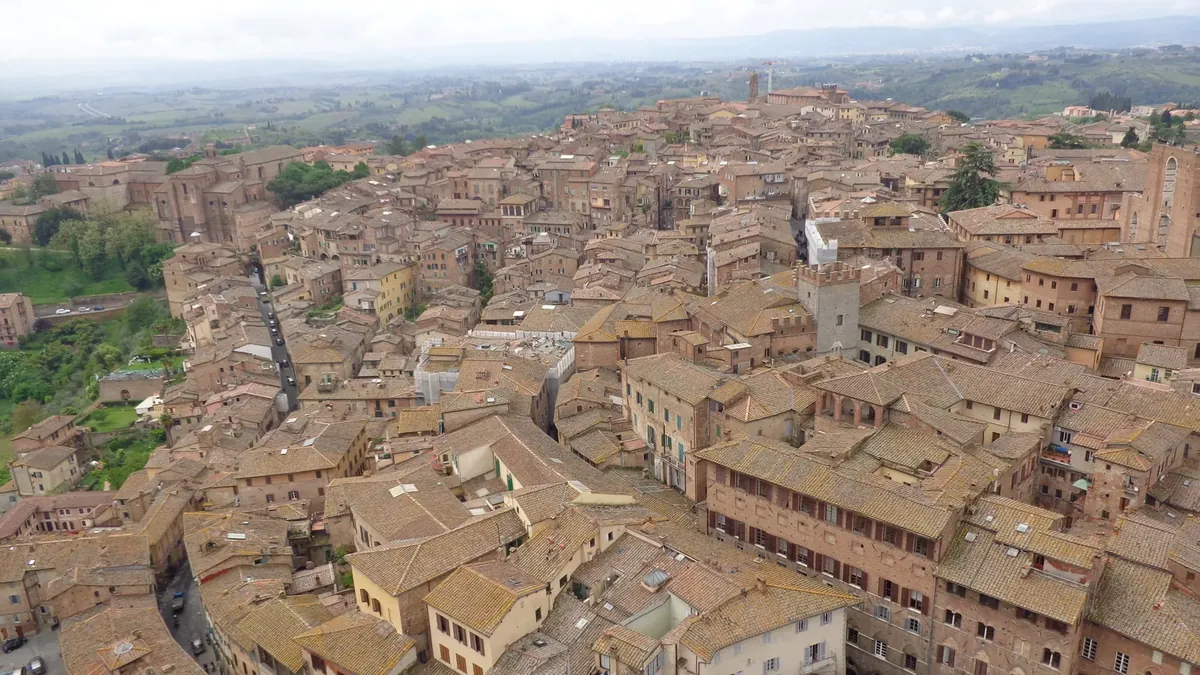
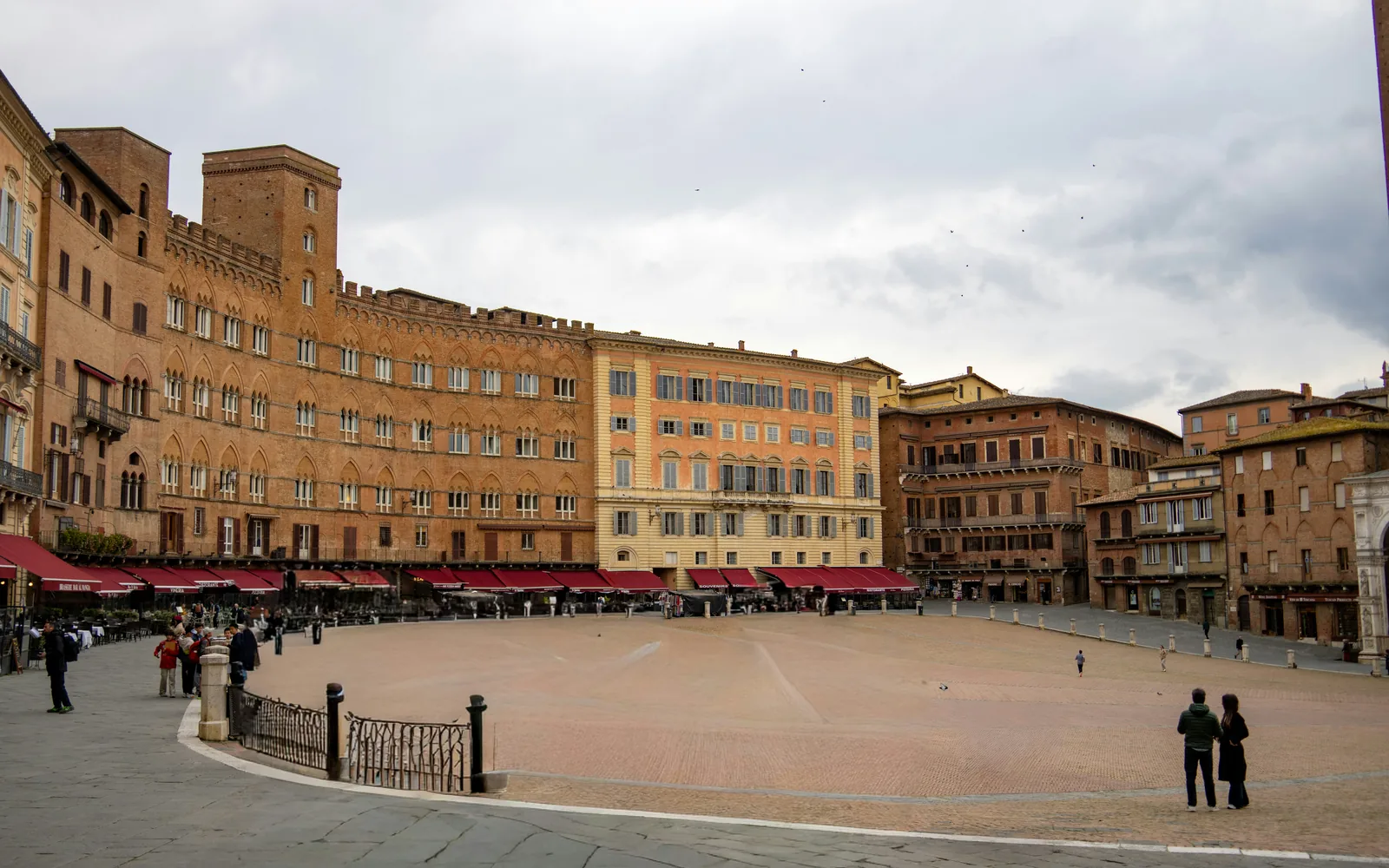
Piazza del Campo, seen from above. The race runs on a track of tuff laid around the outside of the shell; the crowd stands in the middle.
Now a warning about the times that is worth more than the times themselves. When we checked on 28 July 2026, the Comune di Siena had not yet published the hour-by-hour programme for 16 August. Every set of August times circulating online traces back to the Comune's page for the 2024 race, published on 11 August 2024. Treat those as the year-before-last's schedule, not this year's.
What the Comune has published for 2026 is the July race, issued on 25 June, a week before it ran:
| Stage | Official time, 2 July 2026 |
|---|---|
| Jockey mass | 07:45 |
| Morning trials: track cleared, then horses out | 08:40, then 09:00 |
| Evening trials and the *prova generale*, horses out | 19:45 |
| *Provaccia*, horses out | 09:00 |
| *Corteo storico* enters the Campo | 17:20 |
| Race — horses out of the Cortile del Podestà | 19:30 |
Use that as the shape of the day, not as August's clock. The two races have historically started at different times, and the August start is precisely the figure we cannot yet verify. On both the 2024 and 2026 evidence the Comune publishes roughly a week ahead, so the 16 August programme should appear in the first half of August. Check it then, rather than trusting a number copied from a previous year.
The trials are the part visitors underestimate. Each one draws a crowd of contradaioli walking the horse from its stable to the Campo, singing on the way. If you want the atmosphere without the crush of race day, a trial evening gives you a great deal of it.
The race itself
A mortar shell announces the horses leaving the Entrone. They line up between two *canapi*, heavy intertwined ropes. Nine contrade take their place between the ropes in an order drawn in secret immediately beforehand; the tenth enters from behind, *in chase*, and only once it moves can the starter drop the front rope.
The horses run three laps of the track laid around Piazza del Campo, described in the official material as a 1,000-metre course. The first to finish wins — and here is the detail that surprises people most: a horse that has lost its jockey can still win. The Sienese call it *scosso*, and it counts.
If the start is judged invalid a second mortar recalls the horses and the whole line-up begins again. That can happen repeatedly, which is why a race of three laps can be preceded by an hour of tension in the square.
The official material does not publish a race duration, and neither will we. What it does publish is the structure above: four days of ritual, then three laps.
Watching for free, or paying
This is the practical question most guides answer vaguely, so here is the official position, quoted:
"You can watch the trial runs and the Palio by paying to access the stages set up around the Piazza or the windows and balconies overlooking it. Alternatively, you can watch for free from inside the Piazza."
So there are two routes, and the free one is real. What the sentence does not tell you is the cost of it in other currencies:
- The free space is the centre of the Campo, standing, in the open. You are inside the ring the horses run around.
- It fills early and, once the entrances close, you are committed. Plan on being in place hours ahead and staying there.
- Mid-August, that is a long time upright in the heat with no shade and no easy way out. Take water in and eat beforehand.
- A paid stand, window or balcony buys you a seat, a sightline and the ability to leave. Prices are set by the private owners of those windows, not by the city, so compare and book directly.
Neither option is wrong. But choose it deliberately rather than discovering at 17:00 that you cannot leave the square you wandered into.
The postponement nobody plans for
In 2026 the July race did not run on 2 July. Bad weather pushed it to Friday 3 July, where the Contrada dell’Aquila won with the jockey Giovanni Atzeni, known as Tittia, on the horse Diodoro.
Read that as a planning instruction rather than a piece of trivia. Anyone who had booked Siena for the night of 2 July and a train out on the 3rd travelled for the Palio and missed it by a few hours.
The race is run in the open on packed earth. If the weather makes that unsafe it moves, and it moves at short notice. If the Palio is genuinely the reason for the trip, build a spare night into the plan and treat the extra hotel cost as part of the ticket price.
The horses: what changed, and what has not
Most English-speaking readers arrive at the Palio with one question, and it is not about the flags. This section answers it with what the Comune and the campaigners each actually publish, because both sides tend to state only their own half.
What Siena has changed, from its own published record. Horse protection is a standing section of the Comune's Palio material rather than a press response, and the measures are dated and specific:
- A retirement home since 1991. Under an agreement between the Comune and the Corpo Forestale, *il Pensionario* at Radicondoli takes Palio horses that can no longer race through injury or age. The question "what happens to them afterwards" has a published answer.
- Blood testing since May 1999, to enforce the prohibition on stimulants, depressants and local anaesthetics.
- English thoroughbreds banned since 2000. They are faster but more fragile, and were involved in most of the serious accidents. The field is now dominated by Anglo-Arab half-breeds — a lower centre of gravity, more robust joints and a shorter stride, which puts less stress on the limbs over a surface with two brutal corners.
- A training track outside the city built with the same curves and gradients as the Campo, so horses meet the shape before they meet the crowd.
- **An annually re-signed *Protocollo Equino*, current for 2026, which regulates training, requires horses to be registered against their ministerial passports, and puts a Veterinary Commission and a Technical Commission in charge of judging whether each animal is suited to the Piazza. At the end of each season both commissions write an individual report on every horse** determining whether it may run the following year.
- Padded protections at the corners, a veterinary ambulance, veterinary facilities and a farrier on site during the race.
What has not changed: horses still die. Animal-welfare organisations count more than fifty deaths since 1970, and around eight since 2000 — figures that circulate consistently in campaign material. We could not find an equivalent official tally, so treat both numbers as the campaigners' count rather than an audited statistic. Note, though, what the two figures imply when set side by side: the rate after the reforms is markedly lower than the rate before them, and it is not zero. Deaths since 2000 include the fall of Raol in 2018, which drew a prosecutor's inquiry.
The campaign is live and mainstream. ENPA and OIPA run standing protest campaigns against the race, and the Ministry of Health has pressed on the use of thoroughbreds in Italian palii generally. This is not a fringe objection that Siena has seen off; it is an unresolved argument, and the city knows it.
Our honest position. We are not going to tell you the Palio is a charming tradition with the difficult part edited out, and we are not going to tell you it is indefensible. What we can say is that the safety regime is real, dated and publicly documented rather than cosmetic; that it has plainly reduced harm without eliminating it; and that whether a horse race with an accepted residual risk of death is something you want to attend is a judgement, not a fact. Make it with the numbers in front of you.
Checked 16 August 2026 against the Comune di Siena's *Tutela del Cavallo* pages and its *Protocollo Equino* for 2026, and against Italian animal-welfare organisations and press reporting for the fatality counts and the 2018 inquiry. Not established: an official fatality tally, the current age and breed eligibility rules in their exact published form — sources give both "at least five years" and "not under four nor over seven" — and the number of horses currently at the Pensionario.
Should you go?
Go if the event is the point. The build-up across four days, the contrade walking their horse through the streets, a square that belongs to the people who live there — that is not a show staged for visitors, and it is why the Palio is worth the discomfort for some people.
Do not go if what you actually want is Siena. The museums cut their hours, the centre is full, accommodation is at its most expensive and least available, and the cathedral and the quiet lanes that make the city are precisely what you will not get near. Siena in late September gives you far more of itself.
And a matter of manners, since it comes up: the contrade are living neighbourhood institutions, not a costume event. Dinners, ceremonies and church blessings are their own, and are best watched from a respectful distance rather than photographed at close range.
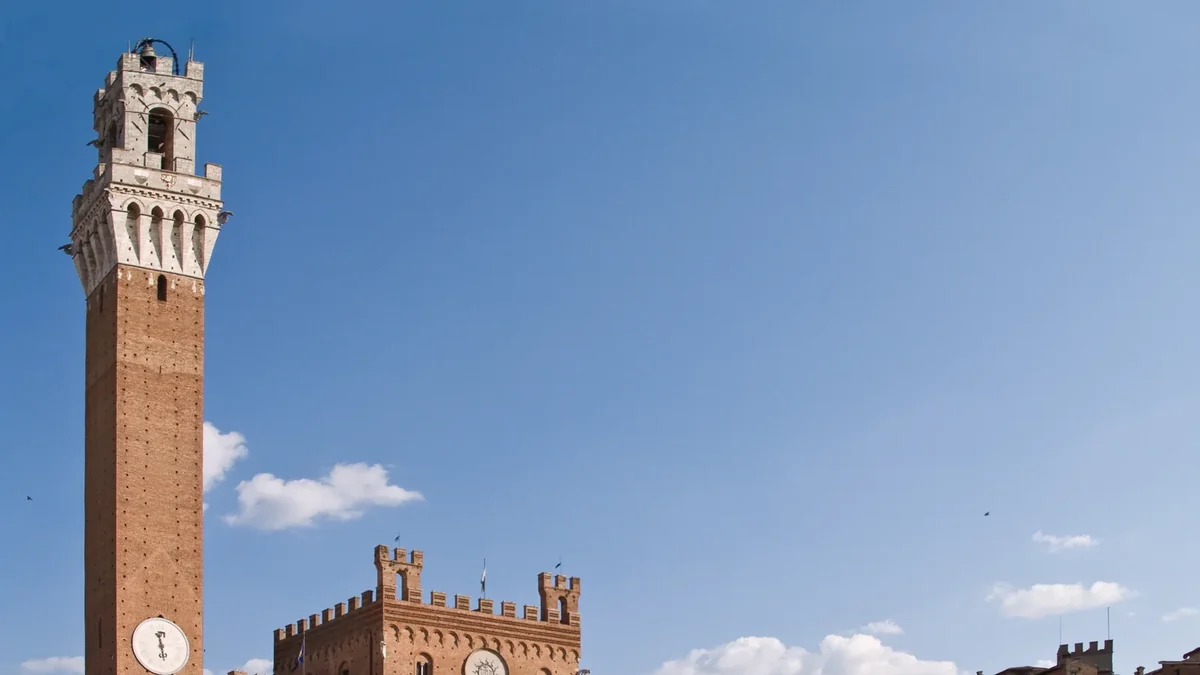
Palazzo Pubblico and the Torre del Mangia. The race finishes in front of this building, and the museums inside it sit directly on the track.
*Race mechanics, the four-day programme and the free-access wording above are taken from the official Palio material published by the Comune di Siena, checked on 26 July 2026 and re-checked on 28 July 2026. The three laps over roughly 1,000 metres, the* canapi*, the tenth horse entering* di rincorsa*, the mortar recall on an invalid start and the fact that a* scosso *horse can win are all confirmed on the Comune's own race page. The 2 July 2026 times are from the Comune's schedule published on 25 June 2026; no equivalent page for 16 August 2026 existed when we checked. The July 2026 postponement and result were confirmed against Italian news coverage.*
Helpful summary
The short version
What happens across the Palio’s four days, how to watch from inside the Campo for free, and the honest case for choosing a different week.
Frequently asked
FAQ
Keep reading
Catherine of Siena: The Dyer’s Daughter Who Moved the Papacy
A dyer’s daughter from Siena talked the papacy into leaving Avignon. Her house, her church and her head are all still here — and all free to visit.
10 min read · Updated 2026-09-06
Siena, 1348: The Year the City Stopped
Siena looks medieval because in 1348 it stopped mid-sentence. The plague, the abandoned cathedral and the fallen government — and where to see each today.
14 min read · Updated 2026-09-05
The Bottini: Siena’s Underground Aqueduct and the River That Never Was
Siena’s bottini: the 25km medieval aqueduct under the city — what it is, the phantom river it replaced, and how visits actually work.
6 min read · Updated 2026-08-18