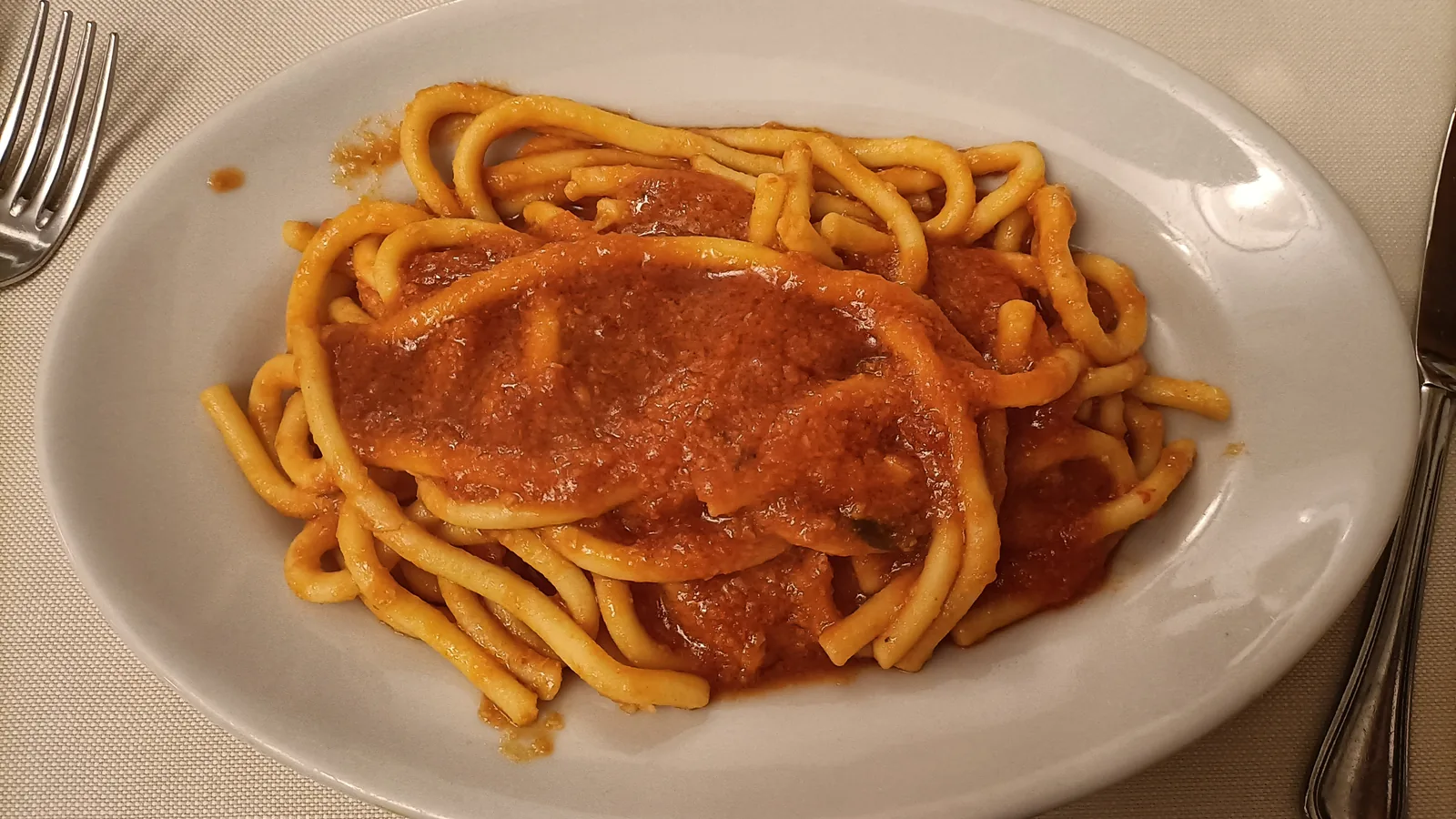
How Eating Out Works in Siena: The Rules Nobody Explains
Why your Siena bill is higher than the menu prices, when the kitchen is actually open, and the counter-vs-table rule that quietly changes what you pay.
Photo: Superchilum, CC BY-SA 4.0. Resized and converted to WebP.
In this guide
Introduction
You will not find a list of "the ten best restaurants" here. Whether a trattoria is good is a matter of taste, it changes year to year, and anyone writing that list from a distance is guessing. What does not change, and what actually determines whether your meal goes smoothly, is how eating out in Siena works — the charges that appear on every bill, the hours the kitchen is really open, and the small rules that quietly move what you pay.
Get these wrong and you arrive at 3pm to a closed kitchen, or stare at a bill that is several euros more than the menu prices added up, and assume you have been overcharged. You have not. You have met the coperto, the riposo and the counter-versus-table rule — three things every Italian takes for granted and almost no guide explains to visitors.
This is the practical layer. It was checked against Italian restaurant law and custom on 23 July 2026, and it applies across Siena and Tuscany.
Quick answer
- The coperto is a small per-person cover charge, usually €1.50–3, added to almost every sit-down bill. It is legal, must be printed on the menu, and is not a tip.
- The kitchen keeps hours. Lunch is roughly 12:00–14:30, dinner from about 19:00–22:30. Between those, the kitchen is closed even if the room is open — turn up at 16:00 hungry and you get a bar snack, not a meal.
- Standing costs less than sitting. In a bar or café, a coffee at the counter (al banco) is cheaper than the same coffee at a table (al tavolo). Both prices must be posted.
- Servizio is not a tip, and Italians barely tip. A service charge, if any, is printed; a tip is a small optional rounding, not 15–20%.
- Restaurants have a closing day — a giorno di chiusura — often Sunday or Monday. Check before you plan a specific place.
If you take one thing from this: the menu price is not the final price, and the kitchen is not open all afternoon.
The coperto: why the bill is more than the menu
This is the single most common source of "was I overcharged in Italy?" — and the answer is almost always no.
The coperto is a fixed cover charge, levied per person, that appears on nearly every sit-down restaurant bill in Siena. It typically runs €1.50 to €3 per person, lower at simple or self-service places, higher at upscale ones. It is not a modern tourist trap — it is an old and normal part of how Italians have always dined out.
Three things visitors most often get wrong about it:
It is not a tip and does not go to the waiter. It is simply a different way of pricing: instead of building overheads into each dish, the restaurant lists them separately as the coperto. Tipping on top does not offset it.
It is charged for everyone at the table, including children. A €3 coperto for a family of four is €12 before anyone has eaten. That is worth knowing when it looks like a small number on the menu.
It is legal, and it must be printed on the menu. Italian law requires the charge to be disclosed. If it is on the menu — usually at the bottom, sometimes in small type — you are agreeing to it by sitting down. A charge that is printed is not a scam; it is the posted price for using a table someone will clear and reset.
Unlike Rome, where the direct coperto is banned by regional law and restaurants substitute a "pane" (bread) or "servizio" charge instead, Tuscany permits the coperto directly, so in Siena you will usually see the word itself on the menu.
Before you sit down, read the bottom of the menu — restaurants are required to post it, often outside the door. If the coperto looks unreasonable, the move is to choose a different place, not to argue the bill afterwards.
Coperto, servizio and tip: three different things
Visitors tangle these together and end up paying twice. They are separate.
Coperto — the fixed per-person cover charge above. Goes to the restaurant. Almost always present, always disclosed.
Servizio — a service charge, shown as a percentage, applied to the food and drink total. It is rarer than the coperto and mostly appears in heavily touristed spots. If it is printed on the menu it is mandatory; if it is not printed, you should not see it on the bill. Crucially, servizio is not a tip in disguise — do not add a further tip to cover the staff on top of a servizio line.
Tip (mancia) — optional, and small. Italians barely tip at restaurants; there is no 15–20% expectation. Rounding up, or leaving a euro or two for good service, is normal and generous. Leaving nothing is not rude. A servizio charge does not go to staff the way a tip would, but its presence still means no further tip is expected.
The practical rule: find the coperto line, check whether a servizio percentage is printed, and treat any tip as optional rounding rather than an obligation.
When the kitchen is actually open
This is the one that ruins afternoons. Italian restaurants do not serve food all day — the kitchen keeps hours, and outside them you cannot get a proper meal even if the door is open and people are sitting inside.
Lunch runs roughly 12:00 to 14:30. Dinner starts around 19:00 and runs to about 22:30, though most locals do not sit down for dinner until 20:30 or later. Turn up at 19:00 and you may have the room to yourself — that is normal, not a bad sign.
Between lunch and dinner, the kitchen is closed. If you are hungry at 16:00, a restaurant will not cook you a meal. What you can get is bar food — a panino, a slice of pizza, a coffee, a gelato — from a bar or café, which runs on different hours.
There is a Tuscan nuance worth knowing. In the deep south of Italy, whole towns shut for the afternoon riposo and even bars can be hard to find. Tuscany is more relaxed: restaurants keep the room open through the afternoon in tourist towns, and bars stay open, so you are rarely stranded. But the kitchen still stops between services. The room being open does not mean the kitchen is.
The practical consequence for a day-tripper: eat your main meal within lunch service, roughly 12:30–14:00, or plan an early dinner from 19:30. Do not count on a sit-down lunch at 15:30. And on a hot day, that mid-afternoon gap is a good time for the sights or a gelato rather than a search for a kitchen that is closed.
Standing versus sitting: the price changes
In Italian bars and cafés — where most visitors get their coffee — where you drink it changes what it costs.
A coffee taken al banco, standing at the counter, is priced low to keep the morning rush moving. The same coffee taken al tavolo, sitting at a table with service, costs more, because someone brings it and clears it. This is entirely legal, and both prices must be posted.
The difference is usually small for an espresso but adds up, and it catches visitors who sit down at a pretty piazza café expecting counter prices. In a famous square — the equivalent of Florence's Piazza della Signoria cafés — the table price can be several times the counter price. You are paying for the seat and the view, disclosed on the price list, not being cheated.
If a bar adds a separate servizio al tavolo supplement for table service, that too must be spelled out on the price list, not sprung on you afterwards.
The practical rule: for a quick coffee, drink it standing at the counter like a local and pay the lower price. Sit down when you actually want to sit down, and know the table price before you do.
Closing days and booking
Two more things shape whether you can eat where you want, when you want.
Most restaurants have a closing day — a giorno di chiusura or giorno di riposo — one day a week when they are shut entirely. It is often Sunday or Monday, but it varies by place. A sign reading "chiuso per turno" or "giorno di riposo" means closed all day, not just for the afternoon. If you have your heart set on a specific restaurant, check its closing day before you build an evening around it.
Booking matters for dinner and weekend lunches. Popular places in Siena's centre fill, particularly on Friday and Saturday evenings and Sunday lunch. For a specific restaurant on a specific night, book ahead. For a casual lunch you can usually walk in, but the good places go first.
Do not confuse "closed for the afternoon" with "closed today". A kitchen shut at 16:00 will reopen for dinner; a restaurant on its giorno di chiusura will not open at all.
Practical checklist
- Expect a coperto of €1.50–3 per person on every sit-down bill. It is normal and legal.
- The menu price is not the final price — add the coperto per head.
- Eat within kitchen hours: lunch about 12:00–14:30, dinner from about 19:00.
- Do not expect a sit-down meal at 16:00 — the kitchen is closed; get a bar snack instead.
- Stand at the counter for a cheaper coffee; sit only when you want the seat.
- Servizio is not a tip. If it is printed, no further tip is needed; if it is not printed, it should not appear.
- Tips are optional and small — round up if you like, but there is no 15–20% expectation.
- Check the closing day of any specific restaurant before you plan around it.
- Book ahead for dinner and weekend lunches at popular places.
- Read the bottom of the menu before sitting — restaurants must post it, often outside.
None of this is designed to catch tourists out. It is simply how Italians eat, priced and timed differently from what many visitors expect. Read the menu before you sit, eat when the kitchen is open, and stand for your coffee — and eating out in Siena is straightforward, and a good deal.
Next steps
Planning a day trip and wondering whether to eat lunch in Siena or Florence? Our guide to visiting Florence from Siena covers the timings, and our day-trip-versus-overnight guide costs out a full day. If you are driving in, read our Siena ZTL guide first — the historic centre is camera-enforced and the fine reaches you months later.
Helpful summary
The short version
Why your Siena bill is higher than the menu prices, when the kitchen is actually open, and the counter-vs-table rule that quietly changes what you pay.
Frequently asked
FAQ
Keep reading
Where to Eat on a Siena Day Trip: The Restaurants Worth Planning a Town Around
Named, researched picks for the day-trip towns — Pienza, Montalcino, Montepulciano, San Quirico and beyond — with the booking rules that make them work.
11 min read · Updated 2026-09-14
Siena with Kids: The Hills, the Stroller Problem and What Works
Siena with children, honestly: where strollers struggle, which sights hold young attention, and a gentle one-day route that works.
12 min read · Updated 2026-07-11
White Truffle Season in Tuscany 2026: Two Fairs, One Legal Window, and the Right Way to Eat It
Tuscany’s 2026 white truffle season: the 1 Oct–15 Jan legal window, San Miniato’s three November weekends, San Giovanni d’Asso’s fair, prices and hunts.
14 min read · Updated 2026-09-16