How to Avoid a ZTL Fine in Siena: A Driver's Guide for 2026
Siena's ZTL cameras run 24/7 and fine you automatically — often months later through your car rental. Here's how the zone works and how to avoid it.
In this guide
- Overview
- Quick answer
- What the ZTL is, and why Siena's is stricter than most
- How the cameras and fines actually work
- Why the fine takes months to arrive
- What a Siena ZTL fine costs
- How to pay, and the trap for non-European cards
- The reliable way to avoid all of it: park outside the walls
- If your hotel is inside the walls
- The myths that get people fined
- Practical checklist
- Next steps
- FAQ
Overview
If you drive a rental car into Siena's historic centre without a permit, a camera photographs your number plate, a fine is issued automatically, and it reaches you months later through your car rental company — with an administrative fee stacked on top. Siena's ZTL cameras run 24 hours a day, every day, and they do not give warnings.
This guide explains exactly where the zone is, how the cameras work, why the fine takes so long to arrive, what it costs, and — most importantly — how to avoid one entirely. It also corrects the common myths that get visitors fined: that the zone lifts at night, that your sat-nav will route around it, that a hotel booking automatically lets you drive in, and that a fine from Italy can be safely ignored once you are home.
Everything here was checked against the Comune di Siena's own pages and the Italian highway code on 21–22 July 2026. Fines and rules change; the official contacts and portals are given so you can confirm anything that matters to your own trip.
Quick answer
The simplest way to avoid a Siena ZTL fine is not to drive into the historic centre at all. Park in one of the car parks just outside the walls and walk or take the escalators up.
- The zone covers the entire historic centre, and the cameras run 24/7 — there is no safe hour to slip in.
- Each camera gate you cross can trigger its own fine. One wrong loop can mean two or three.
- In a rental car the fine reaches you months later, forwarded by the rental company with their own admin fee of roughly €25–60 per fine on top.
- If your hotel is inside the walls, it can register your plate for temporary access — but you must arrange this *before* you drive in, not after.
- Park outside the walls at the Fortezza/Stadio, Santa Caterina, or the station car park, and the problem disappears.
If you take nothing else from this guide: park outside the walls, and if your accommodation is inside them, email the hotel your number plate before you arrive.
What the ZTL is, and why Siena's is stricter than most
ZTL stands for *Zona a Traffico Limitato* — a limited-traffic zone. It is a camera-enforced area, common to almost every Italian historic city, where unauthorised vehicles are banned. Siena was in fact the first city in Italy to restrict traffic inside its walls: parking in Piazza del Campo was banned on 4 July 1962, and the historic centre was closed to traffic on 11 July 1965.
Here is the detail that catches people out, and it is the single most important myth to correct. In many Italian cities the ZTL is only active during posted hours — you will see a sign with a red circle and two times beneath it, meaning "no entry between these hours". Drivers reasonably assume that outside those hours they are free to drive in.
Siena does not work that way. According to the Comune di Siena, entry to the zone is "controlled 24 hours a day" by a system of electronic gates that read your plate the moment you pass and check whether the vehicle is authorised. For an unauthorised vehicle, the fine is issued automatically. There is no overnight window, no quiet Sunday morning exception. The camera is always watching.
The zone is also not a single uniform area. Within it, Siena has a *Zona A* and a *Zona Y storica*, each with different rules for driving through and parking. For a visitor the distinction rarely matters in practice, because the safe approach is the same for all of it: stay out unless you have a permit.
How the cameras and fines actually work
Each entry point into the ZTL is an electronic gate — a *varco* — with a camera that photographs every number plate passing through. There is no barrier and no toll booth. Nothing stops you physically. You simply drive in, the camera records you, and if you are not on the authorised list a fine is generated.
Each gate you cross can generate its own fine. This is where a single mistake becomes an expensive one. If your sat-nav routes you into the centre, you realise something is wrong, and you drive back out through a different gate, you have crossed two cameras — and you can receive two fines. Drive a confused loop through the centre and it can be three or more. Travellers consistently report exactly this: not one fine but several from a single wrong turn.
In a rental car, the chain is longer. The camera records the plate, but the authorities do not know who was driving. So they contact the rental company, which is the registered keeper. The rental company identifies you from the hire agreement, passes your details to the authorities, and — this is the part that stings — charges you an administrative fee for doing so. Travellers report these fees at around €25–60 per fine, entirely separate from the fine itself. One driver on a public travel forum described being charged €36 per fine, repeatedly, after entering and leaving the zone twice a day for five days.
That last point is worth pausing on: the admin fee is charged *per fine*, so the multiple-gate problem multiplies the rental company's charges too, not just the municipal fines.
Why the fine takes months to arrive
If you have driven through Siena's centre and heard nothing, do not assume you got away with it. Italian ZTL fines for foreign-plated and rental vehicles are slow — sometimes extraordinarily so.
The delay is built into the process. The authorities first have to obtain the driver's details from the rental company, which takes time. Only then is the formal fine — the *verbale* — issued and sent. For a fine that has to cross a border to reach a driver abroad, European consumer bodies describe a chain that can, in the worst cases, stretch to well over a year: roughly 150 days for the driver data to change hands, and then a delivery window that can run to many months more.
In practice most travellers receive their fine six to twelve months after the trip, long after they have forgotten the wrong turn. Some arrive later still. The point is simple: the silence after your trip means nothing. The fine may already be working its way through the system.
What a Siena ZTL fine costs
Here this guide will be more careful than most, and deliberately so. Search around and you will find travel sites quoting confident figures for a Siena ZTL fine — €83, €90–100, €80–130, even ranges up to €335. They disagree not because the fine is unknowable but because the law sets a range rather than a single number, because each notice adds costs that vary from case to case, and because many of those figures are lifted from other cities entirely.
Here is what is actually fixed in law. Under Article 7 of the Italian highway code, driving into a ZTL without authorisation carries a penalty of €83 to €332, with the amounts adjusted periodically. A straightforward transit violation is normally assessed at the minimum, and the notice then adds what the law attaches to it — the *spese di notifica* and assessment costs of getting the fine to you — before your rental company's administrative fee goes on top of everything. The exact total appears on the *verbale*; treat any precise all-in figure you see online as an estimate until you see your own notice.
Two deadlines on that notice matter more than the headline number. Pay within five days of the notice reaching you and the penalty itself is cut by 30 per cent — on the €83 base that means roughly €58, though the notification costs remain payable in full. From day six to day sixty you pay the standard amount. Let it run past sixty days without paying or appealing, and the sum owed roughly doubles and the file moves to enforced collection, with interest and collection costs added along the way. In plain terms: the fine is cheapest in the first five days after it reaches you, and most expensive once you decide it can be ignored.
How to pay, and the trap for non-European cards
If you do receive a fine, you can view the photographic evidence and manage the process through Siena's official portal at siena.multeonline.it, and the ZTL control office can be reached at [email protected]. Using the official channels matters: it is where you can see the actual photograph of your vehicle at the gate, which is worth checking before you pay.
Italian municipal fines are generally paid through PagoPA, the national government payment platform. This is where travellers from outside Europe often hit a wall: PagoPA runs on a network of Italian banks, and foreign cards — US-issued credit cards in particular — are sometimes rejected. If your card fails, the fallback is an international bank transfer to the municipality's account, the details of which should be on your notice. Build in time for this; it is not always instant, and the deadlines on the notice — including the five-day discount window — do not wait for your bank.
The reliable way to avoid all of it: park outside the walls
Everything above disappears if you simply do not drive into the centre. Siena is small, and the car parks just outside the walls are well placed for walking in — some connected to the centre by escalators that carry you up the hill.
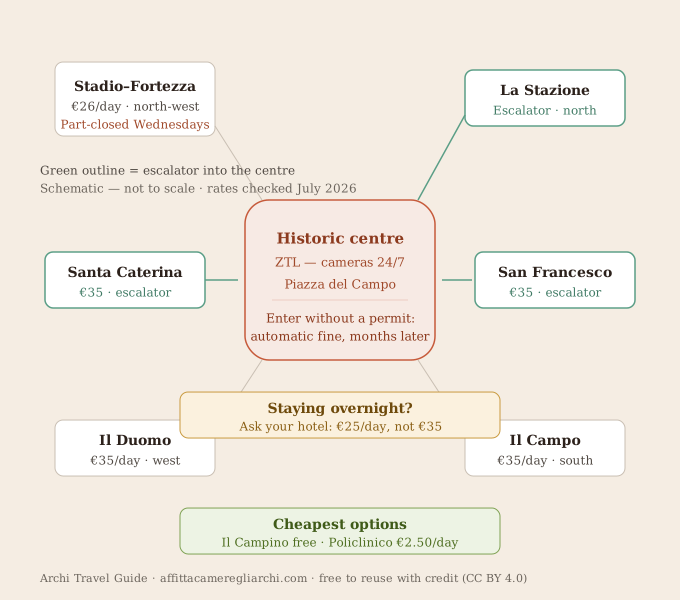
Schematic — not to scale. Rates checked July 2026. Free to reuse with credit.
The main options sit around the edge of the old town: the large Fortezza/Stadio car park to the north-west, Santa Caterina with its escalators running up into the centre, and the car park down by the railway station, which is usually the cheapest for a full day. Hourly rates at the edge-of-town car parks run at around €2 per hour; the station lot is cheaper for longer stays. Several of these car parks also offer a discounted hotel rate — commonly around €25 per day against roughly €35 at the standard rate — if your accommodation books it for you, so it is worth asking your hotel before you arrive.
Park in one of these, walk or ride up into the centre, and the ZTL is simply not your problem. For most visitors this is the whole answer.
If your hotel is inside the walls
Sometimes you genuinely need to reach accommodation inside the zone — to drop luggage, for instance. This is allowed, but only if it is arranged correctly and in advance.
A hotel inside the ZTL can register your number plate for temporary authorised access. The critical points are these. First, you must arrange it before you drive in — the hotel cannot retroactively cancel a fine after a camera has already recorded you. Send the hotel your rental car's exact number plate ahead of arrival; many properties ask for it at least 48 hours beforehand. Second, the responsibility for giving the correct plate is yours: an official Siena permit document notes that the applicant alone is responsible for fines resulting from incorrect plate details. A single wrong character and the registration does not match the camera's reading.
There is one more rule worth knowing if you hold a permit. Siena requires permit holders to take the shortest route to their destination, avoiding the Zona Y storica and Zona A where possible. A permit to reach your hotel is not a licence to drive around the centre; it authorises a specific journey.
If in any doubt, the safest course is still to park outside and walk your luggage the last stretch, or take a taxi from the car park into the centre — taxis are authorised where private cars are not.
The myths that get people fined
Most Siena ZTL fines come down to a handful of wrong assumptions. Correct these and you have avoided the zone.
"The ZTL is only active during certain hours." Not in Siena. The Comune states the zone is controlled 24 hours a day, every day. There is no safe overnight or Sunday window.
"My sat-nav will route me around it." Do not rely on it. Standard navigation apps do not reliably route around ZTLs, and following one blindly into the centre is one of the most common ways tourists get fined. Some apps handle ZTL warnings better than others, but none should be trusted to keep you out on its own. Know where the walls are and stay outside them.
"I'm staying at a hotel inside, so I can drive in." Only if the hotel has registered your plate in advance. A booking alone authorises nothing. Arrange the plate registration before you arrive, or park outside.
"Everyone else is driving in, so it must be fine." The other cars you see crossing into the zone are residents, permit holders, and authorised vehicles. They have passes. You do not, and the camera does not care that you were following someone.
"I'm home now, so the fine can't reach me." It can, and it does. Italy pursues fines across borders, the process is slow precisely because it is cross-border, and ignoring the notice makes it worse: past sixty days the amount roughly doubles and the debt moves to enforced collection. A fine that arrives eight months later is still a fine.
Practical checklist
- Don't drive into the historic centre. Park outside the walls — Fortezza/Stadio, Santa Caterina, or the station car park.
- Ask your hotel about a discounted car-park rate — often around €25/day versus €35 standard.
- If your hotel is inside the walls, email them your exact number plate before you arrive, ideally 48 hours ahead.
- Assume the cameras are always on. There is no safe hour.
- Remember each gate can be a separate fine — don't loop through the centre trying to correct a wrong turn; get out the way you came if you can.
- Don't trust your sat-nav to keep you out of the zone.
- If a fine arrives, don't ignore it. Check the photo at siena.multeonline.it, then pay within five days if you can — that cuts the penalty by 30 per cent. Past sixty days the amount roughly doubles.
- Non-European card? Expect possible PagoPA rejection and be ready for an international bank transfer.
Siena's ZTL has a fearsome reputation among visiting drivers, but the fine is entirely avoidable. It catches people who assume it works like a normal traffic restriction — active only at certain hours, forgiving of an honest mistake, avoidable by sat-nav. It is none of those things. Park outside the walls, sort your plate with the hotel if you must go in, and the walk up into the centre is the nicest part of the arrival anyway.
Next steps
Planning to drive in Tuscany more widely? Our Siena parking guide covers the car parks and escalators around the walls in detail. If you have not yet decided whether to drive at all, our guide to reaching Siena from Florence Airport lays out the bus and train options — for many visitors, arriving without a car removes the ZTL question entirely. Committed to driving but yet to book? Compare car rental prices for Italy on DiscoverCars — and read our renting-in-Tuscany guide for the licence, insurance and toll rules before you commit.
*Facts in this guide were checked against the Comune di Siena's official ZTL and sanctions pages on 21–22 July 2026. Fines and rules change — confirm anything critical on the official pages before you travel. Disclosure: the DiscoverCars link above is an affiliate link — if you book through it we may earn a commission, at no extra cost to you; nothing about how to avoid the fine changes either way.*
Helpful summary
The short version
Siena's ZTL cameras run 24/7 and fine you automatically — often months later through your car rental. Here's how the zone works and how to avoid it.
Frequently asked
FAQ
Keep reading
Where to Park in Siena: Car Parks, Real Rates and the ZTL
Every Siena car park with official 2026 rates, which ones have escalators, the €25 hotel rate, and the Wednesday closure that catches drivers out.
11 min read · Updated 2026-07-23T12:00:00+07:00
Rome to Siena: Train, Bus & the Route That’s Actually Fastest (2026)
Rome to Siena in 2026: why the direct bus beats the train, the Chiusi and Florence rail routes compared, FCO airport options and honest advice.
12 min read · Updated 2026-08-14
Tuscany Without a Car: The Complete Siena-Based Guide
Tuscany without a car works — from the right base. The bus and rail system from Siena: lines, times, tickets, the Sunday rule and what truly needs wheels.
12 min read · Updated 2026-08-25