Renting a Car in Tuscany: The Honest Guide (2026)
Renting a car in Tuscany, honestly: the IDP law most guides get wrong, insurance excess maths, toll-lane survival, fuel false friends and ZTL discipline.
In this guide
- Quick answer
- First: do you actually need a car?
- The licence question: the law most guides get wrong
- Insurance: what Italy bundles, and the excess underneath
- Booking: transmission, age and the small print that matters
- Pickup: where, and the photo ritual that wins disputes
- The ZTL: the fine machine, and how to stay out of it
- Tolls: the lane-colour rule that saves your afternoon
- Fuel: false friends, two prices and one expensive mistake
- Seasonal clauses: winter law, summer ovens
- The five mistakes that cost renters real money
- How we checked these details
- Final thoughts
- FAQ
Quick answer
Guide after guide on this site says some version of “drivers own this day” — here, finally, is how to become one without the expensive surprises. The compressed version, verified August 2026: US, Canadian and Australian licence holders need an International Driving Permit (or a sworn Italian translation) by law — obtained *before* leaving home — while UK photocard holders are the exception; CDW and theft cover come bundled into every Italian rental rate, but the excess underneath runs €1,000–3,000 unless you buy it down; manuals are the default and automatics sell out; at the tolls, never enter a yellow Telepass lane; at the pump, gasolio means diesel, not gasoline; and the ZTL remains the single most efficient fine-generating machine in Italian tourism. Everything above has a section below, with the nuance the summaries skip.
First: do you actually need a car?
The honest gate before the rental counter. For the cities, no — Florence and Siena punish cars with restricted zones, scarce parking and walkable centres, and the bus and rail spine covers the city-to-city moves, Rome arrivals included — the complete car-free system, line by line, is mapped here. For the countryside, increasingly yes: the Val d’Orcia loop, harvest-season farm and mill visits, the thermal springs, scattered beach coves and the deeper winter months all reward wheels, and some are barely reachable without them.
The pattern that works for most trips this site plans: car-free in the cities, car for the countryside days — either a short rental mid-trip (two or three days bracketed by city stays) or a countryside-based week with the car living at an agriturismo. What rarely works is the full-trip rental that spends five of its seven days paid, parked and generating ZTL anxiety outside a city wall.
Decide the shape first; every choice below gets easier once the car has a defined job.
The licence question: the law most guides get wrong
Here is the part the internet reliably muddles, verified against the legal texts and consular guidance in August 2026. Italian law (Article 135 of the Codice della Strada) requires non-EU/EEA licence holders to carry their home licence PLUS either an International Driving Permit or an official sworn Italian translation. Driving without one is an offence fined at €408–€1,634. That covers US, Canadian and Australian visitors squarely — and their governments’ own advice (US Embassy, Canada’s travel.gc.ca, Australia’s Smartraveller) says the same thing.
The practical mechanics: IDPs are issued only in your home country, before travel — AAA in the US, CAA in Canada, the state motoring clubs in Australia — cheaply and quickly, but not retroactively from Italy. Forgot? The sworn-translation alternative (traduzione giurata): commercial services advertise turnaround of about two days working from a scan of your licence — confirm how the physical document will reach you in Italy before relying on it. Either document only works *alongside* your licence, never instead of it.
The UK is the exception: gov.uk’s position is that a full UK photocard licence suffices for visitors, with no IDP needed. (The 2023 UK–Italy licence agreement people cite in this context actually governs *residents* exchanging licences, not tourists — the visitor position rests on gov.uk’s guidance itself, and Article 135’s own text carries no explicit UK carve-out: the reassurance is the UK government’s, not the Italian statute’s.) Old paper licences are another matter, and cautious UK drivers still carry an IDP for zero-friction counters.
Now the nuance that explains the internet’s confusion: rental counters are inconsistent — many never ask, some branches refuse without it. The trap is concluding the law is optional. The counter is not the risk; the roadside document check is — routine in Italy, no violation required — and so is an insurer looking for reasons after a crash. Get the permit. It is the cheapest insurance in this entire article.
Insurance: what Italy bundles, and the excess underneath
Italy runs rental insurance differently from most of Europe, and knowing the structure saves both money and counter-fright. Every Italian rental rate includes CDW (collision damage waiver) and theft protection as standard, and suppliers do not let you decline them — treat the bundling as fixed. (The cover Italian statute itself mandates is third-party liability; the universal CDW bundling is how the Italian market prices, which is why the classic credit-card-CDW strategy works differently here: card cover operates as *supplemental* protection for the excess, not as a replacement for primary cover.)
The catch is that the mandate covers the cover’s *existence*, not its depth: the standard excess (deductible) beneath the bundled CDW typically runs €1,000–€3,000 depending on vehicle class. Your three ways to handle it: accept it (and drive accordingly); buy it to zero at the desk — super-CDW products at roughly €25–45 per day at the major desks, some priced higher, usually excluding tyres and glass; or carry third-party excess insurance bought before travel, from around a quarter of the desk price — the option the desk will not volunteer. Check any credit-card cover’s Italy terms specifically; card policies differ and some are genuinely ambiguous about Italy.
Related counter mechanics: expect a deposit hold on a credit card — commonly €300–600, sometimes pegged to the excess — released by the company within a day or two of clean return but taking 5–10 business days for your bank to actually free. Bring a credit (not debit) card with headroom, in the main driver’s name, or the pickup can fail at the last step.
Booking: transmission, age and the small print that matters
Transmission first, everything else second. Manual gearboxes remain the Italian default; automatics exist at every major supplier but cost more and sell out fast — in high season, weeks ahead. If you cannot drive a manual on hills (Tuscany will examine you on this), book the automatic early and confirm it is a *guaranteed* automatic, not a request.
Age rules: the legal minimum to drive is 18; suppliers set their own rental minimums above that — 21 is the common floor — and under-25s pay a young-driver surcharge set per supplier and surfaced at booking: treat the checkout quote as the real number. At the other end there is no statutory maximum age — upper limits, where they exist, are company policies typically starting around 75–80, sometimes with senior surcharges; older drivers should confirm before booking rather than at the counter.
Size doctrine, from every Tuscan car park we have ever written about: book the smallest car your luggage tolerates. Medieval towns were not designed around SUVs, San Gimignano’s lots fill by mid-morning, and the €10 saved daily on a compact is repaid hourly in manoeuvring sanity. Extra drivers cost extra; one-way fees between cities can be substantial — price the round trip before assuming the open jaw.
Where to book: a comparison broker such as DiscoverCars shows local and international fleets side by side with the excess and deposit terms surfaced before checkout — precisely the small print this section is about — and booking direct with a supplier you already trust works equally well. Wherever you book, the document that binds you is the rental conditions attached to that specific offer: read it before paying, not at the counter.
Pickup: where, and the photo ritual that wins disputes
Where to collect shapes your first hour. For a countryside trip starting from Florence, the repeated wisdom holds: collect at Florence Airport if you are leaving the city the same day — road access is simple and day-one ZTL exposure drops toward zero, with the T2 tram linking the airport and Santa Maria Novella in about twenty minutes for small change. City-centre offices cluster minutes south of SMN, with one-way routing that ushers departing drivers away from the restricted zone — the right choice when you finish Florence on foot first. Pisa Airport keeps a dedicated car-rental terminal minutes from arrivals and makes a calm western starting point.
Then, before you drive a metre, perform the ritual — the one European consumer-protection bodies formally recommend: timestamped photos and video of the entire car, all four corners, wheels and tyres, windscreen, roof, interior — and the under-bumper “belly” nobody photographs and everybody disputes. Every existing scratch goes itemised on the contract’s damage diagram before you sign; a generic “damage accepted” tick-box is not the same thing. At return, repeat the set and add one photo of the dashboard showing fuel level and mileage — and do the full ritual doubly for out-of-hours drop-offs where no staff member inspects.
Five minutes of photography at each end converts every future damage conversation from your word against theirs into paperwork you win.
The ZTL: the fine machine, and how to stay out of it
We wrote a whole guide to Siena’s restricted traffic zone because it is the most reliable way tourists turn a €40 rental day into a €120 one — and the system generalises: every historic centre you will want to visit (Florence, Siena, San Gimignano, Montepulciano, the lot) closes its core to non-resident traffic, enforced by cameras that neither warn nor negotiate, with fines that follow your rental company home — plus the company’s own administration fee for forwarding each one.
The discipline is simple and total: park outside the walls, always — in the signed lots every town provides (San Gimignano’s P1–P4 with their posted tariffs, Siena’s ring of car parks, the Val d’Orcia villages’ edge lots) — and walk in. Never follow a navigation app’s “fastest route” through a stone gateway; never assume a quiet street is a permitted street; and treat your accommodation’s “you can drive in to unload” as true only after they have registered your plate with the comune, in writing.
One more camera to respect: many Italian urban roads carry bus-lane and limited-access cameras beyond the ZTL proper. The generalised rule that keeps the record clean: in any Italian town, if you are not certain a street is open to you, it isn’t.
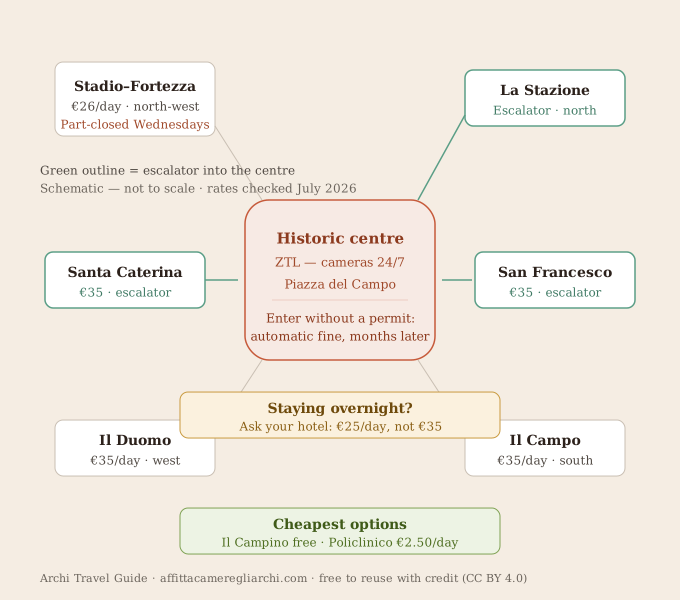
*The pattern every Tuscan town repeats: a camera-enforced core, a ring of legal parking, and a short walk that costs nothing.*
Tolls: the lane-colour rule that saves your afternoon
The autostrada toll plaza is a solved problem — if you know the colours. Yellow lanes marked “T” or “Telepass” are transponder-only: the barrier reads a device you do not have and will not lift. Visitors take a ticket at entry, then exit through a white lane (staffed/cash, marked with a hand or banknotes) or a blue “Carte” lane (cards). Rome-to-Siena’s A1 stretch runs around €18–20 in tolls; Tuscany’s internal superstrade — the Florence–Siena raccordo, the Siena–Bettolle road — are free.
If you do slide into a Telepass lane: do not reverse. Reversing at a toll plaza is the genuinely dangerous (and separately fined) move. Push the assistance button or proceed as directed, collect the missed-payment report (Rapporto di Mancato Pagamento), and pay within 15 days — online through the operator’s pay-per-plate service or the Telepass app, which works for non-customers. Unpaid, the demand chases the registered owner (your rental company, plus its admin fee) and the Highway Code sanction — €87–€344 under Article 176, per current operator and motoring-body documentation, with heavier penalties where non-payment is treated as deliberate evasion — attaches. One wrinkle worth knowing: a Telepass-lane mistake at an *entrance* leaves you ticketless, and the exit toll defaults to the farthest possible entry point unless you flag it with staff — one more reason the assistance button beats improvisation.
None of this is hard. It is simply never explained on the rental contract, which is why it fills forums every August.
Fuel: false friends, two prices and one expensive mistake
Three fuel facts prevent the classic disasters. First, the vocabulary trap: “gasolio” is diesel, not gasoline — petrol is “benzina” (senza piombo for unleaded). English-speaking brains autocomplete gasolio wrongly under time pressure, and many Italian rentals, including small cars, are diesel — so confirm your car’s fuel *before leaving the lot*, then trust the sticker inside the fuel flap and the EU labels (E5/E10 in a circle for petrol, B7 in a square for diesel), not the pump handle’s colour. Misfuelling means a tow and a drained tank at your cost — a bill that can easily top €500.
Second, the two-price system: most stations run self-service (“fai da te”) and attended (“servito”) pumps on the same forecourt, and the big roadside price sign is almost always the *self-service* price — the attendant lane adds roughly €0.10–0.30 per litre. Neither is a scam; just know which hose you picked up.
Third, the ballpark with a date on it: national self-service averages reported in late July 2026 sat around €1.98/litre for petrol and €2.18 for diesel, with autostrada stations markedly higher — and Italian fuel pricing was volatile and politically contested this summer, so treat those figures as a snapshot, not a promise. Fill in towns rather than on the motorway, and return the car full yourself: rental refuelling charges are priced to punish.
Seasonal clauses: winter law, summer ovens
Two calendar rules round out the legal picture. From 15 November to 15 April, Italy’s winter-equipment regime applies: on roads covered by ordinances — signposted, and common across the Apennine and hill routes a Tuscan winter itinerary touches — vehicles must have winter tyres fitted or compatible snow chains on board. It works through local ordinances rather than as a literal blanket rule, and mountain regions run longer windows, but the renter’s version is simple: for a November-to-April trip, confirm at booking that the car comes winter-equipped, and keep the chains in the boot where fitted. Fine amounts vary by source and roadway — we decline to print a number our research could not pin — but the roadside inconvenience alone justifies the phone call.
Summer’s clause is thermal: the August guide’s warning stands — a car parked in full Tuscan sun becomes an oven, so shaded or underground parking is worth paying for, nothing living or meltable stays inside, and steering wheels have genuinely burned hands. Park nose-out in the shade you can find, and the car remains an asset rather than a hazard.
Both seasons share the strike-calendar footnote: fuel-sector and transport actions occasionally touch motorway services — the three-minute calendar check covers it.
The five mistakes that cost renters real money
1. Skipping the IDP because the counter didn’t ask. The counter is not the enforcement mechanism; the checkpoint and the insurer are. €408 minimum, versus a permit that costs about the price of lunch.
2. Declining nothing, understanding nothing. Signing the desk’s zero-excess product unpriced, or declining it unaware of the €1,000–3,000 exposure underneath — both are decisions; make whichever one you *meant*.
3. The unphotographed pickup. Every damage dispute this article can imagine is settled in five minutes of timestamped photos that either exist or do not.
4. Following the sat-nav through a stone arch. The ZTL camera does not know you were confused. Park outside, walk in, as every town guide on this site repeats.
5. The wrong hose and the wrong lane. Gasolio into a petrol car, or a confident swing into the yellow Telepass lane — both recoverable, both expensive, both prevented by thirty seconds of reading this paragraph in advance.
Avoid these five and the Tuscan rental reverts to what it should be: the cheapest key ever sold to the best countryside in Europe.
How we checked these details
Checked in August 2026 through parallel research verified against legal texts, consular guidance and operator documentation: the Article 135 Codice della Strada IDP-or-sworn-translation requirement and its €408–€1,634 sanction (legal-text sources including ACI, corroborated by US Embassy, Canadian and Australian government advice); the UK photocard visitor exception per gov.uk guidance — noting honestly that the 2023 UK–Italy agreement covers resident licence exchange rather than tourists, that Article 135’s text carries no explicit UK carve-out, and that cautious UK drivers may still carry an IDP; the universal CDW/theft bundling — a market-wide practice per major suppliers’ and brokers’ published Italy insurance terms, not a statutory mandate, which we state as such — with typical €1,000–3,000 excess bands and desk versus third-party excess-cover pricing; toll-lane rules, the 15-day missed-payment procedure and the €87–€344 Article 176 sanction (operator and motoring-body documentation), with the A1 toll band cross-referenced from our July 2026 Rome-to-Siena checks; fuel vocabulary, label standards and the late-July 2026 national price averages, flagged as volatile; the 15 November–15 April winter-equipment regime and its ordinance-based application; and the consumer-body pickup photo guidance (ECC-Net). Where our research found genuine conflicts — certain fine amounts, one credit-card network’s Italy coverage, an Australian duration figure — we have either flagged the uncertainty or declined to print a number. Laws, prices and policies change: verify against your government’s travel advice and your rental agreement before relying on any figure here. Disclosure: the DiscoverCars link on this page is an affiliate link — if you book through it we may earn a commission, at no extra cost to you. It is cited as a working example of the comparison-broker category, not an endorsement; no supplier is recommended, and pricing examples remain illustrative market observations. Platform links use our internal /go/ shortcuts.
Final thoughts
Every scary thing in this article is a rule, and rules have the great virtue of being learnable in advance. The renter who lands with a permit in their pocket, an excess decision already made, a photo ritual planned and three Italian words memorised — benzina, gasolio, Telepass — has pre-empted essentially the entire catalogue of Tuscan rental grief, and what remains is the part the fifteen other guides promised: an open superstrada, a ridge road turning gold, a harvest morning at the end of a white gravel track, and the specific freedom of a region whose best corners were never on any timetable. The car is not the risk. The unread paragraph was — and you have now read them all.
Helpful summary
The short version
Renting a car in Tuscany, honestly: the IDP law most guides get wrong, insurance excess maths, toll-lane survival, fuel false friends and ZTL discipline.
Frequently asked
FAQ
Keep reading
Tuscany Without a Car: The Complete Siena-Based Guide
Tuscany without a car works — from the right base. The bus and rail system from Siena: lines, times, tickets, the Sunday rule and what truly needs wheels.
12 min read · Updated 2026-08-25
Should You Rent a Car in Florence or Siena? The Decision, Honestly Argued
Rent the car in Florence or Siena? Where the offices are, how ZTL exposure differs, what one-way drops cost you, and the answer by trip shape.
12 min read · Updated 2026-08-22

Florence to Siena by Train or Bus: Complete Travel Guide
Compare train, bus, and guided tour options from Florence to Siena, including travel times, ticket rules, arrival points, and practical tips.
4 min read · Updated 2026-08-05T12:00:00+07:00