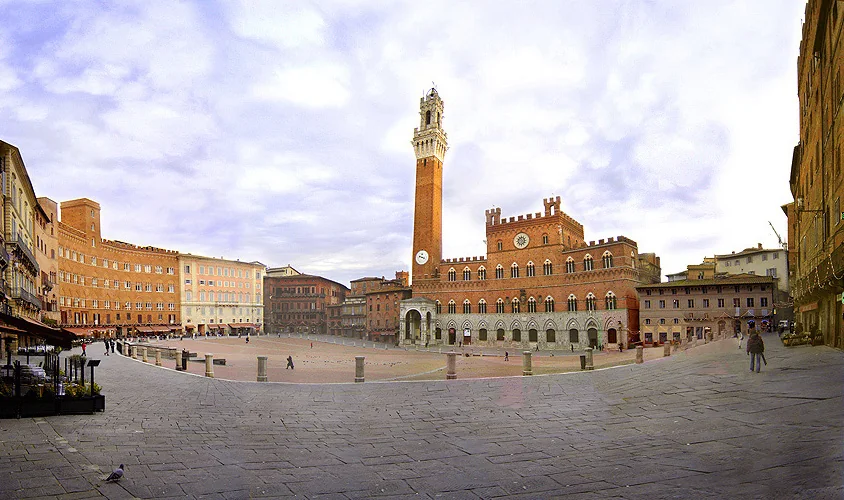
Florence to Siena by Train or Bus: Times, Prices, Which to Pick
Quick answer: The bus and the train arrive in very different places, and that decides the trip: the 131R bus stops beside Siena’s old town at Via Tozzi/Piazza Gramsci, while the railway station sits about 2 km below the hill. For a Piazza del Campo day trip, take the 131R bus — about 75 minutes and €9.90 one-way, as checked on 3 August 2026. Choose the train for onboard comfort and space, and plan the uphill connection from Siena station before you commit.
Travelling from Florence to Siena is straightforward without a car, but the “best” option is not decided by journey time alone. A guided tour costs more, yet it is the only option that combines Siena with Chianti, San Gimignano, Monteriggioni or Pisa in one day without you organising regional transport.
This guide compares Florence to Siena by train, the Florence to Siena bus, and organised excursions. It covers departure and arrival points, realistic timing, ticket rules, luggage, mobility, family travel, and the mistakes that cause visitors to lose time.
Train or bus: the comparison
| What matters | 131R bus | Regional train |
|---|---|---|
| --- | --- | --- |
| Journey time | About 75 minutes on the current timetable, valid from 27 July 2026 (checked 3 Aug 2026); traffic can add time | 1 hr 20 min–1 hr 45 min planning range, direct or changing at Empoli (checked 23 Jul 2026) |
| One-way fare | €9.90 app/counter; €16.00 from the driver (checked 3 Aug 2026) | Not published as a flat fare — check the Trenitalia app for your date |
| Frequency | Weekdays roughly every 20–60 minutes; Sundays and holidays only six departure times from Florence (seven coaches — two share the 09:10 slot), none between 09:10 and 14:10, and eight departures back from Siena, the last at 19:10 (checked 5 Aug 2026) | Mix of direct and Empoli-change itineraries; pattern varies by day — check the live timetable |
| Departs from | Firenze Autostazione, beside Santa Maria Novella station | Firenze Santa Maria Novella (SMN) |
| Arrives in Siena | Antiporto Camollia, then Via Tozzi/Piazza Gramsci — beside the old town | Siena railway station, about 2 km below the hill (city visitor information) |
| Luggage | Hold space varies by coach; keep valuables with you | More room to stand and move; no supervised storage |
Guided tours and rental cars are covered later in this guide: a tour only wins when you want several Tuscan stops in one day, and a car buys flexibility at the price of ZTL risk and parking.
The figures above are planning figures, not schedules. Engineering works, strikes, holidays, traffic and temporary stop changes can alter any journey — check your exact date through the official operator before travel, and compare any third-party platform against the operator’s own timetable, stop notices, ticket rules and service alerts.
Florence to Siena by train
Where do trains leave from in Florence?
Most useful Florence-to-Siena rail itineraries begin at Firenze Santa Maria Novella, often displayed as Firenze S. M. Novella or Firenze SMN. It is Florence’s central station and is within walking distance of much of the historic centre.
Do not search only for “Florence.” Booking tools may show other stations, and a low headline time is irrelevant if you first need to cross the city to reach the departure point.
Arrive early enough to find the platform, read any service notices, buy food or water, and resolve ticket questions. Platforms can be announced close to departure.
Is there a direct train from Florence to Siena?
Many schedules include direct regional trains, while other departures require a change at Empoli. The pattern varies by date and time, so the safest advice is to inspect the live itinerary rather than assume every departure is direct.
A direct train is simpler for first-time travellers, families, and anyone carrying luggage. A connection at Empoli can still be easy when the transfer time is comfortable and the platform information is clear.
Avoid choosing a tight transfer solely to save a few minutes. Regional delays can make an ambitious connection stressful, even when the booking system offers it.
How long is the train from Florence to Siena?
A useful planning range is approximately 1 hour 20 minutes to 1 hour 45 minutes. Direct services may sit toward the shorter end; connections and stopping patterns can take longer.
Door-to-door time is more important. Add:
- travel from your Florence accommodation to Santa Maria Novella;
- station arrival buffer;
- the rail journey;
- the connection from Siena station to the historic centre;
- walking from the centre access point to the first attraction.
This explains why a train that looks similar to the bus on a timetable may feel slower for a Piazza del Campo day trip.
Are these high-speed trains?
The Florence-to-Siena route is normally served by regional trains, not a direct Frecciarossa-style high-speed service. A search engine may display a more complicated long-distance itinerary, but it is rarely the practical choice for this trip.
Regional trains generally do not use assigned-seat reservations in the same way as high-speed trains. Check the exact product conditions shown during purchase.
Train ticket rules: digital and paper are different
This is one of the most important parts of the journey.
Trenitalia digital regional tickets: Under the current digital regional system checked for this revision, the ticket is automatically validated for the selected train’s scheduled departure. The old manual app “check-in” instruction found in many older articles is no longer the standard rule for this product. Follow the current ticket screen because change and validity conditions depend on the ticket type and time.
Paper regional tickets: Paper tickets that are not already tied and validated for a specific journey may require validation in the station machine before boarding. Read the printed instruction and validate when required.
Third-party tickets: A ticket bought through Trainline, Omio, or another platform may have provider-specific instructions. Do not assume the rules for a Trenitalia digital ticket automatically apply to every document. Read the ticket itself.
When uncertain, ask station staff before boarding. A purchased but invalid ticket can still create a penalty.
How much does the train cost?
Regional train fares change with the service and the seller, so check your exact date. The bus fare, by contrast, is published and fixed by distance band. Siena–Florence sits in Autolinee Toscane’s 60.1–70.0 km band (checked 22 July 2026), and the fast-route fare tables as checked on 3 August 2026 give:
- €9.90 bought at a ticket counter or in the operator’s app
- €16.00 bought on board from the driver
Those figures are higher than the €8.40 and €13.00 we verified on 22 July 2026 — the operator’s published fare tables changed between our checks, which is exactly why every figure here carries its date.
A return day trip by bus therefore costs €19.80 if you buy properly, or €32.00 if you buy from the driver both ways — a €12.20 penalty for not planning ahead.
Buying a regional ticket early helps you plan, but it does not create the large advance-purchase savings associated with long-distance high-speed trains.
What is the train like with luggage?
The train generally offers more freedom to stand, move, and manage larger luggage than a busy regional bus. However, luggage space is not guaranteed or supervised.
Keep valuables with you, lift only what you can handle, and avoid blocking aisles or doors. A direct train reduces the need to move bags at Empoli.
The bigger luggage issue comes after arrival: Siena station is below the old town. A taxi or local bus can be better than beginning a steep walk with heavy cases.
Arriving at Siena train station
Siena railway station is outside the historic centre and roughly 2 km from Palazzo Pubblico according to the city museum’s visitor information. It is not a central old-town station.
Options for continuing include:
- local bus toward Piazza Gramsci or another central stop;
- taxi;
- escalator-linked routes followed by walking;
- walking the full distance when weather, luggage, and mobility allow.
If you are driving rather than arriving by rail, our Siena parking guide covers every car park, its rate, and which ones have escalators into the centre.
The official Siena visitor map marks the railway station, buses, taxis, escalators, and parking. Check the route before leaving the station rather than following the first uphill street.
Who should choose the train?
Choose the train when:
- your Florence accommodation is near Santa Maria Novella;
- you prefer rail stations to regional bus stops;
- you want more onboard space;
- you are prone to road motion sickness;
- traffic uncertainty concerns you;
- your Siena accommodation is near the station or offers a transfer;
- the live timetable provides a convenient direct service.
Do not choose it simply because train travel sounds faster. Include the last-mile connection.
Florence to Siena by bus
Which bus should you take?
The key service for most travellers is the Autolinee Toscane 131R, the faster regional connection between Florence and Siena.
Route numbers and stop notices matter. Do not board a bus simply because the display includes “Siena”; slower regional routes may make more stops, terminate elsewhere, or follow a different pattern.
Use the official Autolinee Toscane journey planner or line notice for the exact date. Save the current departure stop and return stop to your phone.
Where does the bus leave from in Florence?
The 131R uses Firenze Autostazione, the main bus station beside Santa Maria Novella railway station and a short walk from it. Roadworks and temporary operational changes can move the exact stand within the station, so check the departure board on the day.
Older travel articles may name a terminal that is no longer used for your date. The correct method is:
1. search the 131R in the official Autolinee Toscane planner; 2. open the service notice for your travel day; 3. confirm the stop on a map; 4. arrive at least 15–20 minutes early; 5. check the bus display and ask the driver when uncertain.
Do not rely only on a screenshot saved months in advance.
How long is the bus from Florence to Siena?
The 131R runs about 75 minutes on the current summer timetable, valid from 27 July 2026 and checked on 3 August 2026. As a concrete example, the 08:10 from Firenze Autostazione arrives at Siena Via Tozzi at 09:25 — 75 minutes.
It is still a road service, so traffic entering or leaving Florence, roadworks, weather, holidays and special events can extend the trip. Build in a margin rather than planning to the minute.
The bus’s advantage is not always a shorter onboard time. It is the more convenient arrival near Siena’s historic centre.
Where does the bus arrive in Siena?
The 131R stops at Antiporto Camollia, just outside the northern Porta Camollia gate, before terminating at the Via Tozzi bus station near Piazza Gramsci.
Getting off at Antiporto Camollia gives you a gentle 10–15 minute downhill walk through the gate and along Via Camollia into the centre. Staying to the Via Tozzi terminus also leaves you close to the centre, with escalators and city buses available. Either way you arrive beside the old town rather than below it, which is the bus’s main advantage over the train.
Confirm both the outbound arrival and the return departure stop, because stops in opposite directions are not always in the same place.
Bus tickets and validation
Buy before you board. A counter or app ticket costs €9.90; buying from the driver costs €16.00 (fast-route driver tariff, checked 3 August 2026), and onboard sales are suspended during ticket inspections, so it is not something to rely on.
Then validate the ticket the moment you board — and this is the part that catches people out. Buying is not validating. The driver may take no interest in your ticket as everyone gets on, which travellers reasonably read as “it’s fine”. It is not: inspectors do board, and people who paid the correct fare at an official counter have still been fined because they never validated.
Scan or activate as you step on, keep the ticket for the whole journey, and show it if asked. A validated ticket is a non-event; an unvalidated one is a fine even though you paid.
When using contactless payment on an extra-urban route, follow the operator’s tap-on and any required tap-off procedure. If the route or card system is unclear, buy through the official app or ticket channel before boarding.
Onboard purchases, where available, may use different pricing or payment conditions. Never plan around the assumption that the driver can sell the exact ticket you need.
Strikes and service alerts
Italian public transport strikes are real, recurring, and announced in advance. They can affect the 131R and the regional trains alike.
Two things make them manageable. Strikes are published ahead of time on the operator’s site, so you can check before you travel. And they run with protected time bands — fasce di garanzia — during which a minimum service still operates, typically covering the busiest commuting hours.
Check Autolinee Toscane’s service status and strike pages before you set out. If a strike falls on your date, the protected bands or the train give you a way through — but you want to know before you are standing at the stop.
Can you book the bus through Omio?
Sometimes a third-party platform shows relevant bus inventory, but not every regional service is always listed. If Omio or another third-party platform does not show the 131R for your date, do not conclude that the bus is not running. Check Autolinee Toscane directly.
Booking platforms should help readers compare bookable options; they should not replace the official regional timetable.
Luggage on the bus
Vehicle type varies. Some regional coaches have lower luggage compartments; other buses have more limited storage.
Keep passports, money, medication, electronics, and fragile items with you. Label larger bags and watch them when passengers leave at intermediate stops.
A large suitcase does not automatically make the train better. The bus’s central arrival may save a difficult final transfer. Compare the entire route to your hotel.
Who should choose the bus?
Choose the 131R bus when:
- you are making a Florence-to-Siena day trip;
- arriving close to the old town is the priority;
- your accommodation is near Porta Camollia, La Lizza, Piazza Gramsci, or Viale Tozzi;
- you want to avoid the station-to-centre connection;
- the official timetable fits your return plan;
- you are comfortable with road travel.
Driving instead? Read our guide to avoiding a Siena ZTL fine before you go — the historic centre is camera-enforced 24 hours a day and the fine reaches you months later through your rental company.
The bus is less attractive when traffic uncertainty, motion sickness, standing in a busy departure area, or luggage storage creates anxiety.
How to buy tickets
Bus: the at bus app, counters, tabaccherie — or €16.00 from the driver
Autolinee Toscane’s published sales channels (checked 3 August 2026) are, from most to least convenient:
- the official at bus app — buy the Siena–Florence fast-route ticket before boarding;
- company ticket offices and automatic ticket machines, including at Firenze Autostazione;
- authorised retailers — tabaccherie and other resellers in the operator’s network;
- contactless on board (tiptap) where the tap-on system operates — follow the operator’s extra-urban tap-on and tap-off instructions.
Buying from the driver is a fallback, not a plan: on the fast-route driver tariff checked 3 August 2026, the Siena–Florence band costs €16.00 instead of €9.90, and onboard sales are suspended while inspectors are working.
Whichever channel you use, validate at boarding and keep the ticket for the whole trip.
Train: the Trenitalia app, station machines, tabaccherie
Trenitalia’s published channels for regional tickets (checked 3 August 2026) are its website and app, station ticket offices and self-service machines, travel agencies and call centres, and third-party points of sale in the Tabaccai PUNTOLIS and Mooney Servizi circuits.
The digital regional ticket is automatically activated at the scheduled departure of the chosen train; a paper regional ticket must be completed within four hours of validation, subject to regional exceptions. Follow the instructions on the ticket actually issued to you.
Guided tours from Florence to Siena
A guided tour is not merely expensive transportation. Its value depends on what it makes possible.
Tours may combine Siena with:
- San Gimignano;
- Monteriggioni;
- the Chianti countryside;
- a winery and tasting;
- Pisa;
- a Tuscan lunch;
- a guided Siena walk.
When a tour is worth it
A tour can make sense when:
- you have only one available day;
- you want more than one rural or hill-town stop;
- you do not want to manage regional timetables;
- wine tasting is important and nobody should drive;
- a guide’s context matters to you;
- mobility and meeting-point details suit your group.
When independent travel is better
Use the train or bus when:
- Siena is the main destination;
- you want six to eight hours in the city;
- you prefer a flexible lunch and museum schedule;
- you want to stay into the evening;
- you are travelling on a tighter budget;
- you dislike fixed group pacing.
How to compare Siena tours honestly
Do not choose the product with the longest destination list. Check:
1. total duration; 2. departure and return point in Florence; 3. actual free time in Siena; 4. whether cathedral admission is included; 5. whether the Siena segment is guided or independent; 6. group size and vehicle; 7. lunch and tasting inclusions; 8. accessibility and child policy; 9. cancellation terms; 10. whether a “winery visit” includes a meaningful tasting or only a shop stop.
A tour that gives Siena 90 minutes is not equivalent to a Siena day trip, even when Siena appears first in the title.
Train, bus, or tour: which is best for you?
Best for a first day trip
Bus, provided the official 131R schedule and stop suit your date. The central arrival protects sightseeing time.
Best for comfort and familiar transport
Train, especially with a direct service and little luggage. Plan the last mile from Siena station.
Best for families
The answer depends on children, luggage, stroller, toilet needs, and motion sickness. The bus reduces the uphill connection; the train offers more movement. Read Siena with kids.
Best for limited mobility
Neither option removes Siena’s hills. The bus arrives nearer the centre, but the exact walking route still matters. The train may offer station assistance, but you then need a bus or taxi into the old town. Confirm assistance directly with providers.
Best for several Tuscan stops
Guided tour, especially for wineries or rural routes that are difficult by public transport.
Best for an overnight stay
Choose based on accommodation location. Bus arrival is convenient for Camollia and central areas; the train can work well for station-side properties. Compare neighbourhoods in Where to stay in Siena.
A realistic Florence-to-Siena day plan
7:30–9:30: Travel to Siena
Choose a departure that allows a comfortable arrival around the start of the sightseeing day. The exact time depends on the live schedule and season.
Morning: Piazza del Campo and Palazzo Pubblico
Begin in the Campo. Visit Museo Civico or check same-day Torre del Mangia availability.
Lunch: Keep the pace realistic
Allow a real meal. Do not plan the Duomo entry for the minute a restaurant bill is expected.
Afternoon: Siena Cathedral complex
Give the cathedral, Piccolomini Library, museum, and viewpoint enough time. Opening hours vary, particularly on Sundays and religious dates.
Late afternoon: Contrade and final drink
Walk through a few quieter streets, then return toward the departure point with a generous buffer.
Return to Florence
Check the last departure for the specific day you are travelling — there is no single answer, which is why so many sources get this wrong.
Autolinee Toscane runs two timetables a year, summer and winter, each with its own validity period. Within each, the departure columns differ by day type: weekdays, Saturdays, and Sundays and public holidays. Sunday service is thinner and the last departure is earlier.
On the summer timetable valid from 27 July 2026 (checked 3 August 2026): the last weekday 131R back to Florence leaves Siena Via Tozzi at 20:45; on Sundays and public holidays there are only eight departures all day and the last leaves at 19:10. The Sunday squeeze also bites on the way out — after the 09:10 from Firenze Autostazione there is no 131R until 14:10, so a Sunday day trip effectively means the 09:10 bus or the train.
So open the official 131R timetable, find the current period, read the column for your actual day, and note the last two departures — the one you intend to take and the one after it. Do not arrive at the stop at the exact scheduled minute, particularly on weekends, in heat, or around the Palio.
For detailed sightseeing priorities, read Best things to do in Siena.
Common mistakes
Choosing only by onboard duration
The last mile makes the bus and train feel very different.
Using an old bus-stop name
Regional stops can move temporarily. Confirm the 131R departure on the official date-specific planner.
Believing every train is direct
Inspect whether the itinerary changes at Empoli.
Following outdated digital-ticket advice
Older articles may still tell Trenitalia digital regional passengers to perform a manual check-in. Current rules for the digital regional product use automatic validation, while paper and third-party tickets may differ. Follow the ticket actually issued to you.
Forgetting to validate a paper or bus ticket
Purchase alone may not activate every ticket type.
Arriving at Siena station and assuming the Campo is nearby
The station is outside and below the old town.
Booking a multi-stop tour without checking Siena time
A long destination list often means short visits.
Ignoring return services
Save the last two realistic connections rather than relying on one final departure.
Treating Palio dates like normal days
July 2 and August 16, plus surrounding preparations, can change crowds, access, hours, and transport.
Ticket and travel checklist
Before leaving Florence, confirm:
- exact departure station or stop;
- route number and destination display;
- direct train or Empoli change;
- ticket activation or validation rule;
- live delay or service alert;
- arrival point in Siena;
- route from arrival to the centre;
- return stop or platform;
- two return options;
- phone battery and offline screenshots;
- official operator links saved separately from third-party bookings.
How much should you budget?
By bus, return transport costs €19.80 per person with tickets bought through the app or at a counter, or €32.00 bought from the driver (fares checked 3 August 2026). Train fares vary by service and seller, so check your date.
Add food, attractions, and any local transport or taxi at the Siena end. If you are driving instead, parking ranges from free at Il Campino below the Fortezza to €2.50 a day at the Policlinico car parks and €35 at the central ones.
Read How much does a trip to Siena cost? for complete day-trip and overnight examples.
Frequently asked questions
Is it better to take the train or bus from Florence to Siena?
The 131R bus is usually more convenient for a day trip because it arrives near the historic centre. The train is comfortable and familiar but requires an additional connection or uphill route from Siena station.
Is there a direct train from Florence to Siena?
Many schedules include direct regional services, while other departures change at Empoli. Check the exact date and choose a direct option when simplicity matters.
How long does Florence to Siena take?
The 131R bus runs about 75 minutes on the current summer timetable (checked 3 August 2026); the train is usually longer, roughly 1 hour 20 to 1 hour 45 depending on whether it is direct or changes at Empoli. Add stop or station access at both ends, and the route into Siena from wherever you arrive.
Where does the Florence to Siena bus leave?
From Firenze Autostazione, the main bus station beside Santa Maria Novella railway station. The stand within the station can change, so check the departure board on the day.
Where does the bus arrive in Siena?
At Antiporto Camollia, just outside the northern Porta Camollia gate, then at the Via Tozzi bus station near Piazza Gramsci. Getting off at Antiporto Camollia gives a 10–15 minute downhill walk into the centre. Confirm the return departure stop separately — it is not always in the same place.
Is Siena train station close to Piazza del Campo?
No. The station is outside and below the old town, about 2 km from Palazzo Pubblico according to the museum’s official visitor information. Use local transport, a taxi, escalator-linked routes, or a longer uphill walk.
Do Trenitalia digital regional tickets require check-in?
Under the digital regional system current at this fact-check, the ticket is automatically validated at the selected train’s scheduled departure. Paper and third-party ticket rules can differ, so follow the instructions on the issued ticket.
Do you need to book the bus in advance?
Not always, but you need the correct ticket and current timetable. Check official purchase, validation, and boarding rules instead of assuming the driver will sell the ticket.
Can you visit Siena as a day trip from Florence?
Yes. Start early and keep the plan focused on the Campo, Duomo complex, historic streets, and a relaxed meal. Six to eight hours in Siena creates a much better visit than a rushed multi-town plan.
Is a guided tour worth it?
Yes when you want Siena plus wineries or other Tuscan towns with low planning effort. Independent transport is better when you want maximum time and flexibility in Siena.
Final recommendation
Take the 131R bus when a central arrival and efficient day trip matter most. Take the train when you value rail comfort and accept the final connection into the old town. Book a guided tour only when the wider Tuscany itinerary—not simply transportation—is worth the extra cost and fixed pace.
The best journey is the one that leaves you enough energy for Siena itself. Once the transport decisions are settled, the reward is simple: walking from the arrival point into streets that narrow, rise, and suddenly open onto Piazza del Campo. Plan the route carefully, then let the city make the journey feel much bigger than the distance from Florence.
Official sources
- https://www.at-bus.it/en/destination-tuscany-arrival-and-departure
- https://www.trenitalia.com/en/information/digital-regional-ticket.html
- https://www.trenitalia.com/en/information/travelling-on-regional-trains.html
- https://sigericospa.it/en/train-station-porta-camollia-escalator/
- https://www.at-bus.it/en/faq/tickets
- https://www.at-bus.it/en/linee-e-orari/regionali-131r
- https://www.at-bus.it/en/howtopurchase
- https://www.at-bus.it/en/tiptap
- https://www.at-bus.it/en/discover/news/strikes
- https://www.at-bus.it/en/ticket/suburban-tickets/fast-routes-ordinary-ticket
- https://www.at-bus.it/en/ticket/suburban-tickets/fast-routes-ticket-driver
Editorial note
Archi Travel Guide Editorial Team
Our editorial team writes practical, opinionated travel guides with source checks, clear update notes, and no filler.
We keep source notes visible and separate editorial recommendations from commercial links. Read our editorial policy.