Is Arezzo Worth Visiting? An Honest Answer, With the Booking Trap Included
Is Arezzo worth visiting? Yes — for the right traveller. The Piero frescoes and their booking trap, the antiques fair, honest negatives and the verdict.
In this guide
- Quick answer
- The frescoes: why art people cross Italy for Arezzo
- The rest of the centre: a compact, underrated sight list
- The antiques fair: first Sundays, since 1968
- The film, the joust and the city’s two famous faces
- The honest negatives
- A day in Arezzo that earns the verdict
- The verdict, traveller by traveller
- How we checked these details
- Final thoughts
- FAQ
Quick answer
Yes — for the right traveller, emphatically. Arezzo holds one of the supreme achievements of Renaissance painting, one of Tuscany's most beautiful squares, Italy's oldest major antiques fair and a twice-yearly medieval joust — with a fraction of the crowds that besiege Florence and Siena, because the coach-tour circuit simply does not come here.
The right traveller, specifically: anyone who cares about art (Piero della Francesca's fresco cycle justifies the trip alone), anyone allergic to queues, film lovers tracing *Life is Beautiful*, collectors and browsers timing the first-Sunday antiques fair, and anyone in Tuscany on 6 September 2026, when the 150th Giostra del Saracino runs.
The wrong traveller exists too, and honesty serves them better than salesmanship: Arezzo is a working city of around a hundred thousand people, not a postcard hill town — the station approach is ordinary, the beauty is concentrated rather than continuous, and visitors whose style is highlight-ticking sometimes find it quiet.
One thing decides more Arezzo day trips than any other, so it goes here at the top: the Piero della Francesca frescoes require a timed reservation that cannot be bought on the day. Book before you board the train — the full trap is explained below.
The frescoes: why art people cross Italy for Arezzo
In the Bacci Chapel of the Basilica di San Francesco, Piero della Francesca painted the Legend of the True Cross — a fresco cycle telling the story of the wood of the Cross from Eden to Byzantium, and one of the foundational works of the early Renaissance: geometry, light and stillness composed with a rigour painting had never seen. Art historians rank it with the Sistine ceiling and Giotto's Padua chapel; unlike either, you will share it with at most thirty people.
That intimacy is engineered, and here is the trap it sets. Entry is by compulsory timed slot — thirty minutes, a maximum of thirty visitors — and same-day tickets are not sold. The official sale channel is Arezzo's Discover Arezzo ticketing service, and its published conditions of sale require payment at least three working days before the visit — counting neither the booking day nor the visit day. At our check the chapel ticket ran €6 plus a compulsory €3 booking fee (reduced €2 plus the fee) — outdated figures — both higher and lower — still circulate on third-party pages, so trust the official checkout. (The €3 reservation fee applies to any state-circuit ticket bought online, the museums below included; at their doors, the base price stands.) The maintenance scaffolding that offered close-up visits in early 2024 is long gone; what you see now is the restored cycle, unobstructed.
The rule this produces is absolute: book the chapel before you plan anything else about the day. Every disappointed Arezzo review we found tells the same story — a spontaneous visit, a locked chapel, a lesson learned on the platform home.
The rest of the centre: a compact, underrated sight list
Everything worth seeing sits within a fifteen-to-twenty-minute walk, stacked up the hill from Corso Italia.
Piazza Grande is the heart: a sloping, trapezoidal square in red brick crossed by white stone lines, ringed by an almost theatrical jumble of medieval towers, Renaissance palazzi and Vasari's arcaded Loggia along the top side. It hosts the antiques fair, the joust, and the town's evening life; many visitors rank it above Siena's Campo for the simple reason that it is usually half-empty.
Santa Maria della Pieve, Arezzo's oldest church, backs onto the square — a twelfth-century Romanesque wall of stacked arcades, every column individually carved, under the 1330 bell tower locals call the *tower of the hundred holes* for its double windows. Its curved apse forms one wall of Piazza Grande: church and square share a body.
The Cathedral is free to enter and hides its own Piero — the serene Mary Magdalene fresco of the 1460s near the sacristy door — alongside Andrea della Robbia terracottas. Casa Vasari (€4, capped small groups) is the house Giorgio Vasari — Arezzo's other great son, architect of the Uffizi and inventor of art history — bought and frescoed for himself. And the archaeological museum (€6) occupies a monastery built into the curve of a second-century Roman amphitheatre, whose arena arc still shapes the streets. Its one warning: opening hours swing sharply by weekday — some days it closes at 14:00, others it runs into the evening — so check the day's pattern before building your route around it.
The antiques fair: first Sundays, since 1968
On the first Sunday of every month and the Saturday before it, Piazza Grande and the streets around it fill with the Fiera Antiquaria — founded in 1968 by the antiquarian Ivan Bruschi and generally described as Italy's oldest and largest monthly antiques market. Furniture, prints, ceramics, jewellery, tools, the gloriously uncategorisable: several hundred stalls of it, spilling down the Corso.
For planners it is the town's metronome. Fair weekends are Arezzo at its liveliest — and, first Sundays being also free-admission days at Italy's state museums, at their busiest and best value. Other weekends are notably quieter, and quiet Mondays after fair weekends can feel positively private. Match the rhythm to your taste: browsers and people-watchers should aim for the fair; fresco pilgrims who want the chapel at its calmest should avoid it.
One 2026-specific collision worth knowing: the September fair weekend (5–6 September) coincides with the 150th Giostra del Saracino, when Piazza Grande is given over to the joust — local reporting indicates that month's fair shifts around the event rather than sharing the square, so expect a different layout that weekend and read the Giostra guide if that is your date.
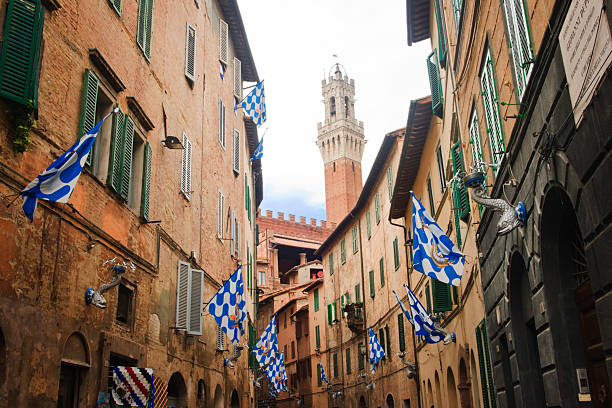
*Quarter banners — Siena's, from our own archive; Arezzo's four quartieri dress their streets the same way around the Giostra, and we have not yet photographed Arezzo itself.*
The film, the joust and the city’s two famous faces
Roberto Benigni filmed the first, golden half of *Life is Beautiful* across central Arezzo: Piazza Grande hosts the falling-key scene, the bicycle crash that lands Guido on Dora happens before the Badia's steps, and half the film's strolls trace streets you will walk between sights — our set-jetting guide maps the locations. The city wears the connection lightly: no tour-bus circus, just plaques and the occasional fan re-enacting the *"Buongiorno, Principessa!"* balcony shout. That lightness is worth savouring while it lasts — film tourism has transformed smaller Tuscan towns before, and Arezzo's version still feels like a private discovery rather than an itinerary item.
A timing note that rewards the flexible: in the week before each joust, the quarters' knights train in Piazza Grande on public evenings — the spectacle at a fraction of joust-day's crowd, and free. If your dates fall in early September or mid-June, an ordinary Arezzo day trip can catch armoured riders at full gallop as a bonus, no ticket required.
The other face is the Giostra del Saracino — the twice-yearly joust in which the city's four quarters charge an armoured effigy across Piazza Grande. The 2026 editions: a night joust on Saturday 20 June and the milestone 150th edition on Sunday 6 September. Everything about tickets, the free ceremonial week and the day itself is in the dedicated guide; the point for this article is what the joust reveals — that Arezzo, like Siena, performs its rituals for itself, not for tourism, which is precisely the quality that makes it worth the detour.
The honest negatives
A verdict is only trustworthy with the case against on the table, so here it is, assembled from the less flattering reviews and our own weighing.
Arezzo is a working city, not a hill-town postcard. Around a hundred thousand people, industrial suburbs, and a station approach of banks and ordinary shops. The beauty starts a few blocks uphill and concentrates around the piazza and the upper town; travellers expecting wall-to-wall San Gimignano will notice the difference immediately.
The station walk is uphill — about a kilometre, ten to fifteen minutes, gentle but real, and worth knowing in August heat or with limited mobility.
Tickets stack. The chapel plus its booking fee, Casa Vasari, the archaeological museum, a tower or two — sight-by-sight ticketing adds up, and at least some reviewers have grumbled about the total. Free first Sundays flip that equation entirely if your dates allow.
Quietness cuts both ways. The absence of crowds is the product of an absence of spectacle: no leaning tower, no dome climb, no single iconic photograph. Visitors who measure a day by highlights sometimes leave underwhelmed; visitors who measure it by texture rarely do. Know which you are.
And from Siena, the logistics are honestly mediocre: no direct train (the rail routing via Chiusi takes about three hours), so it is the sparse 138 bus at roughly an hour and a half, or the train via Florence. From Florence, by contrast, Arezzo is one of the easiest day trips in Tuscany: direct regional trains in 50–75 minutes, just under €10, multiple departures an hour.
A day in Arezzo that earns the verdict
Book first — the chapel slot, days ahead, ideally late morning. Then let the geography plan the rest.
Arrive on a mid-morning train from Florence and walk up Corso Italia as the shops open. Take the Pieve's arcaded facade on the way, circle onto Piazza Grande for the first coffee — the square photographs best in morning light, before the sun flattens the brick. Make the fresco slot the late morning's anchor, giving the cycle the unhurried half-hour the booking bought you.
Lunch where the aretini do — the streets off the Corso rather than on the square — and this is Chianina country: the beef dishes are the local statement. The afternoon takes the Cathedral and its Magdalene, Casa Vasari if Vasari's self-decorated rooms tempt you, and the amphitheatre curve if the museum's hours cooperate. Finish with the *passeggiata* back down the Corso — Arezzo's evening stroll is the unhyped, resident version of the ritual — and an aperitivo on the square as the towers go gold, before an easy evening train home.
Fair-weekend variant: come Saturday, let the antiques swallow the morning, and push the frescoes to the afternoon slot. Giostra variant: that is its own article, and its own kind of day entirely.
The verdict, traveller by traveller
The art pilgrim → go, and build the day around the chapel slot. Piero's cycle is the region's least crowded world-class artwork, and the Cathedral's Magdalene plus Casa Vasari turn the day into a coherent Renaissance argument. This is the strongest single-interest case Arezzo has.
The crowd-weary → go, especially in high summer. When Florence in July is an endurance sport and Siena's Campo is shoulder to shoulder, Arezzo at the same hour has tables free on its great square. The town works precisely because the coach circuit skips it.
The browser and collector → go on a fair weekend. First Sunday and the Saturday before, with the free-museum first-Sunday bonus stacked on top; hands in pockets, no plan, the best kind of day.
The film sentimentalist → go with the locations list. An hour's gentle walking covers the Benigni sites, and the town's refusal to make a circus of them is part of the charm.
The first-time-in-Tuscany traveller on a short trip → probably skip, honestly. With three or four days in the region, Siena, Florence and one hill town earn their places first; Arezzo is a second-visit reward, not a first-visit obligation.
The Siena-based, car-free traveller → borderline. The 138 bus is sparse and the rail detour runs via Florence; the day works, but it costs more logistics than anything else in this verdict. If the frescoes call, answer via Florence.
Anyone in Tuscany on 6 September 2026 → the question answers itself. The 150th Giostra is the event of the season, and this article is merely its supporting act.
How we checked these details
Checked 9 August 2026, via web research: the Bacci Chapel's compulsory timed booking, the 30-person/30-minute slot rule, the no-same-day rule, the three-working-days payment condition and the €6-plus-€3-fee structure from the official Arezzo ticketing conditions of sale as reflected in current sources (outdated figures both higher and lower still circulate on third-party pages and are ignored); the completed status of the fresco maintenance from reporting on the 2024 scaffolding programme; cathedral, Pieve, Piazza Grande and Vasari facts from heritage sources; Casa Vasari (€4) and archaeological museum (€6) admissions with the museum's sharply weekday-variable hours from museum information; the Fiera Antiquaria's first-Sunday-plus-Saturday pattern and 1968 founding from the fair's published history, with the September 2026 Giostra-weekend collision noted from local reporting; Life is Beautiful locations from film-location documentation; crowd contrasts from consistent multi-source traveller reporting (a specific Arezzo annual-visitor figure circulates from a single industry source and we decline to print it); and transport from regional rail data and Autolinee Toscane line information. Prices, hours and booking rules change — the Discover Arezzo official channels supersede everything here. We have no affiliate relationship with any venue, ticketing service or operator named; recommendations are editorial.
Final thoughts
"Is Arezzo worth visiting" is really a question about what you think Tuscany is for. If it is for icons, Arezzo will feel like a detour. If it is for the thing the icons crowd out — a great square with room to stand in, a world-class fresco cycle seen thirty people at a time, a city performing its rituals for itself — then Arezzo is not a detour but a correction. Book the chapel, take the morning train from Florence, and decide over an aperitivo on the sloping square whether the quiet was a flaw or the entire point. Our verdict is on record: for the right traveller, this is the best-value day in eastern Tuscany.
Helpful summary
The short version
Is Arezzo worth visiting? Yes — for the right traveller. The Piero frescoes and their booking trap, the antiques fair, honest negatives and the verdict.
Frequently asked
FAQ
Keep reading
Montalcino or Montepulciano? Two Wine Towns, One Honest Comparison
Montalcino or Montepulciano? The wines, the towns, walk-in tastings versus appointments, and how to reach each from Siena — compared honestly.
12 min read · Updated 2026-08-24
Giostra del Saracino 2026: Arezzo Runs Its 150th Joust on 6 September
Arezzo runs the 150th Giostra del Saracino on 6 September 2026: how the joust works, verified ticket prices and dates, and the day trip by train.
14 min read · Updated 2026-08-20
Volterra: Etruscan Urns, Alabaster Dust, a Working Prison, and No Vampires
Volterra in full: Etruscan urns, the 1208 Palazzo dei Priori, Roman theatre, alabaster workshops, the Balze, the €23 card and the Twilight truth.
11 min read · Updated 2026-09-26