Panzano in Chianti: Is Dario Cecchini Worth It, and the Vino al Vino Weekend
Is Dario Cecchini worth it? The honest answer, plus Panzano’s Vino al Vino wine weekend, the Conca d’Oro and how to reach the village without a car.
In this guide
- Quick answer
- Who Dario Cecchini actually is
- The three ways to eat there — and what they cost
- Booking, and the two unknowns to resolve before you travel
- The honest verdict: who should book, and who should not
- Vino al Vino: the festival the growers run themselves
- The village, the Conca d’Oro and the organic hillside
- How we checked these details
- Final thoughts
- FAQ
Quick answer
Panzano is a village of a thousand-odd people on the Chianti ridge road that punches so far above its weight it has two separate international reputations: the world's most famous butcher, and a producers' union whose wine festival is run by the winemakers themselves.
Is Dario Cecchini worth it? Yes — if you understand what you are buying. His communal restaurants are a fixed-price, fixed-menu, elbow-to-elbow performance of Tuscan meat cookery, not a gastronomic tasting menu, and the diners who leave disappointed are almost always the ones who expected the second thing. Two facts every guide should tell you before you book and most do not: the Officina della Bistecca costs €50 per person including water and table wine, with your own bottle welcome at no corkage — and the beef is not Chianina. It comes from a family of butchers in Catalonia who have raised it to Cecchini's specification for over thirty years. He is entirely open about this; it is only a betrayal if nobody told you.
Vino al Vino is the other reason to come: Panzano's own producers pouring in Piazza Bucciarelli, reported for 18–20 September 2026 — a date we flag as secondary-sourced, because we found no first-party announcement at our check. In 2025 the format was a €30 tasting glass that served as the pass to every stand.
And underneath both sits the village itself: the Conca d'Oro, the golden south-facing amphitheatre of vineyards that made Panzano one of the eleven named subzones of Chianti Classico, farmed roughly 90 per cent organically. Bus 365 from Florence, about an hour — with one large caveat about the evening return, below.
Who Dario Cecchini actually is
Strip away the television and there is a real story here. Cecchini, born 1955, is the eighth generation of his family behind the counter of the Antica Macelleria Cecchini on Via XX Luglio — a shop whose trading history is given as reaching back to 1780. He left veterinary studies at Pisa in 1976 to take the business over from his dying father, which is to say: he did not choose the butcher's life as a brand, he inherited it as a duty.
Three things built the legend beyond Chianti. The first is Dante — he recites the Commedia while working, a habit long documented and not a later invention for visitors. The second is the funeral. In 2001, on the eve of the EU's mad-cow-related ban on bone-in beef from cattle over twelve months — a Brussels measure, not a Roman one, which took effect on 1 April 2001 and ran until December 2005 — Cecchini staged a public funeral for the *bistecca alla fiorentina* in Panzano. Contemporary April 2001 reporting confirms the funeral procession, the marching band, the coffined T-bone and the hundreds of mourners; the open-casket and raw-slab flourishes come from later retellings. The point of the protest was that Brussels had killed a Tuscan dish. The third is the writing and the screen: Bill Buford spent months apprenticed to him for Heat (2006), whose subtitle names him as "a Dante-Quoting Butcher in Tuscany", and Netflix's Chef's Table devoted an episode to him — Volume 6, Episode 2, released 22 February 2019 (some sources misfile it under Season 2; the sixth is correct).
What this means for a visitor is worth stating plainly: you are not going to a restaurant that happens to have a famous chef. You are going to a butcher's shop with dining rooms attached, run by a man whose whole argument is that the animal deserves to be used completely and eaten in company.
The three ways to eat there — and what they cost
Cecchini runs four eating operations in the same village, plus the shop counter, and choosing between them is most of the planning.
Officina della Bistecca — the flagship. €50 per person, fixed, covering the whole meal, with a dedicated children's menu at a reduced price: a progression of beef courses that typically runs beef tartare (the "sushi del Chianti"), rump, the Panzanese steak and finally the bistecca alla fiorentina, alongside Tuscan bread, his seasoned salt, raw vegetables with oil, Tuscan beans, roast potatoes and whipped lardo. Water and red wine are on the table within the price, and you may bring your own bottle with no corkage. There is no à la carte: each room eats one menu at one sitting, at long communal tables, and a vegetarian menu is offered at the same price (reviewers describe it as noticeably plainer than the meat service). Seating mechanics per the official site: aperitivo at 12:00 or 19:00, seated half an hour later, service beginning at 13:00 or 20:00.
Solociccia — lunch only, single seating, and the *nose-to-tail* argument in practice: braised, boiled and lesser-known cuts rather than the big steak. It carries a Michelin Plate listing (a listing, not a star). It now costs €50 per person — the same as Officina — per the official site, which lists a single daily 12:00 seating with a meat or vegetarian menu. That matters, because the long-standing advice that Solociccia is "the cheaper option" no longer holds. Aggregator and Michelin-adjacent listings still showing €40, and older material showing €30, are out of date; confirm at booking.
Dario DOC — the casual daytime option, roughly 11:30/12:00 to 15:00, built around a half-pound burger with garlic-and-sage roast potatoes, raw vegetables and bread. The official site describes it as street food open daily 11:30–15:00 with no booking required — the flexible, no-plan option. We found a €10 burger figure circulating but not on a first-party page, so we do not print prices here.
The Panini Truck is the fourth and cheapest: a permanent van parked at the Panzano belvedere with the grill lit, serving his meat in Tuscan bread — no reservation, no ceremony. If the communal rooms are full or the budget is tight, this is how to eat Cecchini's cooking on the day you decide to.
The butcher shop itself is the free-est option: every source describes complimentary tastings at the counter during opening hours — crostini with lardo and rillettes, fennel salame, a glass of Chianti — with no purchase required. None of those sources is the business stating a policy, so read it as customary hospitality that may vary with the day and the crowd, not an entitlement. Buy something anyway; it is a shop.
Booking, and the two unknowns to resolve before you travel
Booking for the communal restaurants runs by email or telephone, taken any day between 09:00 and 16:00, with a request form on the official site; allergies must be declared at the time of booking. We found no published deposit or cancellation policy for any of the three — which is not the same as there being none, so ask when you confirm.
Two unknowns deserve resolving before you build a day around them, and we would rather flag them than paper over them:
One: which days Officina actually runs. The official site presents it as operating every day at 12:00 and 19:00. Multiple current secondary listings instead say dinner only on Tuesday, Friday and Saturday, plus Sunday lunch. The official site is the stronger source and the aggregator listings the weaker, but the conflict is real and current on both sides. This is the single most consequential unknown for a visitor: confirm your date directly with the business before booking travel around it.
Two: the last bus home. Panzano is served by Autolinee Toscane's line 365 group from Florence — the stop is Panzano P.za Campana, journey time about an hour and often a little over, departures from beside Florence's Montelungo/Santa Maria Novella bus terminus. But we could not confirm the last evening departure back to Florence, and the arithmetic matters enormously: an Officina dinner beginning service at 20:00 almost certainly cannot be done by bus in a day trip. Lunch by bus is comfortable; dinner by bus is a plan that needs the actual timetable, or a car, taxi or bed in the village. Autolinee Toscane's fare page prices extra-urban journeys by distance zone without publishing this pair, so we print no fare either — buy at a bar, tobacconist or newsagent, or tap on and off, as the car-free guide explains.
If Panzano proves impossible, there is now a legitimate fallback: Cecchini opened Cecchini in Città in Florence, at the 25hours Hotel Piazza San Paolino, on 19 September 2024.
The honest verdict: who should book, and who should not
The case for. Fifty euro for a multi-course beef feast with wine included is, by the standards of anywhere else charging for a famous name, remarkable value. The communal table does what communal tables do — you leave having talked to strangers from four countries. The cooking is genuinely good and genuinely committed to a philosophy: nose-to-tail, no waste, no fuss. And Cecchini himself is usually present, cleaver in hand, performing the Dante and the salt and the welcome. For anyone who enjoys eating as an event, this is one of the best-value theatrical dinners in Italy.
The case against, assembled honestly from the criticism rather than dismissed: you eat elbow to elbow at long shared tables, in noise; there is no choice of dish; and a recurring complaint calls it "a show for tourists and definitely not a place for gourmets". Vegetarians are catered for but at a plainer standard. If your ideal dinner is quiet, chosen and paced by you, this is structurally the wrong restaurant, and no amount of fame changes that.
And the fact to know before you go, because discovering it at the table sours people who would otherwise have loved the meal: the beef is not Chianina and is not Tuscan. For more than thirty years Cecchini has sourced it from the Viñals family, butchers in Mataró in Catalonia for over a century, who supply him from free-range herds raised in the Catalan Pyrenees — Cerdanya, Girona, Lleida — to his specification rather than to any single breed — he argues openly that it delivers better marbling and tenderness than the Chianina available to him. That is a defensible position from a butcher who has spent fifty years judging meat. It is also simply not what most visitors assume they are buying in the heart of Chianti, and you deserve to decide with the information rather than after it.
Our verdict: book Officina if you want the full performance and the steak; consider Solociccia if you care more about the nose-to-tail philosophy than the showpiece cut (and confirm its price); use Dario DOC or the shop counter if you just want to taste the man's cooking without ceremony. Skip all of it if crowds and fixed menus are your idea of a bad evening — Panzano's wine is reason enough to come anyway.
Vino al Vino: the festival the growers run themselves
The second reason to know Panzano's name fills Piazza Bucciarelli each September, and its distinguishing feature is who stands behind the tables: the winemakers themselves, pouring their own bottles.
The organisation matters. The Unione Viticoltori di Panzano was founded in 1995 for the first Vino al Vino and is described as the first association of winemakers formed within the Chianti Classico territory; it counts 23 member estates as of 2026. Its membership rule is stricter than the denomination's own: grapes, winemaking and bottling must all happen in Panzano. The result at the festival is a tasting of over 80 labels that are, in a genuinely unusual sense, all from one hillside.
Dates, with an honest flag. The 2026 edition is reported as Friday 18 to Sunday 20 September, matching 2025's confirmed 19–21 September running. The union describes the event as the third weekend of September, but that is a guide rather than a rule — the 2024 edition ran 13–15 September, the second weekend. But we found no first-party announcement from the growers' union for September 2026 at our check, and the sources disagree at the edges — one outlier lists a seven-day span, and the union's own historic description mentions a four-day format (the third weekend plus the preceding days) against 2025's three days. Treat 18–20 September as likely, not settled, and confirm on the union's channels before booking travel.
How entry works — and this is the part visitors get wrong. There is no conventional ticket: you buy a tasting glass, supplied with a shoulder-strap holder, and the glass is your pass to every stand. In 2025 it cost €30, with a 10 per cent discount for buying ahead through the union's online shop. Do not confuse the September festival with Vino al Vino in Cantina, the union's spring edition, when member estates open their own cellars instead — 2–3 May in 2026, tastings 11:00–19:00. 2025 opening hours ran Friday 11:00–19:30, Saturday 11:00–20:00, Sunday 11:00–19:00; the 2026 hours are not published anywhere we could find. Past programmes have added extras — in 2025, Cecchini's own panini truck on the Saturday evening and the Panzano Orchestra on Sunday morning — but those were 2025-specific and no 2026 programme exists yet.
How it differs from the bigger fair up the road. Expo Chianti Classico in Greve runs 10–13 September 2026, a week *earlier*, and is a different animal: organised by the comune, drawing producers from every municipality of the Chianti Classico zone, and using a token system — a €20 glass including seven tasting tickets, with Riserva and Gran Selezione costing two. Vino al Vino is smaller, single-village, grower-run and open-pour. Serious Chianti drinkers with September dates should consider doing both: the zone-wide survey first, the deep dive into one hillside a week later. If your dates run into October instead, the region’s other set-piece is L’Eroica at Gaiole on 3–4 October 2026 — a different crowd entirely, and one that fills Chianti’s beds the same way.
The village, the Conca d’Oro and the organic hillside
Panzano itself is a *frazione* of Greve in Chianti, perched at about 500 metres on the SR222 Chiantigiana — the wine road that runs the 69-odd kilometres between Florence and Siena, and one of the great drives in Italy when the car is the right tool.
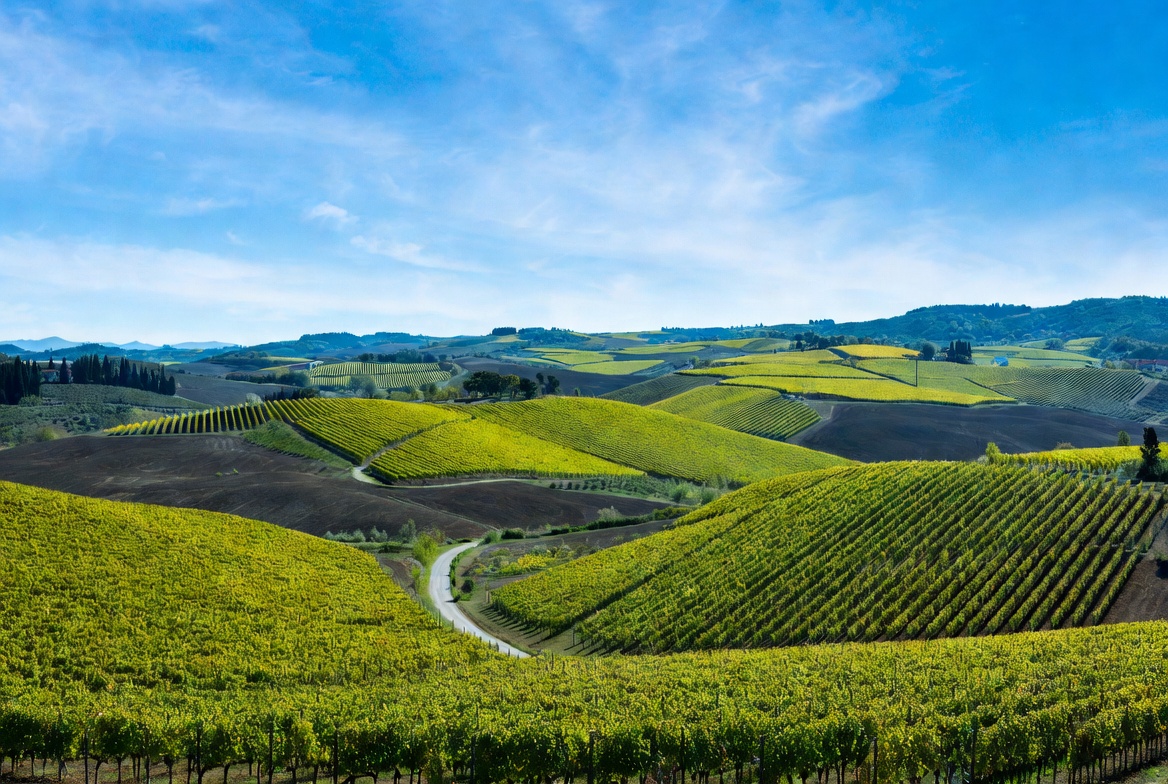
Its geographic signature is the Conca d'Oro, the "golden basin": a south-facing natural amphitheatre of hillside dropping toward the Pesa valley, whose name comes from the old practice of growing grain between the vine rows, turning the whole bowl gold before harvest. The bowl is also the reason Panzano's wine has a reputation of its own — it is one of the eleven official Unità Geografiche Aggiuntive of Chianti Classico (alongside Castellina, Radda, Gaiole, Lamole, Montefioralle and the rest), a subzone whose name may now appear on Gran Selezione labels under rules published in 2023. The Panzano UGA covers roughly 2,840 hectares, of which about 595 are vineyard — some 6.7 per cent of all Chianti Classico plantings.
And it is unusually green: the growers' union puts organic farming at around 90 per cent of Panzano's vineyards, while the Chianti Classico consortium's own subzone profile says 95 per cent certified — either way, effectively the whole hillside — a process the growers date from 2012, when a bio-district covering Greve and Panzano was formally established that July. You will see the claim "the first organic wine district in Italy" repeated widely; it is plausible and locally asserted, and we flag it as a claim rather than a verified first.
What to see between glasses. The Pieve di San Leolino, about a kilometre from the village, is documented as far back as 982 with the present Romanesque church rebuilt in the first half of the 1100s, with a thirteenth-century cloister alongside — but note that it opens by request rather than to fixed hours, so arrange access rather than turning up hopeful. The upper village keeps a surviving stretch of the castle wall — documented in the eleventh century, its standing fabric dated to the twelfth, held by the Firidolfi and Ricasoli families through the Florence–Siena wars — and the best free viewpoints over the Conca d'Oro. And the Sunday morning market fills Piazza Bucciarelli from about 08:30 to 13:00, enlarging on the first Sunday of the month into the artisan *aprilante*.
Half a day covers the village comfortably; a full day covers it with a Cecchini lunch and a vineyard visit. Free parking sits outside the historic centre, with footpaths climbing to the square — the standard hill-town parking discipline applies here as everywhere.
How we checked these details
Checked 9 August 2026, via web research (direct page fetches are blocked in our environment, so every fact rests on search-surfaced material rather than pages we opened ourselves — the confidence language above reflects that ceiling). Verified: Cecchini's biography, the shop's 1780 trading history and Via XX Luglio address, the 2001 bistecca funeral against contemporaneous April 2001 news coverage — which supports the procession, band, coffined T-bone and crowd, but not the open-casket and raw-slab details of later retellings — the EU (not Italian) origin of the ban that provoked it, the Buford subtitle, and the Chef's Table attribution to Volume 6 Episode 2 (22 February 2019) against three independent listings — correcting a widely repeated Season 2 error; Officina's €50 price, wine-and-water inclusion, no-corkage BYO policy, single-seating communal format and stated seating times from the official site; Solociccia's lunch-only nose-to-tail format and Michelin Plate listing; the Catalonia sourcing, which Cecchini states publicly. Solociccia's €50 price, its single daily seating and Dario DOC's no-booking street-food format come from the official site, which outranks the stale aggregator listings that still show €40. Explicitly unresolved and printed as such: Officina's operating days (official site's daily schedule versus secondary listings' Tue/Fri/Sat-plus-Sunday-lunch), any deposit or cancellation terms (none found), Dario DOC's prices and reservation policy, the Florence–Panzano bus fare, and the last evening 365 departure — the one that decides whether a bus-based dinner is possible at all. For Vino al Vino: the 2025 edition's confirmed 19–21 September dates, the €30 glass and 2025 opening hours, the union's 1995 founding, 23 members, 80-plus labels and its grapes-winemaking-and-bottling-in-Panzano rule; the 2026 dates rest on secondary sources with no first-party confirmation found, and the duration conflicts between sources, so we flag rather than assert. Village facts (UGA status and hectares, the 2012 bio-district, the ~90% organic figure, San Leolino's 982 documentation, twelfth-century Romanesque rebuild and by-request access, the Sunday market) come from producer-union, heritage and municipal-adjacent sources. The organic share is given as the 90–95% span its two primary-tier sources publish rather than averaged. Prices, dates and opening arrangements change: confirm with the businesses and the growers' union before travelling. We have no affiliate relationship with any restaurant, winery, producers' union or event named here; no booking on this page pays us anything, and the verdict above is editorial.
Final thoughts
Panzano is a lesson in what a thousand people can do with one hillside. They made a wine subzone the denomination had to recognise, farmed nine-tenths of it organically, built their own growers' union before anyone else in Chianti thought of it, and threw a festival where the person pouring your glass is the person who grew it. And in the middle of all that stands a butcher who buried a steak in 2001 to make a point and has been quoting Dante over the counter ever since.
Come for a lunch, stay for a hillside. Book Cecchini knowing exactly what it is — fixed, communal, theatrical, Catalan-sourced and, for the right diner, wonderful — and time the trip for the third weekend of September if you want the growers' own wine in your hand while you decide. Just confirm the dates, the days and the last bus first: Panzano rewards the traveller who checks.
Helpful summary
The short version
Is Dario Cecchini worth it? The honest answer, plus Panzano’s Vino al Vino wine weekend, the Conca d’Oro and how to reach the village without a car.
Frequently asked
FAQ
Keep reading
Where to Eat on a Siena Day Trip: The Restaurants Worth Planning a Town Around
Named, researched picks for the day-trip towns — Pienza, Montalcino, Montepulciano, San Quirico and beyond — with the booking rules that make them work.
11 min read · Updated 2026-09-14
The Tuscan Food Calendar: Dishes Worth Timing Your Trip Around (2026–27)
The Tuscan foods locals wait all year for — olio nuovo, schiacciata all’uva, white truffle, carnival cenci — and the exact seasons to catch each one.
12 min read · Updated 2026-08-15
Tuscan Food Guide: 25 Dishes Worth Ordering, and Why
Twenty-five Tuscan dishes and drinks worth ordering, what makes each one local, and the dining habits that shape a Tuscan menu.
11 min read · Updated 2026-07-12