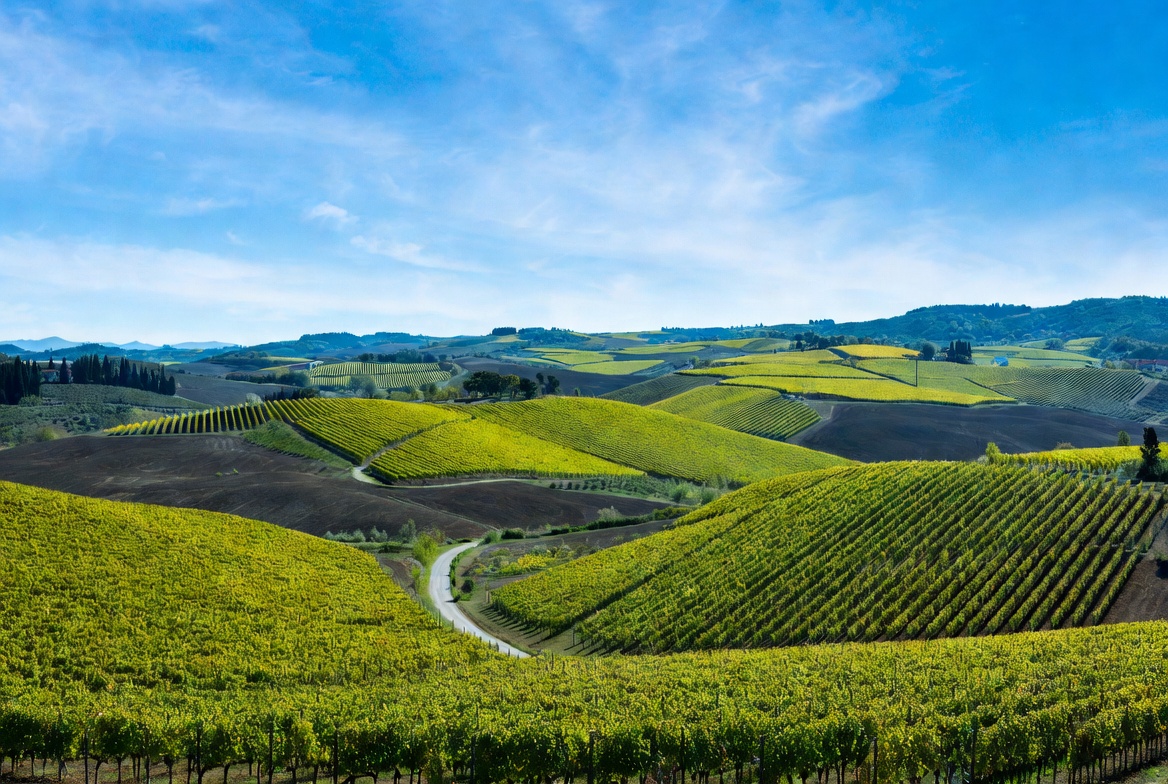
L’Eroica Gaiole 2026: Sold Out to Ride, Wide Open to Watch
L’Eroica returns to Gaiole in Chianti on 3–4 October 2026. Entries are gone — but the weekend never needed a race number. How to be there properly.
In this guide
- Quick answer
- What L’Eroica actually is, and why it exists
- The five routes, and which day each one runs
- The bicycle rules, which are enforced
- Entries: what happened in 2026, and how to get 2027
- The weekend without a number — which is the better weekend anyway
- If you are driving in Chianti that weekend
- Getting to Gaiole, and where to sleep
- What else is within ten minutes of the start line
- The route is there every other week of the year
- How we checked these details
- Final thoughts
- FAQ
Quick answer
L’Eroica rides out of [Gaiole in Chianti](/blog/chianti-classico-towns-guide/) on Saturday 3 and Sunday 4 October 2026. If your plan was to ride it, the honest headline is that you are late. Entries opened on 10 December 2025 and the categories closed one by one: the Ciclo Club Eroica places at €60, the Privilege and sports-team allocations, the 2,500-number Standard at €100, the 2,000-number Standard Late at €125 released on 2 April 2026, the Combined “Double Eroica” Saturday-plus-Sunday ticket at €130, the Combined “B” pairing with Nova Eroica at €140. Every one of them showed sold out when we checked the official registration page on 16 August 2026. The single category still listed as available was the children’s entry — €40, ages 13 to 17.
Most articles stop there, which is a waste, because the number is the least interesting part of the weekend.
You do not need an entry to be at L’Eroica. Gaiole spends the weekend as an open-air museum of bicycles that people still ride: a market of vintage frames and parts filling the village, wool jerseys and shellac-taped bars everywhere you look, riders rolling back in through the afternoon covered in white dust and visibly delighted with themselves. Nothing about that is ticketed. You walk in.
Three practical things to take from this article before the detail starts:
- The roads are not closed. L’Eroica runs on open public roads for its entire duration, and every rider is bound by the Italian Highway Code. If you are driving anywhere in southern Chianti or the Crete Senesi that weekend and did not know the event was on, you will find out at the first blind gravel bend.
- Beds went months ago. Gaiole is a village. Radda, Castellina and Siena absorb the overflow, and even they tighten. If you are reading this in September for this October, plan on Siena and a car or a very early start.
- The route exists all year. The 209 km course is a permanently signposted public route. You can ride it, or any part of it, on any bike, on a Tuesday in March, with nobody watching.
What L’Eroica actually is, and why it exists
L’Eroica was not conceived as a bike race. It was conceived as a protest about road surfacing.
In the mid-1990s the *strade bianche* — the pale, unsealed gravel roads that thread the hills between Chianti and the Val d’Orcia — were being asphalted, stretch by stretch, as a routine municipal improvement. Giancarlo Brocci, from Gaiole, thought this was a loss disguised as progress: the white roads were the landscape’s working memory, the surface on which Italian cycling’s hard century had actually happened. Arguing for them on heritage grounds alone was not going to beat a paving budget. Arguing that they had economic value might.
So in 1997 he put on a ride for what the event’s own account calls 92 “hunters of feelings and emotions”: old steel bicycles, old clothing, the unpaved roads, and a deliberate refusal of everything that had made cycling faster and duller. It worked, in the specific way that only a very stubborn idea works. The gravel stayed. The event grew into a foundation for protecting what remained of it, and then into a network of Eroica events on four continents. The professional Strade Bianche one-day race that now anchors the early-season calendar is a direct descendant: its first edition, in October 2007, was called Monte Paschi Eroica and ran from Gaiole in Chianti to Siena, spun off from the amateur event and using the roads it had defended. It moved to March the following year and became a modern classic.
The scale in 2025 makes the point better than any adjective: 8,328 riders from 51 countries, more than four in ten of them from outside Italy, with Germany at 17 per cent, Switzerland at 4.6 and the United Kingdom at 3 — and a women’s field of 1,200 registered riders. That was the twenty-eighth running.
What has not grown is the tone. The regulations describe a leisure ride, not a race, and the event’s own vocabulary is about fatigue and conviviality rather than performance. Riders consistently report the refreshment stops — long tables of Chianti wine, pecorino and whatever the village has cooked — as the point rather than the interruption. It is a nine-hour lunch with hills in it.
The five routes, and which day each one runs
The distances are split across the two days, with the punishing ones going out first.
Saturday 3 October 2026
- Lungo L’Eroico — 209 km. The full course, Gaiole to the Val d’Orcia by way of the Val d’Arbia and the Crete Senesi, and back. Around 3,800 metres of climbing on a bicycle with two chainrings and a five- or six-speed block. Riders leave in the dark.
- Medio Crete Senesi — 135 km. The technical middle distance, reaching the clay ridges south of Siena.
Sunday 4 October 2026
- Cento Val d’Arbia — 106 km.
- Medio Gallo Nero — 81 km. The classic first Eroica, named for the black rooster of Chianti Classico.
- Corto Valle del Chianti — 46 km. The short route, and the one that makes the day possible for riders who are not training for it.
Sunday is the busier, louder, more sociable day by a distance — three routes starting from one village square inside a few hours. If you are choosing which day to *watch*, Sunday morning in Gaiole is the one.
Start windows follow the same shape every year: the 209 km field rolls out well before dawn (in 2024 the pre-1930 machines went first, from 04:30, with the main long-route start through to 06:00), the 135 km follows from 06:00, and Sunday’s routes leave from 07:00 for the 106 and from 08:00 for the 81 and the 46. Race-pack collection on Sunday morning runs 06:00–09:30. Confirm the exact 2026 windows on the event’s own programme before setting an alarm around them — the pattern is stable, the minutes are not.
How much of it is gravel? On the long route, roughly 112 of the 209 kilometres are unsealed. That proportion is the whole design. It is also why the ride is harder than the elevation profile suggests, and why a dry week beforehand changes the day completely.
The bicycle rules, which are enforced
This is where L’Eroica differs from every other mass ride, and where people who turn up hopeful get turned away.
An eligible bicycle — the regulations call it a heroic bike — is a road-racing machine with dropped handlebars built up to and including 1987, with or without gears. The specifics:
- Frame: steel. Aluminium is admitted only in the rare screwed-and-glued construction — ALAN-type frames — and never welded. Mountain bikes are excluded outright.
- Gear levers on the down tube. Bar-end shifters are permitted only in the pre-1980 non-indexed form.
- Pedals with toe clips and straps. Clipless pedals are not allowed, at any distance.
- Brake cables running outside and over the handlebars, in the pre-aero-lever manner.
- Wheels with at least 32 spokes, laced to a low-profile rim of 20 mm depth or less.
The rules are not styling guidance. They are the reason the event looks the way it does, and they are checked.
If you do not own such a bicycle, the event’s own travel information points to vintage-bike hire with collection in Gaiole in the days before the ride — worth arranging in the same breath as an entry rather than after it, since the rental pool is finite and shares a village with several thousand visitors.
And the requirement nobody mentions until it blocks them: the medical certificate. Italian mass-participation cycling requires proof of medical fitness, and L’Eroica is no exception. Riders resident abroad need a certificate of fitness for cycling issued by a physician in their own country, uploaded to the MyEroica platform under *My documents*, where validation is stated to take up to 15 days. Foreign riders aged 70 or over must supply the competitive-fitness certificate under the Italian standard (DM 18/02/82), which is a more involved examination than a general fitness note. Leaving this to the week before is the most common way a paid entry becomes a spectator ticket.
Entries: what happened in 2026, and how to get 2027
The 2026 sequence, as published, is the template for planning next year:
| Category | Price | Status at our check |
|---|---|---|
| Ciclo Club Eroica members | €60 | Sold out |
| Privilege / Friend Sport Team (1,000 numbers) | — | Sold out |
| Standard (2,500 numbers) | €100 | Sold out |
| Standard Late (2,000 numbers, released 2 April 2026) | €125 | Sold out |
| Combined “Double Eroica” (Sat + Sun) | €130 | Sold out |
| Combined “B” (L’Eroica + Nova Eroica) | €140 | Sold out |
| Children, ages 13–17 | €40 | Listed as available |
Registration opened at 09:00 CET on 10 December 2025. Read that table as a clock rather than a price list: the numbers went out in tranches — 1,000, then 2,500, then 2,000 — with the price climbing from €100 to €125 as each one emptied, and the last of them gone before high summer. The 2025 field was 8,328 riders, so those named tranches are not the whole start list; they are simply the part a member of the public can buy.
Three things follow for 2027.
Join the Ciclo Club Eroica first, not the waiting list later. The members’ category opens ahead of the public one and at the lowest price. It is the only category that reliably converts intention into a number.
Diarise the December opening, not the October event. Entries for an early-October ride are decided in the previous December. A traveller who starts planning in the summer is planning the wrong year.
Get the medical certificate before you have a place. It costs a GP appointment and it removes the only administrative step that cannot be hurried.
If the 2026 answer is simply no, the family of Eroica rides gives you other doors: Nova Eroica opens the white roads to modern gravel bikes with no vintage requirement, and Eroica Montalcino takes the Brunello hills in late spring, when the days are long and the light is different. Their 2027 dates were not published at our check, so treat them as a reason to watch the calendar rather than book flights.
The weekend without a number — which is the better weekend anyway
Here is the part the cycling press never writes, because the cycling press comes to ride.
Gaiole is the event. The village — normally a quiet, unshowy place that visitors drive through on the way to a castle — spends the weekend as a working museum. The Mercato Eroico, the vintage market, fills the streets with frames, wheels, cranksets, jerseys, cycling caps and the specific smell of old tubular glue; in 2025 it was published as running 09:00–20:00 on Saturday and 09:00–19:00 on Sunday, alongside the sponsor village. Music, food stands and grills run through both days, and the festival programme builds from midweek.
Time your Sunday morning properly. Get into Gaiole before 08:00 and you see the thing that photographs badly and lands hard in person: several thousand people on sixty-year-old bicycles, in wool, rolling out of a medieval village in the half-light. By ten the square has emptied of riders and filled with everyone else. From early afternoon they start coming back — dusty, sunburnt, some of them pushing — and the arrival is more moving than the start, because by then you can see what the day cost them.
Watch from the gravel, not the village. The white roads climbing out of the Gaiole and Radda basins put riders in front of you slowly, at conversational speed, on a surface that makes the effort visible. Any signposted *strada bianca* within a few kilometres of the route will do; you need no ticket, no pass and no plan beyond walking uphill for twenty minutes and finding a wall to sit on.
Bring cash and patience. A village of a few thousand people is hosting a crowd many times its own size — more than eight thousand riders in 2025, before anyone who came to watch. Queues at bars are long, card networks strain, and the lavatories are the ones the village already had.
And bring layers. Early October in these hills gives daytime highs around 20°C and nights near 10°C, and October is one of the wetter months — long-run averages put it near 113 mm across roughly twelve rain days. Standing still on a ridge at seven in the morning in October is a different proposition from walking around Siena at noon; our guide to what to wear in Tuscany in September covers the layering that still applies in the first week of October.
If you are driving in Chianti that weekend
This section is for the far larger group of readers who are not coming for L’Eroica at all, and who will be in Tuscany anyway on 3–4 October 2026.
The roads stay open. L’Eroica is explicit about this: the entire route remains open to normal traffic for the whole event, and participants ride under the Highway Code like anyone else. There is no rolling closure, no marshalled corridor, and no reason for a driver to expect one.
What that means in practice, across a broad arc of countryside from Gaiole and Radda down through the Val d’Arbia to the Crete Senesi and toward Montalcino:
- Thousands of cyclists on narrow, unsealed, blind-cornered roads, from before dawn on Saturday and from first light on Sunday.
- Riders on machines with 1970s braking — single-pivot calipers on steel rims, in gravel, sometimes wet. Assume stopping distances longer than you would from a modern bike.
- The white roads are where this concentrates. If your route was going to include a scenic gravel section, that weekend is the one to take the asphalt instead.
- Villages along the course will be busy and parked-out well beyond Gaiole itself.
None of this is a reason to stay away. It is a reason to add an hour, take the SR222 or the main provincial roads rather than the pretty shortcut, and not to plan a tight airport run through Chianti on the Sunday morning. If you are hiring a car for that week, our guide to renting a car in Tuscany covers the insurance and ZTL issues that matter more than the daily rate — and the Chianti-versus-Val d’Orcia comparison will help you decide whether to be in this landscape at all that weekend.
Getting to Gaiole, and where to sleep
By car is the straightforward answer, with the caveat that Gaiole’s parking is a village’s worth and the event is not. Arrive early, expect to walk in from the outskirts, and treat any published parking arrangement as the thing to check on the day.
By bus, it is harder than the map suggests. Autolinee Toscane runs line 127, Siena–Pianella–Gaiole — the line exists and the operator publishes it. What we could not verify for October 2026 is the part that decides your day: journey planners put it near 40 minutes with only a handful of departures and no Sunday service, and we have not been able to confirm that against the operator’s own timetable. From the Florence side, line 365 runs to Greve and continues through Radda toward Gaiole, on the same principle: real, and sparse. The trap is Sunday, which is the main event day and the day rural Tuscan lines run least or not at all. Check your date on the at-bus.it planner before assuming a return exists; this is the same problem our car-free Tuscany guide works through in detail for the whole region.
Where to stay. Gaiole has few beds and they go first. The realistic bases, in widening circles:
- Radda and Castellina in Chianti — closest, small, and subject to the same pressure.
- Panzano and Greve — the Florence side of Chianti, well connected by the 365, and worth a day in their own right if you are there for the food; see our Panzano guide.
- Siena — the practical fallback. Enough rooms to absorb a bad booking decision, a proper evening, and a 40-minute drive to Gaiole. Our Siena hotel guide covers the neighbourhoods; if you are driving, the parking-specific list matters more than the star rating.
Booking guidance for an event of this size is unglamorous: for the following year, book accommodation when you book the entry, in December. For this year, in September, take Siena and stop optimising.
What else is within ten minutes of the start line
A non-riding companion — or anyone who has come for the atmosphere and wants a second day — has an unusually good corner of Chianti to work with. Gaiole is one of the eleven official Unità Geografiche Aggiuntive of Chianti Classico, and the castles around it are the reason the wine has the history it does.
Castello di Brolio is the serious one. The Ricasoli family have held it since 1141, and it was Bettino Ricasoli — nineteenth-century prime minister, obsessive agronomist — who set down the grape formula that became Chianti Classico. At our check the gardens were open 10:00–18:00, with garden entry €5 and gardens plus museum €8, each including a tasting, and a two-hour guided *classic tour* at €28. Seasonal hours change; confirm for your date.
Badia a Coltibuono, a Benedictine abbey founded around the year 1000 and turned into a villa-farm after the suppressions of 1810, is the quieter and, for some visitors, the better one — the Romanesque church of San Lorenzo and the cloister, plus the estate’s own wines. Published guided-tour times run 14:30–17:30 in late March, April and from October to early November, extending to 18:30 from May to September; €7 for the tour, €10 with a tasting.
Castello di Meleto, also of around the year 1000, opens its interiors and cellars on daily tours. Vertine, a walled hamlet a mile west of Gaiole, appears in Coltibuono’s records in the early eleventh century and takes about forty minutes to walk around, which is exactly right.
Put together, that is a full second day without a bicycle in it — and if you are here in the first fortnight of October, you are also in the window where the olive harvest and the first pressings begin, and just past the Chianti grape harvest, which finishes earlier here than in Montalcino. Our month guide to October in Tuscany sets the whole month in order.
The route is there every other week of the year
The most useful fact in this article, for most readers, has nothing to do with the first weekend in October.
L’Eroica’s long course is a permanent, signposted public route. The roughly 205–209 km loop from Gaiole through the Val d’Arbia, the Crete Senesi and the Montalcino hills is waymarked and rideable year-round, on any bicycle, by anyone, in one day or across three to five. You can join it at any point rather than starting from Gaiole, and nothing about it requires an entry, a wool jersey or a 1980s frame.
That changes the planning question entirely. If what appeals to you about L’Eroica is the *roads* — white gravel, cypress ridgelines, no traffic, the Crete Senesi opening out south of Siena — then the first weekend in October is the single worst time to experience them, because that is the weekend they have eight thousand people on them. May, late September and mid-October give you the same surfaces in near-solitude.
Go in October and you also get what the event weekend hides: the ordinary version of these villages, where the bar in Gaiole has a free table and the strada bianca out toward Coltibuono has nobody on it at all.
How we checked these details
Checked 16 August 2026, by web research; direct page fetches are blocked in our environment, so this rests on search-surfaced material rather than pages we opened, and we have not published outbound links we could not confirm.
Verified from the event’s own published material: the 3–4 October 2026 dates and the split of the five routes across the two days (209 and 135 km on Saturday; 106, 81 and 46 km on Sunday); the 10 December 2025, 09:00 CET registration opening; the category structure and prices — Ciclo Club Eroica €60, Standard €100 with 2,500 numbers, Standard Late €125 with 2,000 numbers released 2 April 2026, Combined “Double Eroica” €130, Combined “B” €140, children 13–17 €40 — and the sold-out status of every adult category at our check; the 06:00–09:30 Sunday race-pack window; the bicycle regulations (built up to and including 1987, steel or screwed-and-glued aluminium, down-tube shifters with the pre-1980 non-indexed bar-end exception, toe clips and straps, brake cables over the bars, minimum 32 spokes on rims of 20 mm depth or less, no mountain bikes); the medical-certificate requirement, the MyEroica upload, the stated 15-day validation and the competitive-fitness certificate required of foreign riders aged 70 and over; the statement that the route stays open to traffic throughout and that the Highway Code binds participants; vintage-bike hire collectable in Gaiole before the event; and the permanent signposted route of roughly 205–209 km, around 112 km of it unsealed.
Verified from event reporting and regional sources: the 1997 founding by Giancarlo Brocci with 92 riders and the strade-bianche preservation motive; the descent of the professional Strade Bianche from it, whose first edition ran in October 2007 as Monte Paschi Eroica from Gaiole in Chianti to Siena before moving to March in 2008; the 2025 turnout of 8,328 riders from 51 countries, over 40 per cent from abroad, Germany 17 per cent, Switzerland 4.6, the United Kingdom 3, with a women’s field of 1,200, described as the twenty-eighth edition; the 2025 Mercato Eroico hours of 09:00–20:00 Saturday and 09:00–19:00 Sunday; Castello di Brolio (Ricasoli since 1141; gardens 10:00–18:00; €5 gardens, €8 gardens and museum, both with a tasting; €28 two-hour classic tour), Badia a Coltibuono (founded around the year 1000, villa-farm after 1810; tours 14:30–17:30 late March, April and October to early November, 14:30–18:30 May to September; €7, €10 with tasting) and Castello di Meleto; Autolinee Toscane’s existence of line 127 Siena–Pianella–Gaiole; and early-October climate averages for Gaiole of roughly 20°C by day, 10°C at night, and about 113 mm of rain across twelve days in the month.
Flagged as unconfirmed and deliberately not stated as fact: the exact 2026 start windows for each route (we describe the 2024 pattern and tell you to confirm); the frequency, journey time and Sunday operation of bus lines 127 and 365, where the figures in circulation come from journey planners rather than the operator’s own timetable and must be checked on at-bus.it for your date; the 2026 edition number; the 2027 dates for L’Eroica, Nova Eroica and Eroica Montalcino, and the 2027 registration calendar; and event parking arrangements. Prices and opening hours at Brolio, Coltibuono and Meleto are seasonal and were correct at our check only.
We have no commercial relationship with L’Eroica, with any of the properties named, or with any bike-hire or tour operator mentioned. No booking made from this page pays us anything.
Final thoughts
Brocci’s argument in 1997 was that a gravel road has a value you cannot see on a highways department spreadsheet. Nearly thirty years later, eight thousand people fly to a Tuscan village to ride bicycles that are worse than the ones they own, on surfaces that make them slower, in wool that makes them hotter — and the roads he was defending are still there.
That is the thing to go and look at, and it does not require an entry. Stand on a white road above Gaiole at half past seven on the first Sunday in October and watch a man in his seventies come past on a Bianchi older than his children, and the appeal of the whole enterprise stops needing explanation.
If you want to ride it, join the Ciclo Club, get the medical certificate signed in the autumn, and be at your computer in December. If you want to *be* there, just turn up — and if what you actually want is those roads, come back in May and have them to yourself.
Helpful summary
The short version
L’Eroica returns to Gaiole in Chianti on 3–4 October 2026. Entries are gone — but the weekend never needed a race number. How to be there properly.
Frequently asked
FAQ
Keep reading
San Galgano: The Roofless Abbey and the Real Sword in the Stone, an Hour from Siena
San Galgano: the roofless Cistercian abbey (€6), the real twelfth-century sword in the rock (free), the 27 September closure and how to get there.
11 min read · Updated 2026-09-27
Sant’Antimo: The Romanesque Abbey That Still Sings, Nine Kilometres from Montalcino
Sant’Antimo below Montalcino: the Charlemagne legend, the 1118 travertine church, onyx capitals, the monks’ chant times, free entry and hours.
11 min read · Updated 2026-09-22
Lucca Comics & Games 2026: Lucca Is Already Full — Here Is How to Go Anyway
Lucca Comics & Games 2026 runs 28 Oct–1 Nov, the 60th edition. Tickets, the 99%-booked centre, and the Pisa, Viareggio and Florence bases that still work.
11 min read · Updated 2026-09-15