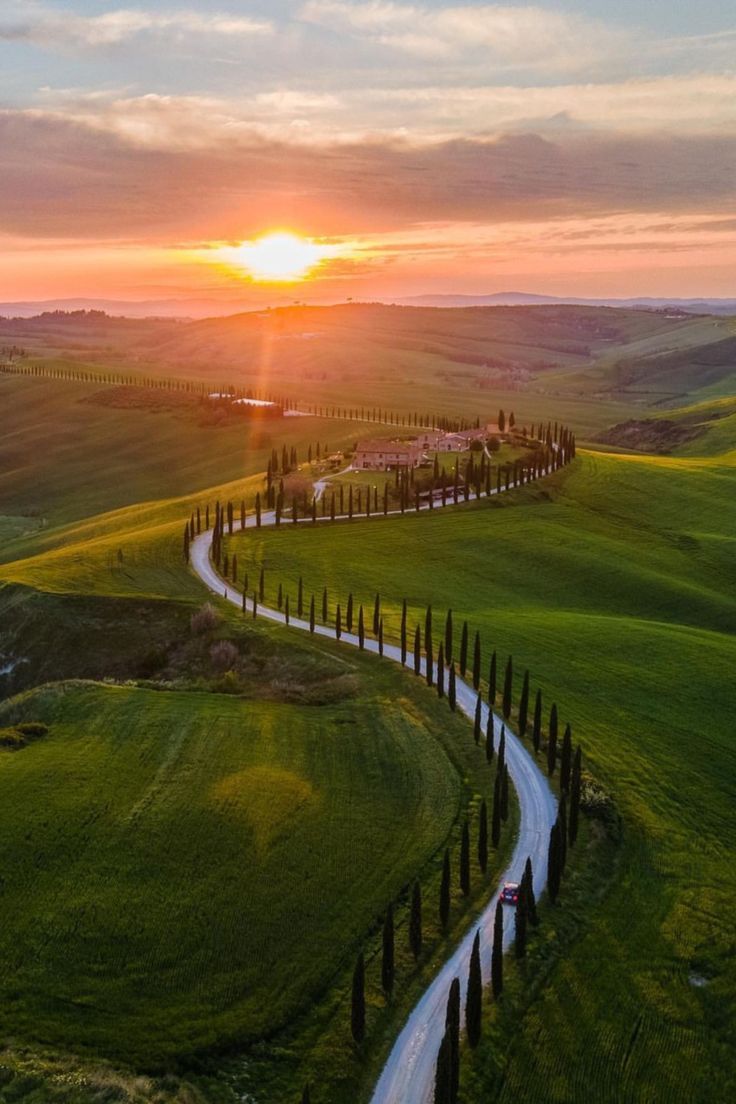
Sant’Antimo: The Romanesque Abbey That Still Sings, Nine Kilometres from Montalcino
Sant’Antimo below Montalcino: the Charlemagne legend, the 1118 travertine church, onyx capitals, the monks’ chant times, free entry and hours.
In this guide
- Quick answer
- Charlemagne’s legend, and what the documents actually say
- The building: French Romanesque in Tuscan stone
- Timing the chant
- Two abbeys, one order: Sant’Antimo and Monte Oliveto
- Around the abbey: Castelnuovo dell’Abate and the Brunello south
- Getting there, and the day around it
- How we checked these details
- Final thoughts
- FAQ
Quick answer
Nine kilometres south of Montalcino, in a valley of olive trees and cypresses at the hamlet of Castelnuovo dell'Abate, stands what many judges call the finest Romanesque church in Tuscany: the Abbey of Sant'Antimo, rebuilt in pale travertine around 1118–1130, with capitals carved in translucent onyx-alabaster and a resident community of Olivetan Benedictine monks who sing the daily offices in Gregorian chant. It is free to enter, open every day, and — timed to one of the sung hours — the single most affecting half-hour in the southern Val d'Orcia.
The practical facts at our check: open 10:00–19:00 from April to October and 10:30–17:00 from November to March; the monks' weekday office schedule as published by visitor sources runs Lauds 7:00, Terce and Mass 9:00, Sext 12:45, None 14:45, Vespers 19:00, Compline 20:30, with different Sunday times — treat those as the pattern to plan around and confirm on the abbey's own site, because monastic timetables move with the liturgical year. There is no public transport worth relying on; you drive, and the abbey is the natural afternoon of a Montalcino day.
This guide covers the legend and the real history, the building and what to look at inside it, how to time a visit to the chant, and the logistics.
Charlemagne’s legend, and what the documents actually say
The abbey tells its own origin as a miracle. In 781, the story goes, Charlemagne was returning from Rome with an army sickening from plague; he stopped in this valley, prayed, his soldiers recovered, and in thanks he founded a monastery on the spot. It is a splendid story and the abbey has told it for nine hundred years — but the honest reading is that the Charlemagne foundation has no direct historical basis: the accounts first appear in a document of the Emperor Henry III in 1051, two and a half centuries after the supposed event.
What the documents do support is nearly as old. The first solid record is from 814, when Louis the Pious, Charlemagne's son, granted privileges to a Benedictine community already here. Through the early Middle Ages Sant'Antimo grew rich — an imperial abbey with lands across southern Tuscany, on the pilgrim road's flank — and around 1118 it rebuilt its church in the form you see, work continuing through the 1130s. Then the long decline of the great abbeys: by the fifteenth century it had lost its independence, and for centuries the church stood in its valley as a magnificent near-ruin, its monastery buildings gone.
The modern chapter is the one that makes the visit: monastic life returned to Sant'Antimo in the late twentieth century, and since January 2016 the community has been Olivetan Benedictine — the same congregation as Monte Oliveto Maggiore across the hills — and it is their voices you hear at the offices. The legend gave the abbey its name and its fame; the monks give it its life.
The building: French Romanesque in Tuscan stone
Sant'Antimo does not look like other Tuscan churches, and that is the first thing to notice. The abbey's twelfth-century builders drew on Burgundy and Provence — the Cluniac and southern French Romanesque — rather than on Pisa or Florence, which gives the church its tall, single-minded clarity: a basilican plan of three naves, round arches on columns, an ambulatory with radiating chapels around the apse in the French manner, and an interior that rises and narrows toward the light with almost no ornament to distract from the stone.
The stone is the ornament. The church is travertine, but the capitals are carved from onyx-alabaster — a translucent stone that catches the light and glows faintly from within, so that on a bright afternoon the tops of the columns seem lit from behind. Every capital is carved: geometric patterns, foliage, animals, human figures.
The one to find is on the second column of the right-hand nave: Daniel in the lions' den, attributed to the Master of Cabestany, the anonymous twelfth-century sculptor whose work is scattered from Catalonia to Tuscany. Daniel prays between the hungry lions on the front face; on the other sides, the lions devour his accusers. It is the finest single piece of Romanesque carving in the region, and the reason art historians make the detour.
Outside, walk the full circuit: the apse with its chapels, the surviving fragments of the monastery, the bell tower, and the setting itself — the church rising alone from the valley floor with the olive terraces and cypresses around it, the composition that every photograph of Sant'Antimo is trying to capture and that only the walk around it delivers.
Timing the chant
The abbey is worth visiting silent. It is a different place during an office, when the monks file in and the plainsong fills a building designed for exactly that acoustic — and the difference is the reason to plan.
The pattern, as published by visitor sources at our check (Monday to Saturday): Lauds 7:00, Terce and Mass 9:00, Sext 12:45, None 14:45, Vespers 19:00, Compline 20:30, with Sunday and feast-day times differing — Sunday Mass in particular draws a congregation and a fuller sung liturgy. The two offices that fit a day-tripper's schedule are Sext at 12:45 and None at 14:45 — short, midday, and reachable after a Montalcino morning; Vespers at 19:00 is the most beautiful and the hardest to fit, because the abbey's public hours close at the same time in high season and the drive back is in the dark from November.
How to behave. This is a working monastery's liturgy, not a performance: sit, keep still, no photographs during the office, no walking the aisles while the monks are singing, and leave the choir to them. Come early enough to be seated before it begins, and stay to the end. The shop by the entrance sells the monks' herbal teas, sweets and cosmetics, and the abbey's own recordings — the honest souvenir.
Confirm before you build a day on it. Monastic timetables shift with the liturgical calendar, retreats and the seasons; the abbey's own site publishes the current schedule, and the figures above are the pattern, not a promise.
Two abbeys, one order: Sant’Antimo and Monte Oliveto
Southern Siena has two great living abbeys, and since 2016 they belong to the same congregation — which makes the comparison worth a paragraph, because visitors regularly confuse them and each rewards a different kind of attention.
Monte Oliveto Maggiore, in the Crete Senesi, is the Olivetans' mother house: a red-brick monastic city in the clay country, whose reason to visit is *painting* — the Great Cloister's thirty-five-fresco cycle of the life of St Benedict by Signorelli and Sodoma, a Renaissance gallery inside a working monastery. You go for the walls.
Sant'Antimo is the opposite proposition: a Romanesque church almost without images, whose reason to visit is *stone, light and sound* — the travertine, the glowing capitals, the plainsong. You go for the space. It is smaller, older in its fabric, freer (no ticket), and far more dependent on timing: Monte Oliveto is the same at any hour, Sant'Antimo is transformed by the office.
The practical consequence: they are on opposite sides of Siena's southern hinterland — one east in the crete, one south below Montalcino — and belong to different days. Give Monte Oliveto the crete loop and Sant'Antimo the Montalcino day, and let the shared habit of the monks — the same rule, the same hours sung in two very different buildings — be the thread between them.
Around the abbey: Castelnuovo dell’Abate and the Brunello south
The abbey sits in the heart of Brunello's southern vineyards, and the hamlet above it, Castelnuovo dell'Abate, is a village of a few streets on the ridge with the estates spread around. This is the quiet side of Montalcino's wine country — south-facing, warmer, later-ripening than the northern slopes — and in the harvest weeks of September and October the roads around the abbey carry tractors and the air carries the *vendemmia*; the 2026 picking, per the consortium, began early on 7 September.
Pairing the abbey with a tasting. The honest order is abbey first, wine second: attend the midday office with a clear head, then drive back toward Montalcino for the enoteca flight at the fortress or a booked estate visit — and if you are the driver, the region's rules on tasting and driving apply with the usual force on these bends. Estate visits in this southern zone need a booking, in season weeks ahead; the town's enotecas need nothing.
The walk. From the abbey, tracks and quiet lanes climb the valley sides through olives and vines — the abbey seen from above, rising alone from its floor, is the image the photographs chase, and an hour's stroll delivers it. Wear shoes for farm tracks and carry water; there is nothing to buy between the abbey shop and the village.
The season for it. Autumn, unambiguously: the light through the capitals, the harvest around the walls, the truffle fairs an hour to the north the following month. Winter for solitude; spring for the green; summer for early mornings only.
Getting there, and the day around it
By car, only. Sant'Antimo is a ten-minute drive south of Montalcino via Castelnuovo dell'Abate, with parking below the abbey and a short walk down to it. There is no bus a visitor should plan around; for the car-free traveller the abbey is a reason to take a tour or to hire for the day, as our car-free guide advises for the whole southern valley.
Hours and entry. Free. Open every day: 10:00–19:00 from 1 April to 31 October, 10:30–17:00 from 1 November to 31 March at our check. Modest dress applies as in any Italian church.
The classic pairing is the Montalcino day: fortress and Brunello in the morning, lunch in town, the abbey for the 14:45 office, then the Val d'Orcia's golden hour on the drive back. The abbey also closes the Via Francigena's southern landscape from a different angle, and in the truffle weeks of November it is the quiet counterweight to the fairs.
When. Autumn light through the onyx capitals is the best of the year; winter mornings are empty and cold; high summer afternoons are hot on the walk but cool inside the stone. Whenever you come, time it to the singing.
How we checked these details
Checked 21 September 2026, by web research; direct page fetches are blocked in our environment, so this rests on search-surfaced material — the regional tourism board, reference works on the abbey, and visitor guides that reproduce the abbey's published hours and office times — rather than pages we opened.
Verified: the abbey's location at Castelnuovo dell'Abate in the comune of Montalcino, about nine kilometres from the town; the Charlemagne legend of 781 and its lack of direct historical foundation, the accounts first appearing in a 1051 document of Henry III; the 814 privileges of Louis the Pious to an existing Benedictine community; the rebuilding in travertine around 1118–1130 with Burgundian and Provençal echoes; the three-nave basilican plan, the onyx-alabaster capitals, and the Daniel in the lions' den capital attributed to the Master of Cabestany; the Olivetan Benedictine community in residence since January 2016; free admission, the shop, and the published seasonal hours (10:00–19:00 April–October, 10:30–17:00 November–March); and the weekday office pattern (Lauds 7:00, Terce and Mass 9:00, Sext 12:45, None 14:45, Vespers 19:00, Compline 20:30) with Sunday variations.
Stated with care: the office times, which come from visitor sources reproducing the abbey's schedule and move with the liturgical year — confirm on the abbey's own site; the ambulatory-and-chapels description, which follows the standard architectural accounts; and the drive time from Montalcino, which is an estimate from the distance rather than a checked figure.
We have no commercial relationship with the abbey, its shop, any tour operator or any body named. Nothing on this page is bookable through us.
Final thoughts
Tuscany is full of churches you admire. Sant'Antimo is one you *hear*: a twelfth-century French idea built in Tuscan stone, lit through translucent capitals, and filled twice a day with the sound it was designed for by monks who arrived a decade ago to restart a thousand-year-old habit.
Drive down from Montalcino after the Brunello. Sit before the office begins. Let the building do what it was built to do. Then walk the circuit outside, find Daniel and his lions, and understand why an emperor's son thought this valley worth a charter in 814 — whether or not his father ever stood in it.
Helpful summary
The short version
Sant’Antimo below Montalcino: the Charlemagne legend, the 1118 travertine church, onyx capitals, the monks’ chant times, free entry and hours.
Frequently asked
FAQ
Keep reading
San Galgano: The Roofless Abbey and the Real Sword in the Stone, an Hour from Siena
San Galgano: the roofless Cistercian abbey (€6), the real twelfth-century sword in the rock (free), the 27 September closure and how to get there.
11 min read · Updated 2026-09-27
Lucca Comics & Games 2026: Lucca Is Already Full — Here Is How to Go Anyway
Lucca Comics & Games 2026 runs 28 Oct–1 Nov, the 60th edition. Tickets, the 99%-booked centre, and the Pisa, Viareggio and Florence bases that still work.
11 min read · Updated 2026-09-15
L’Eroica Gaiole 2026: Sold Out to Ride, Wide Open to Watch
L’Eroica returns to Gaiole in Chianti on 3–4 October 2026. Entries are gone — but the weekend never needed a race number. How to be there properly.
20 min read · Updated 2026-09-02