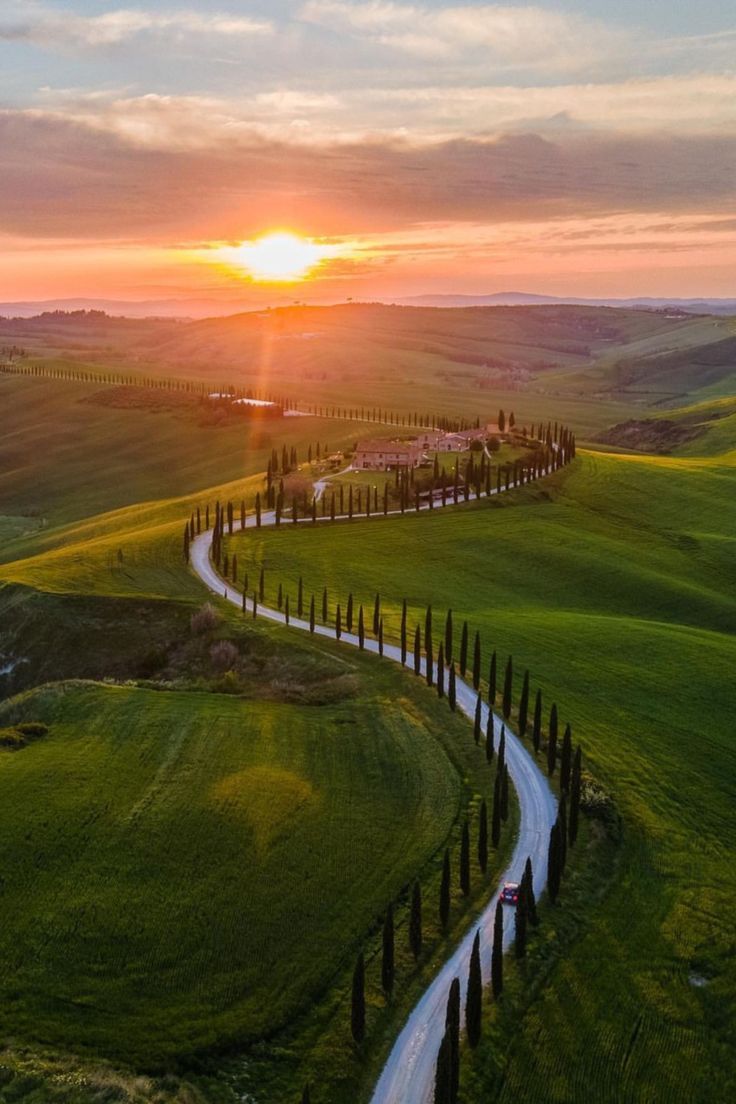
The Crete Senesi: Tuscany’s Clay Moonscape, and How to Do It Right
South-east of Siena the postcards stop and a clay moonscape begins. What the Crete Senesi are, the loop to drive, and the frescoed abbey at its heart.
In this guide
- Quick answer
- What the crete actually are
- Not the Val d’Orcia — and why the difference matters
- The loop: half a day by car
- Monte Oliveto Maggiore: a Renaissance gallery in a clay desert
- The Treno Natura: the crete by heritage railway
- When to go: the four planets of the crete
- How we checked these details
- Final thoughts
- FAQ
Quick answer
Twenty minutes south-east of Siena, Tuscany stops looking like Tuscany. The vines and stone farmhouses give way to bare, rolling clay — grey-green in spring, scorched white-gold in summer, dissolving into fog in autumn — with single farmhouses and cypress lines stranded on the ridgetops like ships. These are the Crete Senesi, the "Sienese clays", and they are the most distinctive landscape in the province and the least understood by visitors.
What you need to know before going:
- It is a landscape, not a sight. The pleasure is the driving and the stopping, on ridge roads between Asciano, Monteroni d'Arbia, Buonconvento and Rapolano Terme. Budget half a day minimum for the loop.
- There is one great indoor destination at its heart: the abbey of Monte Oliveto Maggiore, whose Great Cloister carries a 35-fresco cycle of the life of St Benedict begun by Luca Signorelli in 1497 and continued by Il Sodoma — one of the major Renaissance fresco cycles in Tuscany, in the middle of a clay desert.
- You realistically need a car. The honest alternatives are thin, with one glorious seasonal exception — the Treno Natura, a heritage railway that has run excursions through the crete since 1996, sometimes behind steam.
- This is not the Val d'Orcia. The two get blurred together online, and they are neighbours — but the Val d'Orcia is the lush postcard, and the crete are its stark, stranger sibling. If your Chianti-versus-Val-d'Orcia decision left you wanting something less photographed, this is the answer.
What the crete actually are
The short version: you are driving on a sea floor.
More than two million years ago this basin lay under water, and the sediment it left behind — a clay the locals call *mattaione*, mixed with rock salt and chalk — is what the hills are made of. It drains badly, erodes dramatically and grows little without effort, which is why the landscape looks the way it does: sparse, sculpted and strangely lunar in a region famous for abundance.
The erosion has its own vocabulary, worth having before you stand in front of it:
- *Biancane* — pale domes of exposed clay, named from *bianco*, white, for the light colour of the soil and the saline bloom on its surface. They cluster like a pod of surfacing whales.
- *Calanchi* — steep gully systems fanning down the hillsides, like half-open vertical fans.
- The Deserto di Accona — the "Accona Desert", the semi-arid heart of the crete near Asciano where these formations concentrate and the nickname stops feeling like exaggeration.
Two things follow from the geology. First, the landscape changes utterly with the seasons — this is one of the few places in Tuscany where the month you visit changes not just the light but the apparent *planet*. And second, what little grows here is precious: the region's white truffles, its pecorino pastures and its wheat all come out of the same difficult clay, which is why the eating in these unglamorous villages is better than it has any right to be.
Not the Val d’Orcia — and why the difference matters
Search for the crete online and half the photographs are actually the Val d'Orcia, which borders it to the south. The confusion costs travellers real disappointment in both directions, so here is the distinction plainly.
The Val d'Orcia is the composed postcard: green in the right months, punctuated by famous towns — Pienza, Montalcino, San Quirico — with an itinerary of named sights and a guide of ours to match. The crete are emptier, starker and closer to Siena, with almost no headline sights beyond the abbey — and that emptiness is the product. You go to the Val d'Orcia to see things; you go to the crete to be somewhere.
There is also an art-historical reason this landscape should look familiar. In the Palazzo Pubblico, Ambrogio Lorenzetti's *Effects of Good Government* (1338–1339) rolls its frescoed countryside away behind the well-run city — and the bare, ridged hills he painted are recognisably these, the working land south-east of Siena as the Nine knew it. Drive the crete after seeing the fresco and you are moving through the oldest great painted landscape in the tradition, seven centuries on and barely reset. The battle that made that regime possible was fought on the crete's north-western edge — Montaperti, 1260, whose memorial hill makes a natural first stop on the loop below.
The loop: half a day by car
The classic circuit runs anticlockwise from Siena and can fill a half day or a whole one depending on how often you stop — and this is a route where stopping is the point.
Siena → Montaperti (15 min). Leave the city south-east and, if the battle means anything to you after Siena's museums, take the short detour to the cypress-ringed pyramid before the clay country opens.
→ [Asciano](/blog/asciano-guide/), by the Lauretana. The road to aim for is the SP438 "Lauretana" toward Asciano — the ridge road whose bends produce the classic crete views: lone farmhouses, cypress avenues, and the biancane of the Accona country. Every pull-out is a photograph; the discipline is choosing three.
→ Monte Oliveto Maggiore (20 min beyond Asciano). The abbey in its cypress woods is the loop's set piece and gets its own section below.
→ San Giovanni d'Asso (15 min). The truffle village — small castle, and in its cellars Italy's first museum dedicated to the truffle, 250 square metres under the vaults. If your dates land on 7–8 or 14–15 November 2026, the village's white-truffle fair — its 40th edition — is the crete at their most alive; our white truffle season guide covers both Tuscan fairs, and the autumn food calendar puts it in context.
→ [Buonconvento](/blog/buonconvento-guide/). A walled brick market town on the old Via Francigena corridor, flat and walkable, good for the late lunch the hill villages struggle to provide. From here the fast road runs straight back to Siena — or on south into the Val d'Orcia if you are combining the two.
Rapolano Terme, on the loop's eastern edge, adds the option most itineraries miss: working thermal baths in a landscape that has been geologically busy for two million years. If the hot-springs afternoon appeals but Bagno Vignoni feels far, this is the near version.
Driving notes: the ridge roads are narrow, the gravel turnoffs are where the best views hide, and on the first weekend of October the L'Eroica ride puts thousands of vintage cyclists across exactly this country on open roads — plan around it, in either direction. Our Tuscany car-rental guide covers the practicalities.
Monte Oliveto Maggiore: a Renaissance gallery in a clay desert
The abbey announces itself from kilometres away — a red-brick monastic city in a stand of cypress, founded by Sienese Olivetan monks and still a working monastery. It is the one place on this loop where you stop being a landscape-watcher and become a museum visitor, and the museum is extraordinary.
The Great Cloister carries thirty-five frescoes of the life of St Benedict, wrapped around all four walls. Luca Signorelli began the cycle in 1497–1498; Antonio Bazzi — Il Sodoma — continued it after 1505, and between them they produced one of the signature fresco cycles of the Italian Renaissance: crowded, worldly, frequently funny scenes — Sodoma painted himself in, with his pet badgers — in a place built for silence. If the name Sodoma rings a bell from Siena, it should: his ruined fresco from the Cappella di Piazza is in the Museo Civico, and here you meet him at full strength.
Practicalities, honestly stated. Published visiting hours run roughly 9:00–12:00 and 15:00–18:00 in summer, closing earlier (12:00 and 17:00, opening 9:15 and 15:15) in winter, with Sunday mornings extending to 12:30 — figures from visitor guides rather than a page of the abbey's we could open, so treat them as the pattern and check before building a day on them; the midday closure is real and catches people who arrive at 12:30 expecting lunch-hour sightseeing. We could not confirm the admission arrangements — whether entry is free, by donation or ticketed — so carry cash and expect any of the three. This is a working monastery: dress and volume as for a church, and services take precedence.
Give it ninety minutes: the cloister slowly, the church, and the walk back up through the woods.
The Treno Natura: the crete by heritage railway
The one genuinely great car-free way into this landscape is also one of Tuscany's best slow-travel experiences, and it is oddly little known outside Italy.
The Treno Natura has run since 1996 on the otherwise-disused line from Asciano to Monte Antico — about 51 kilometres through the crete and on into the Val d'Orcia toward the Ombrone basin — on excursion dates from roughly late March to late October, some of them behind a steam locomotive. The excursions are themed around what the country is doing that day: harvest events, village festivals, and in November the truffle weekends at San Giovanni d'Asso, when the train itself becomes the way to arrive at the festival.
Treat it as an event to book, not a service to catch: dates are a published calendar, not a timetable, and they sell to Italian families as much as to visitors. If your trip overlaps a running date, it is the best half-day this region offers without a steering wheel.
Beyond the Treno Natura, the honest car-free picture is thin. Regular trains and buses do reach the edge towns — but we could not verify current timetables to a standard worth printing, and services in country this empty run on school-and-work logic, not visitor logic. Check Trenitalia and at-bus.it for your date; and if the answer disappoints, the car-free Tuscany guide is frank about which landscapes are worth the fight and which want a car. This one wants a car.
When to go: the four planets of the crete
No landscape in Tuscany changes more across the year, so the honest advice is seasonal.
Late spring (April–June) is the green planet: young wheat over the clay, the fields at their softest, and the strongest contradiction of the "desert" nickname. The classic rolling-green photographs are taken now.
High summer is the scorched planet: the clay bakes pale, the wheat goes, shade is nearly absent and the middle of the day is genuinely punishing. Beautiful in a severe way — go early or at sunset, and treat it like the exposed country it is.
Autumn (late September–November) is the atmospheric planet, and our pick. Ploughing turns the hills to bare grey corduroy, the fog pools in the valleys at dawn and leaves the ridgetop farms floating — the single most photographed effect the crete produce, and the reason our October guide sends photographers this way — and the season ends with truffles in San Giovanni d'Asso.
Winter is the empty planet: frost on the biancane, long light, nobody at all. For a certain kind of traveller, the best version.
Whenever you come, the hours matter more than the month: this is a landscape of raking light, flat and lifeless at noon, extraordinary in the first and last two hours of the day. Build the loop around a dawn or a sunset and put the abbey in the middle.
How we checked these details
Checked 18 August 2026, by web research; direct page fetches are blocked in our environment, so this rests on search-surfaced material rather than pages we opened.
Verified: the character and extent of the Crete Senesi across the comuni of Asciano, Buonconvento, Monteroni d'Arbia and Rapolano Terme; the *mattaione* clay as marine sediment of a sea of more than two million years ago, mixed with rock salt and chalk; the *biancane* (pale clay domes, named from the white soil and saline efflorescence) and *calanchi* (fan-like gully systems), concentrating in the Deserto di Accona near Asciano; the abbey of Monte Oliveto Maggiore and its Great Cloister cycle of thirty-five frescoes of the life of St Benedict, begun by Luca Signorelli in 1497–1498 and continued by Il Sodoma after 1505; the abbey's published seasonal visiting pattern (roughly 9:00–12:00 and 15:00–18:00 in summer, shorter in winter, Sunday mornings to 12:30), from visitor guides; the Treno Natura heritage railway running since 1996 on the roughly 51 km Asciano–Monte Antico line, with excursions from late March to late October, some steam-hauled, including truffle-festival services; the Truffle Museum of San Giovanni d'Asso as Italy's first museum dedicated to the truffle, in about 250 square metres of the castle cellars; and the village's white-truffle fair on 7–8 and 14–15 November 2026 (its 40th edition, as confirmed at a 9 September 2026 re-check; an earlier version of this page said the second and third weekends).
Flagged as unconfirmed: the abbey's admission arrangements, which none of our sources stated plainly — carry cash and expect free, donation or ticket; the abbey's exact current hours, which come from visitor guides rather than the abbey's own page; regular rail and bus timetables to Asciano and Buonconvento, which we deliberately do not print — check Trenitalia and at-bus.it for your date; current Treno Natura dates and fares, which are a yearly calendar to look up rather than a fact to store; and the Rapolano Terme baths' prices and hours, which we describe only as existing. The SP438 Lauretana's status as the classic viewpoint road is a widely repeated judgement we share, not a measured fact.
We have no commercial relationship with the abbey, the railway, any baths, museum or festival named. No booking made from this page pays us anything.
Final thoughts
Tuscany's problem, for the returning visitor, is that its beauty has been so completely photographed that the real thing can feel like a re-enactment. The crete are the cure. Nobody's screensaver looks like a biancana; no influencer queue forms on the Lauretana at dawn; and the abbey at the centre of it holds a Renaissance masterpiece you can usually stand in front of alone.
Go in the shoulder months, drive it at the edges of the day, eat wherever the truffle village feeds you, and let the emptiness do its work. Siena's painters knew this country seven hundred years ago; it is still the best supporting argument for the city's whole view of the world — that the land, worked patiently, is the painting.
Helpful summary
The short version
South-east of Siena the postcards stop and a clay moonscape begins. What the Crete Senesi are, the loop to drive, and the frescoed abbey at its heart.
Frequently asked
FAQ
Keep reading
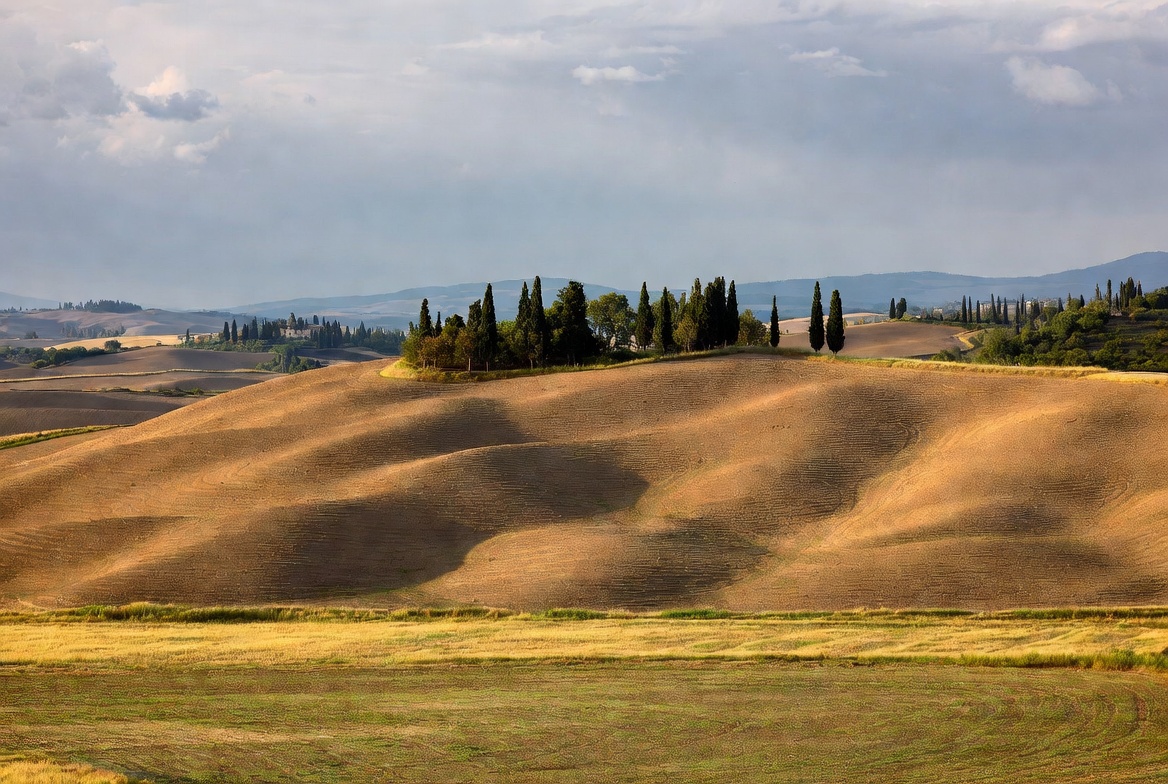
Asciano: The Crete Senesi Town With a Train Station and a Lorenzetti Masterpiece
The Crete Senesi’s main town is under half an hour from Siena by train, and its quiet museum holds an Ambrogio Lorenzetti masterpiece. How to do it right.
12 min read · Updated 2026-09-13
Radicofani: The Brigand’s Fortress at the End of Tuscany
The fifth UNESCO Val d’Orcia town nobody visits: Ghino di Tacco’s fortress on its volcanic crag, the Medici post-house, and the Francigena’s hardest climb.
12 min read · Updated 2026-09-17
Volterra: Etruscan Urns, Alabaster Dust, a Working Prison, and No Vampires
Volterra in full: Etruscan urns, the 1208 Palazzo dei Priori, Roman theatre, alabaster workshops, the Balze, the €23 card and the Twilight truth.
11 min read · Updated 2026-09-26