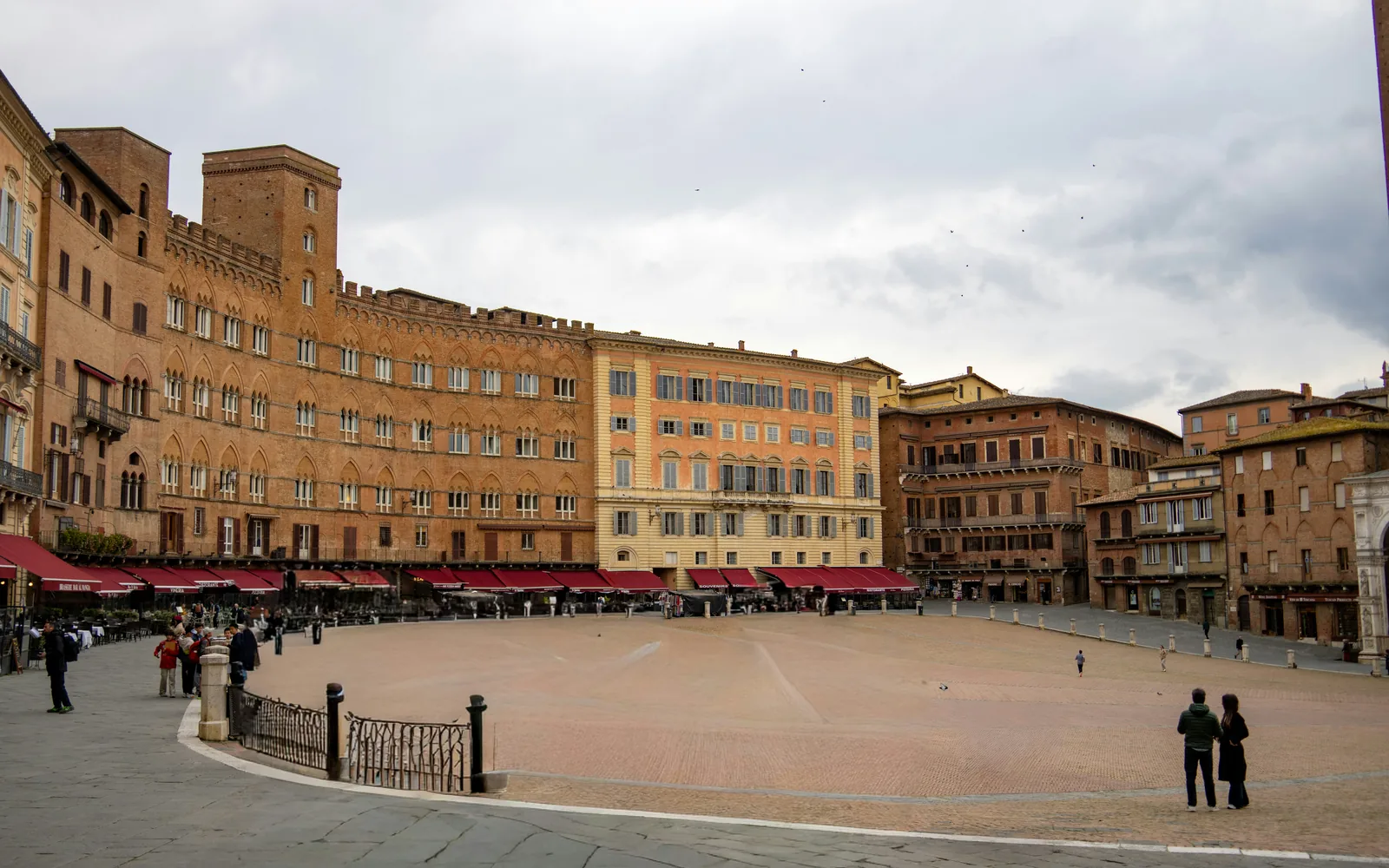
Piazza del Campo: What to Look For, and the Rules That Changed
Piazza del Campo is the best free thing in Tuscany, and a square with rules as of 2026: an ordinance running to 30 September prohibits eating on it, with sanctions from €50 to €480. This guide covers what is and is not allowed, how to read the nine segments and the slope, the Fonte Gaia copy and where the originals are, and the corrected Museo Civico prices and hours.
Piazza del Campo is the best free thing in Tuscany, and the one most travellers get slightly wrong. They photograph it from the upper curve, sit for twenty minutes, pay eight euro for a coffee at a terrace table, and leave without seeing what the square is actually saying.
It is also, as of 2026, a square with rules — including one that turns the classic Siena picnic into a fineable act. Start there, because it is the part nobody tells you.
Quick answer
You can sit on the Campo. You cannot lie down on it, and you cannot eat on it. A Comune ordinance, extended to 30 September 2026, prohibits sleeping, lying down and placing bedding in public squares, and prohibits consuming food on the steps of public buildings and in Piazza del Campo in front of the Palazzo Pubblico. Sanctions across the ordinance run from €50 to €480.
Sitting on the brick is not itself banned — the point was debated publicly when the ordinance was made, and ordinary sitting was not prohibited. The sandwich is the problem, not the sitting.
Allow 45 minutes for the square alone, and walk the full perimeter rather than standing at one viewpoint. Early morning for the space, the hour before sunset for the light and the life. It costs nothing, it never closes, and it is the one sight in Siena you cannot exhaust.
The 2026 rules, plainly
Siena tightened its urban-decorum regime across 2025–26, and a traveller who last visited a few years ago will find the Campo governed differently.
What the ordinance prohibits, as published: sleeping, lying down, and placing mattresses, bedding or camping objects in squares, green areas, porticoes and around monuments; and consuming food on the steps of public buildings, and in Piazza del Campo in front of the Palazzo Pubblico. Enforcement measures include immediate removal, clearing of occupied areas, and in serious cases referral for prosecution. Administrative fines run from €50 to €480.
What it does not prohibit: sitting. The ordinance drew local political criticism precisely on this point — one opposition line was that "Piazza del Campo is not a drawing room" — and ordinary sitting on the square was not made an offence. The separate historic-centre regulation does prohibit sitting on church steps, which is a different rule in a different place and worth remembering as you walk around the cathedral.
How to read this as a visitor. The ordinance's wording ties the food ban to the area in front of the Palazzo Pubblico, and we could not establish whether it is enforced across the whole shell or only that section. Treat the entire Campo as somewhere you do not eat. Buy the schiacciata, walk two minutes to the Orto de' Pecci or up to the Fortezza, and eat there instead. The saving on a terrace lunch is real; a €480 exposure to save it is not a trade worth making.
One apparent exception we cannot resolve for you. The Comune authorises events that put food on the square — most visibly the Mercato nel Campo, the December market whose stalls sell and serve on the shell. The ordinance is aimed at people consuming their own food there; how it interacts with licensed event catering is not something we could establish from the published wording. If you are here for an authorised market, do what the market is set up for; the rest of the year, assume your own sandwich is not welcome.
And the date matters. This ordinance has been extended repeatedly rather than made permanent, and the current extension runs to 30 September 2026. If you are travelling after that, check whether it was renewed again — the direction of travel in Siena, as in Florence, is toward more regulation of the historic centre rather than less.
Reading the square: what you are standing on
Most guides call the Campo shell-shaped and stop. The shape is an argument, and it is legible from the ground once you know what to look for.
The paving was laid between 1327 and 1349, in knife-shaped red brick, and it is divided by ten lines of white travertine into nine segments that all converge on the Palazzo Pubblico at the low point.
The nine are the Governo dei Nove — the merchant oligarchy that governed Siena from the 1280s to the 1350s, the most stable stretch in the city's history and the regime that commissioned nearly everything visitors come to see. Nine segments, nine governors, all pointing at the building they governed from. The same nine folds are also read as the folds of the Virgin's cloak; Siena declared the Virgin its sovereign, not merely its patron, and the square is a floor laid under her.
The slope is not a defect. The Campo occupies the junction of the three ridges Siena is built on — the meeting point of the city's three terzi — and was a market field before it was a piazza, which is where the name comes from. Its inward tilt means everyone standing in it faces the seat of government and everyone can see everyone else. That was the point. It is also why the Palio works: the crowd fills the dish, the horses run the rim.
Do this, and the square opens up: stand at the top of the curve for the full view, then walk down the slope to the Palazzo Pubblico and turn round. From below, the enclosing palazzi form a continuous, unbroken wall of façades — the result of a fourteenth-century building code that regulated window forms around the square. Very few medieval squares in Europe held that discipline for seven hundred years.
The Fonte Gaia is a copy, and the originals are worth finding
The fountain on the upper curve is the Fonte Gaia, and what you are photographing is a nineteenth-century replacement.
Jacopo della Quercia carved the original in the 1410s, finishing in 1419 — a Madonna and Child flanked by the Virtues, with Justice among them, deliberately echoing the imagery of Lorenzetti's Good Government frescoes inside the Palazzo Pubblico a few metres away. The square and the town hall were making the same argument in stone and paint.
By the nineteenth century the marble had deteriorated badly, and in 1858 the ensemble was replaced in situ by a free adaptation carved by Tito Sarrocchi. That is what stands there now. The surviving original fragments are displayed in Santa Maria della Scala, the former hospital facing the cathedral — which is a good reason to buy the €20 combined ticket described below, and one that almost no visitor knows.
The Palazzo Pubblico and the Museo Civico
The Palazzo Pubblico closes the low side of the square and still houses Siena's city government. The Museo Civico occupies its historic rooms, and it holds the single most important thing on the Campo: Ambrogio Lorenzetti's Allegory and Effects of Good and Bad Government, painted 1338–1339 in the Sala dei Nove — the room where the nine governors actually met, with a picture of the consequences of their own decisions wrapped around them. It is the most significant secular painting cycle to survive from medieval Europe, and it is in the room it was painted for.
The 2026 prices and hours, checked 16 August 2026:
| Ticket | Price | Notes |
|---|---|---|
| Museo Civico | €10.00 | €11.00 with booking |
| Museo Civico + Torre del Mangia | €15.00 | Valid 1 day; not bookable |
| Museo Civico + Santa Maria della Scala | €14.00 | Valid 2 days; €15.00 with booking |
| Museo Civico + Santa Maria della Scala + Torre | €20.00 | Not bookable |
- Summer, 1 March to 31 October: 10:00–13:45 and 14:30–19:00, ticket office closing 18:15.
- Winter, 1 November to 28 February: 10:00–13:00 and 13:45–16:00, ticket office closing 15:15.
Read the ticket-office time rather than the closing time, and note that the winter counter shuts at 15:15 — a winter visitor who lunches slowly has lost the museum, not just the queue.
The chapel most people walk straight past
At the foot of the Torre, leaning against the Palazzo Pubblico, is an open marble loggia that thousands of visitors photograph by accident and almost nobody looks at. It is the Cappella di Piazza, and it is the most direct surviving statement of what 1348 did to this city.
Siena built it in fulfilment of a vow made during the plague — an open-air chapel on the civic square, promised by a population that had just lost a catastrophic share of itself. The pillars went up between 1352 and 1376 under Domenico di Agostino and then Giovanni di Cecco; the corner pilasters took their present form in 1378, with sculpture carved in 1378–1382 by Mariano d'Angelo Romanelli and Bartolomeo di Tommé. A century later, between 1463 and 1468, Antonio Federighi added the Renaissance arches and the covering that give it its present monumental look — which is why the chapel reads as two centuries stacked on each other, because it is.
The fresco that once stood above its altar, a Madonna and Child with God the Father painted by Il Sodoma between 1537 and 1539, no longer weathers on the square; what survives of it is inside the Museo Civico. Worth knowing before you buy the ticket: the chapel outside and the fragment inside are the same object, separated.
Stand in front of it for one minute. The tower behind it was finished in 1348 and the chapel in front of it was promised in the same year, for opposite reasons — civic confidence and civic terror, built four metres apart. Our history of 1348 tells the whole story that pair belongs to.
The Torre del Mangia, briefly
The tower beside the Palazzo Pubblico is the climb that gives you the Campo from directly above, and it comes with rules that decide the day: it cannot be pre-booked at all, ascents run every 45 minutes for 25 people, and on a combined ticket your first entry must be at the tower rather than the museum.
Those constraints are why the €15 combination is worth buying at the ticket office first thing rather than mid-afternoon. Our Torre del Mangia guide sets out the full price ladder, the ascent times, the official health warnings and the case for the Facciatone instead.
When to be on the Campo
The square changes character more than any other space in Siena, and the difference between a good visit and a memorable one is an hour of timing.
- Before 09:00. The Campo belongs to Siena — deliveries, dog walkers, people crossing to work. The best photographs and the only time the space feels large.
- 10:00 to 16:00. Peak. Day-trip coaches from Florence unload into these hours, the terraces fill, and the square is at its least atmospheric and most expensive.
- The hour before sunset. The brick warms to a colour that has no equivalent, the slope fills with people sitting, and the Torre throws a shadow across the shell. If you only stand here once, stand here then.
- After dark. The Palazzo Pubblico is lit and the square empties slowly. Quietly one of the best things about staying overnight rather than day-tripping — a distinction our day trip versus overnight comparison is built around.
Seasonally: the Campo is at its best in late spring and from mid-September through October. In high summer the unshaded brick radiates heat well into the evening, and in deep winter the wind funnels down the ridges into it.
Eating and drinking around the Campo
Two honest facts, given that eating on the square is now restricted.
The terraces charge for the view, and that is a legitimate transaction. A coffee or an aperitivo at a Campo table costs a multiple of the same drink two streets away, and you are buying an hour in one of Europe's great rooms. Do it once, deliberately, at the hour you most want to be there — and read the price list before sitting, because table service and terrace surcharges are normal and legal here.
For actual meals, walk away from the shell. The rule that holds across Siena holds hardest here: quality rises and prices fall within two streets of the Campo. Our Siena eating guide covers the streets worth walking into.
And for a picnic — now that the square itself is out — the Orto de' Pecci below the walls and the Fortezza Medicea are the two obvious places, both a few minutes' walk, both free, both with a view.
The Campo during the Palio
Twice a year the square stops being a square. A track of tuff is laid around the outside of the shell, stands go up against the palazzi, and the centre becomes standing room for the crowd. The races run on 2 July and 16 August, with four days of trials, drawings and processions before each.
For those periods, everything above is suspended: the surface is different, access is controlled, the Museo Civico and Torre run special published hours, and the ordinary business of sitting on the brick is not available. If your dates fall in late June, early July or mid-August, read our Palio guide before planning anything on the Campo — including the honest case for choosing a different week.
How Piazza del Campo fits a Siena day
The Campo is the hub and should be visited more than once rather than ticked off. A workable shape: cross it early on the way to the Museo Civico ticket office, climb the tower on the first slot, see the Lorenzetti frescoes, walk up to the cathedral complex for the afternoon, and come back to the Campo for the last hour of light.
Our one day in Siena itinerary lays out the walking, and the cathedral ticket guide covers the other half of the day — including the Facciatone, which gives you the view of Siena with the Torre del Mangia in it.
How we checked these details
Checked 16 August 2026, by web research; direct page fetches are blocked in our environment, so this rests on search-surfaced material rather than pages we opened.
Verified against the Comune di Siena and municipal-museum sources: the anti-bivouac ordinance extended to 30 September 2026, its prohibitions on sleeping, lying down and placing bedding in public squares and around monuments, its prohibition on consuming food on the steps of public buildings and in Piazza del Campo in front of the Palazzo Pubblico, the enforcement measures, and the €50–€480 sanction range; the fact that ordinary sitting was not made an offence, and that this was publicly contested at the time; the separate historic-centre rule prohibiting sitting on church steps while permitting paid tables; and the Museo Civico's 2026 prices (€10.00, €11.00 with booking) and combined tickets at €15.00, €14.00/€15.00 and €20.00, together with the summer hours of 10:00–13:45 and 14:30–19:00 with the ticket office closing at 18:15 and the winter hours of 10:00–13:00 and 13:45–16:00 with the office closing at 15:15.
Verified against reference and regional tourism sources: the paving laid between 1327 and 1349 in knife-shaped brick, divided by ten travertine lines into nine segments converging on the Palazzo Pubblico; the reading of those nine as the Governo dei Nove, who governed from the 1280s to the 1350s, and as the folds of the Virgin's cloak; the Fonte Gaia carved by Jacopo della Quercia and finished in 1419, its imagery of the Madonna and Child with the Virtues including Justice, its replacement in situ by Tito Sarrocchi's adaptation in 1858, and the display of the surviving originals in Santa Maria della Scala; Ambrogio Lorenzetti's Allegory and Effects of Good and Bad Government, painted 1338–1339 in the Sala dei Nove; and the Cappella di Piazza — its origin as a vow made during the 1348 plague, the 1352–1376 construction under Domenico di Agostino and Giovanni di Cecco, the 1378 pilasters with sculpture of 1378–1382 by Mariano d'Angelo Romanelli and Bartolomeo di Tommé, Antonio Federighi's 1463–1468 Renaissance remodelling, and Il Sodoma's 1537–1539 altar fresco whose remains are now in the Museo Civico.
Flagged as unconfirmed: how the food prohibition interacts with authorised events that serve on the square, such as the December Mercato nel Campo; whether the prohibition is enforced across the whole Campo or only the section in front of the Palazzo Pubblico — the ordinance's wording admits both readings, and we advise treating the whole square as off-limits; whether the ordinance will be extended beyond 30 September 2026, as it has been repeatedly before; and the exact Palio-period Museo Civico and Torre hours, which the Comune publishes close to each race. Sources differ on whether Jacopo della Quercia began the Fonte Gaia in 1408 or 1414, so we give only the completion date, which they agree on.
We have no commercial relationship with the Comune di Siena, any museum or any bar or restaurant on or near the square. No booking made from this page pays us anything.
Final thoughts
The Campo does not need a ticket, a slot or a plan, which is exactly why people give it twenty minutes and move on. Give it three visits in a day instead — early, mid-afternoon on the way past, and the last hour of light — and it does something no single sight in Siena manages, which is to stop being a monument and start being a place.
Just do not eat your lunch on it. Seven hundred years of civic self-regard have produced, among other things, a fine of up to €480.