The 17 Contrade of Siena: What They Actually Are
Siena's contrade are territorial associations with their own legal personality, boundaries fixed by a 1730 edict that named palaces rather than streets, and a membership you are mostly born into. This guide covers the seventeen and their terzi, the six that died out and the 1675 story that did not happen, the seven official rivalries including one that runs only one way, and how contrada museums actually open.
The contrade are usually introduced as the seventeen teams that race in the Palio. That is roughly as useful as describing a parish as a bingo night.
They are territorial associations with their own legal personality, their own governing offices, their own churches, museums and social clubs, boundaries fixed by an eighteenth-century edict that is still the working instrument today, and a membership you are mostly born into. The race is two afternoons a year. The contrada is the other three hundred and sixty-three days.
Quick answer
There are seventeen contrade, grouped under Siena's three medieval terzi. Ten run in each Palio. Six more contrade existed and died out — and the popular story of how is almost certainly wrong.
The one practical thing to know: every contrada has a museum, and they open by prior arrangement with the individual contrada. There is no drop-in, no combined ticket and no central booking desk. If you want to see inside one, that is a phone call or an email made days ahead, not a decision made on the afternoon.
And the one thing to get right socially: a contrada is not a fan club you can join for a week. Curiosity is welcome; adopting a contrada as a holiday allegiance is the move that marks a visitor out.
The seventeen, and the three terzi
Siena is divided into three terzi — thirds — which are older than the contrade and still organise them.
| Terzo | Contrade |
|---|---|
| Città | Aquila, Chiocciola, Onda, Pantera, Selva, Tartuca |
| San Martino | Civetta, Leocorno, Nicchio, Torre, Valdimontone |
| Camollia | Bruco, Drago, Giraffa, Istrice, Lupa, Oca |
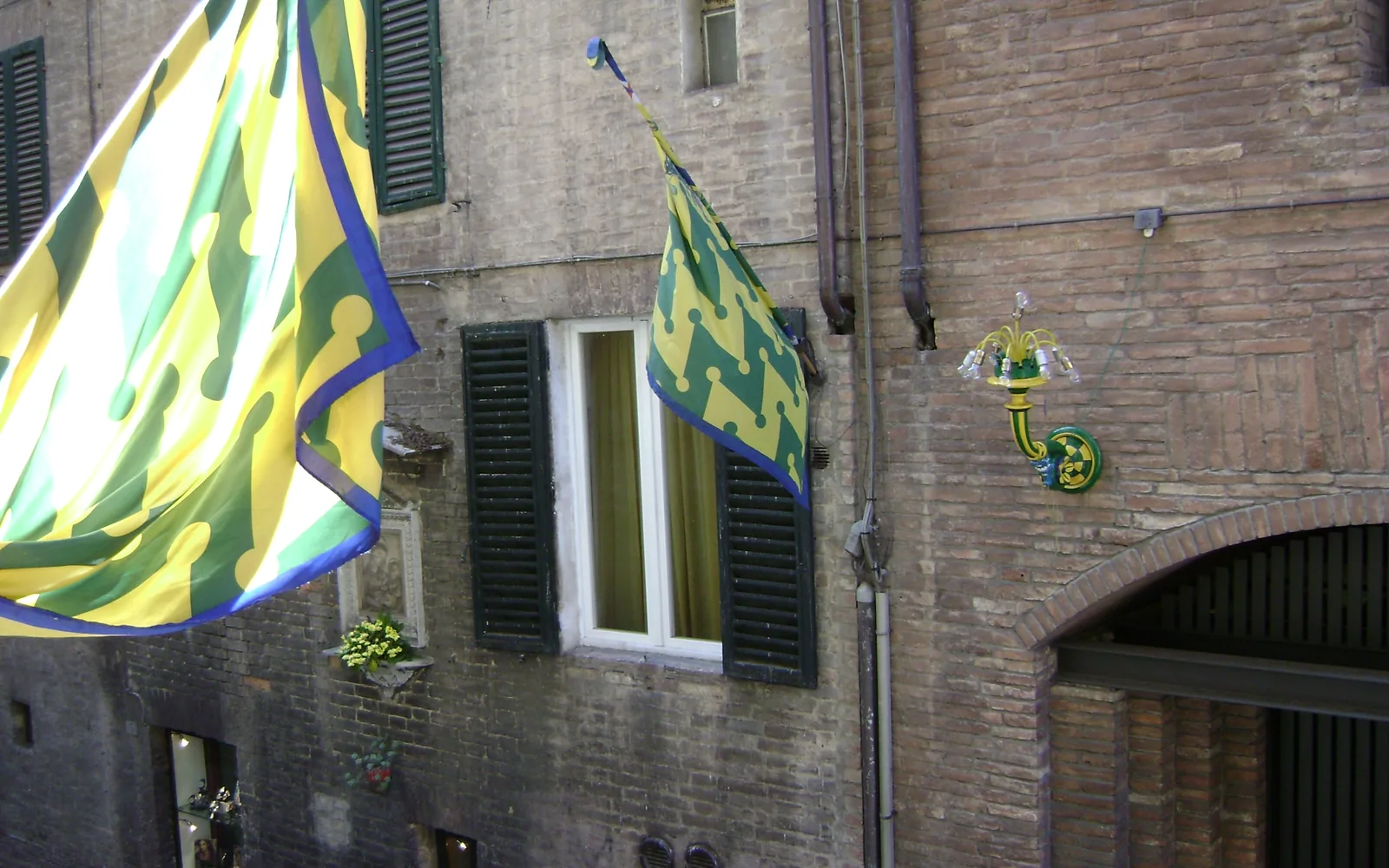
Each has an emblem and a livery, and the liveries are how you read the streets — the flags, the lamp brackets, the ceramic plaques on building corners.
| Contrada | Emblem | Colours |
|---|---|---|
| Aquila | Eagle | Yellow/gold with turquoise-blue and black |
| Bruco | Caterpillar | Yellow and green with turquoise-blue |
| Chiocciola | Snail | Red and yellow with dark turquoise-blue |
| Civetta | Crowned owl on a branch | Red and black with white |
| Drago | Flying dragon with a pennant bearing "U" | Old rose and green with yellow |
| Giraffa | Giraffe led by a Moor | Red and white |
| Istrice | Porcupine | White with red, black and blue arabesques |
| Leocorno | Unicorn | White and orange with blue |
| Lupa | She-wolf suckling Romulus and Remus | White and black with orange |
| Nicchio | Seashell with coral branches | Blue with red and yellow |
| Oca | Crowned goose with a Savoy collar | White and green with red |
| Onda | Crowned dolphin | White and light blue |
| Pantera | Rampant panther | Red and light blue with white |
| Selva | Rhinoceros at the foot of an oak | Green and orange with white |
| Tartuca | Tortoise | Yellow and blue |
| Torre | Elephant with a tower on its back | Crimson with white and blue |
| Valdimontone | Rampant crowned ram on a gold field | Red and yellow with white |
Two details worth having right, because both circulate wrongly. Valdimontone's ram stands on gold, not blue — blue appears only in the small upper-left canton carrying the crowned letter U, added in 1889 by authorisation of Umberto I. And Selva's motto is "Prima Selvalta in campo", from the contrada's older name Selvalta; the widely copied "Prima Selva in campo" is a corruption.
Eight titles, and what they were for
Eight contrade carry an honorific granted for a specific historical service; the other nine carry none.
Nobile: Aquila, Bruco, Nicchio and Oca. Priora: Civetta. Imperiale: Giraffa. Capitana: Onda. Sovrana: Istrice.
Most trace to medieval or early-modern events — the Nicchio's Nobile, for instance, was earned at Montaperti in 1260, the battle that made Siena the City of the Virgin. Civetta is Priora because it hosted the first meetings of the Comitato dei Priori in 1887, the body that became the Magistrato delle Contrade — the assembly of the seventeen Priors that still coordinates them. Istrice is Sovrana through the Order of Malta, whose Sienese seat and hospital have stood in Istrice territory since the fourteenth century.
And one that deserves a sentence rather than a gloss. Giraffa's Imperiale is not medieval: it comes from winning the Palio of 2 July 1936, which was dedicated to the proclamation of the Italian Empire — the Ethiopian conquest — and run before Vittorio Emanuele III. It is a Fascist-era honorific that the contrada still carries. Guides that translate it as "imperial" and move on are skipping the only interesting thing about it.
The six that died, and the story that did not happen
Siena once had far more contrade. Six are gone: Gallo, Leone, Orso, Quercia, Spadaforte and Vipera.
The story you will be told is that they were abolished by decree after disorder at the Palio of 1675. It is repeated confidently across enthusiast sites and guidebooks, and the documentary support for it is weak. The Sienese record shows these contrade already inactive before 1675: they faded through organisational weakness and withdrawal from civic life across the seventeenth century, and their disappearance was formalised only in 1729–30, when the boundary edict recognised seventeen and no more.
That is a duller story and a truer one, and it says something about how institutions actually end — not by decree, but by nobody turning up.
Their territory was absorbed by their neighbours. The Quercia went into the Chiocciola; the Spadaforte was divided between Leocorno and Torre; the Gallo's and Orso's streets were shared among Civetta, Selva and Oca.
But they are not forgotten, and this is the detail to watch for. All six still appear in the Corteo Storico, the procession before each Palio — each represented by a mounted knight carrying a lance, with a helm bearing the dead contrada's symbol. Siena has been walking its extinct districts through the Campo for three centuries.
Why the boundaries follow palaces, not streets
Contrada territory looks arbitrary on a map because it was not drawn on one.
Before the eighteenth century there was no rule governing where one contrada ended and the next began, and the resulting disputes were frequent and sometimes violent. The fix came from the city's governor, Violante Beatrice of Bavaria, whose Bando sopra la nuova divisione e riforma de' Confini delle Contrade settled the question — promulgated on 7 January 1730 by modern reckoning, and dated 1729 in Sienese usage, because Siena counted the year ab Incarnatione, from 25 March. Both dates are correct; sources using different ones are not contradicting each other.
The edict drew boundaries by naming palaces and their owners rather than by naming streets. That is why a boundary can run through the middle of a block, why one side of a doorway can be in a different contrada from the other, and why the plaques are on building corners rather than at junctions. It fixed the number at seventeen, and it is still the working instrument.
Its purpose was public order rather than sentiment. What it produced, three centuries later, is a city where a five-minute walk crosses three sovereignties.
Rivalries: seven pairs, and one that only runs one way
This is where travel writing romanticises hardest, so here is what is officially recognised rather than what makes a good paragraph.
There are seven official pairs of rival contrade, recognised on the Palio's own official channels — not folklore, not a journalistic invention. Among them: Oca and Torre, Istrice and Lupa, Aquila and Pantera.
Torre is the only contrada with two enemies — Oca and Onda.
And the Onda–Torre rivalry runs in one direction only: Onda regards Torre as its enemy, and Torre does not reciprocate the recognition. Being someone's rival without their agreement is, if you think about it, worse than mutual hatred.
Four contrade have no official rival at all: Drago, Giraffa, Bruco and Selva.
Because only ten of seventeen run each race, a rivalry can be live (both present), one-sided (one racing, one watching) or, in the Sienese phrase, frozen — both enemies absent, nothing to settle. It is entirely possible for a contrada to regard stopping its rival as the better outcome than winning, and that logic shapes the race in ways an outsider watching for speed will not see.
How the contrade meet the Palio
Ten of the seventeen run in each Palio, on 2 July and 16 August. The rest watch — from their own territory, which is a different experience from watching as a visitor.
The mechanics of who runs, how horses are assigned, and what the four days actually contain are a separate subject, and we cover them in our Palio di Siena guide — including the honest case for choosing a different week.
What belongs here is the consequence: a contrada's year is organised around a race it may not be in. That is the part that makes no sense from outside and complete sense from inside.
Visiting a contrada museum — how it actually works
This is the section we most want you to read, because the common advice is wrong in a way that wastes an afternoon.
Every one of the seventeen contrade has its own museum, generally alongside its oratory and its società. They hold the drappelloni the contrada has won, the masgalani, old and new monture — the procession costumes — antique banners, sacred furnishings and works of art. The finest room is always the Sala delle Vittorie, which frequently doubles as the hall where the contrada's General Council meets.
They open by prior reservation with the individual contrada. That is the official position, and the practical consequences follow from it:
- There is no drop-in. Turning up at a contrada's door on the day will usually find it locked.
- There is no combined or city-wide ticket. Each contrada manages its own museum independently.
- There is no central booking desk at the Comune or the tourist office that will arrange it for you. You contact the contrada.
- Admission is generally free or by voluntary donation rather than a fixed charge — which makes the reservation, not the money, the barrier.
- A few contrade publish limited opening hours — the Leocorno's museum is one — but these are the exception and are commonly afternoon-only, with mornings and Sundays still by appointment.
- Commercial walking tours that include a contrada museum exist, and for a visitor with two days and no Italian they are the pragmatic route in. Guided visits arranged directly with a contrada are often in Italian, with English by request.
So the honest advice is: decide before you travel. If a contrada museum matters to you, write to one a week ahead, or book a tour that includes one. If you only realise you want it on the second morning, take the flags and the streets instead — which cost nothing and are always open.
Walking the territories
You do not need a museum to see the system working. The observable layer is free and continuous.
Look for the plaques on building corners carrying a contrada's arms — that is the boundary, and it is why the marker is on a wall rather than at a crossroads. Look up for the lamp brackets and flag holders in contrada colours. And find the fountains: each contrada has its own fontanina, the baptismal fountain where new members are received into the contrada in a lay ceremony of its own.
From the Campo, walking uphill toward the cathedral and back down the far side will cross several territories inside an hour, and the change of colours as you pass a corner is the whole point made without a word. Our Siena walking tour covers the route; the one-day itinerary fits it around the ticketed sights.
How to be a good visitor
Two facts established above do most of the work here, and they are better guidance than any list of tips.
First, a contrada is a legal person, not a theme. It owns property, elects officers, holds assemblies and buries its members. Its museum is private property opened by invitation; its società is a members' club. Approaching any of it as a public amenity is the error, and it is a category error rather than a rudeness.
Second, membership is not chosen the way a football club is. It runs through birth in the territory and through family, and where adults do join by affinity it is a commitment confirmed over time. That is why announcing that you have "picked" a contrada for the week lands badly: it is not that you have picked the wrong one, it is that picking is not the mechanism.
Beyond that, the ordinary courtesies apply and are enough: ask before photographing people, do not walk through a procession, and treat a rivalry as something to be curious about rather than to joke about with someone who lives inside it.
What we could not establish
An unusual section, but this subject is unusually badly served by confident writing, and we would rather show you the edge of what we checked.
- Membership numbers. There is no current census of contradaioli. The last city-wide figures date from 1954, and contrada officials have said publicly that a comprehensive count would be very hard to conduct. Any total you see quoted should be treated as an estimate.
- The full list of seven rival pairs. We verified that seven officially recognised pairs exist and confirmed several of them; we did not enumerate all seven from a primary source in this session.
- Each contrada's patron saint and titular feast date. These govern when a contrada baptises and celebrates, and we could not assemble a reliable list.
- The contrada baptism in detail — who officiates, how often it is held, and the claim that the Chiocciola revived the rite in 1949 and the practice then spread. Widely repeated; not confirmed here.
- Each contrada's own stable arrangements. We could not establish how individual contrade house and care for a horse during Palio week. The city-wide veterinary regime, the reforms since 1991 and the fatality record are now covered in our Palio guide.
How we checked these details
Checked 16 August 2026, by web research; direct page fetches are blocked in our environment, so this rests on search-surfaced material rather than pages we opened.
Verified against the Comune di Siena and the official Palio channels: the seventeen contrade and their names; their distribution across the three terzi; the emblems and colours listed above, including the Comune's own description of Valdimontone's arms as a rampant crowned ram on a gold field with the crowned letter U on blue in the upper-left canton, authorised in 1889; the eight honorific titles and which contrade hold them; Civetta's Priora title deriving from its hosting of the first Comitato dei Priori in 1887, the body that became the Magistrato delle Contrade; Istrice's Sovrana title through the Order of Malta's Sienese seat since the fourteenth century; Giraffa's Imperiale title deriving from the Palio of 2 July 1936 dedicated to the proclamation of the Italian Empire; the six extinct contrade, the absorption of their territories, and their continuing representation in the Corteo Storico by mounted knights; the Bando of Violante Beatrice of Bavaria promulgated 7 January 1730 modern style and 1729 Sienese style under the ab Incarnatione calendar, its fixing of the number at seventeen and its definition of boundaries by named palaces and owners; the existence of seven officially recognised rival pairs, Torre as the only contrada with two enemies, the unilateral character of the Onda–Torre rivalry, and Drago, Giraffa, Bruco and Selva having no official rival; that ten of seventeen run each Palio; and that every contrada has a museum, that the museums open by prior reservation with the individual contrade, and that their principal room is the Sala delle Vittorie holding drappelloni, masgalani, monture, banners, sacred furnishings and artworks.
Corrected during checking: Selva's motto, which the contrada and the official Palio site give as "Prima Selvalta in campo" rather than the widely copied "Prima Selva in campo"; Valdimontone's shield, commonly described as blue when the field is gold; and the 1675 dissolution story for the six extinct contrade, which the Sienese documentary record does not support — those contrade were already inactive before that date.
Sourced to visitor-information and commercial channels rather than official ones, and flagged as such: that admission to contrada museums is generally free or by donation; that a small number of contrade publish limited afternoon opening hours; and that commercial walking tours including a contrada museum are available. Confirm access arrangements with the contrada itself before travelling.
We have no commercial relationship with any contrada, with the Comune di Siena, or with any tour operator. No booking made from this page pays us anything, and no tour is recommended.
Final thoughts
The contrade are the reason Siena feels different from every other beautiful Tuscan hill town, and the reason is not pageantry. It is that a medieval territorial settlement — palaces named in a 1730 edict — is still the live organising fact of people's social lives, their marriages, their funerals and their arguments.
You will not get inside that in three days, and the attempt is what goes wrong. What you can do is learn to read the corners, notice when the colours change, understand that the four contrade with no enemy are not the friendly ones but the unallocated ones, and accept that the most interesting thing in the city is not open to you. Siena is unusually good at being looked at without being consumed. Let it.