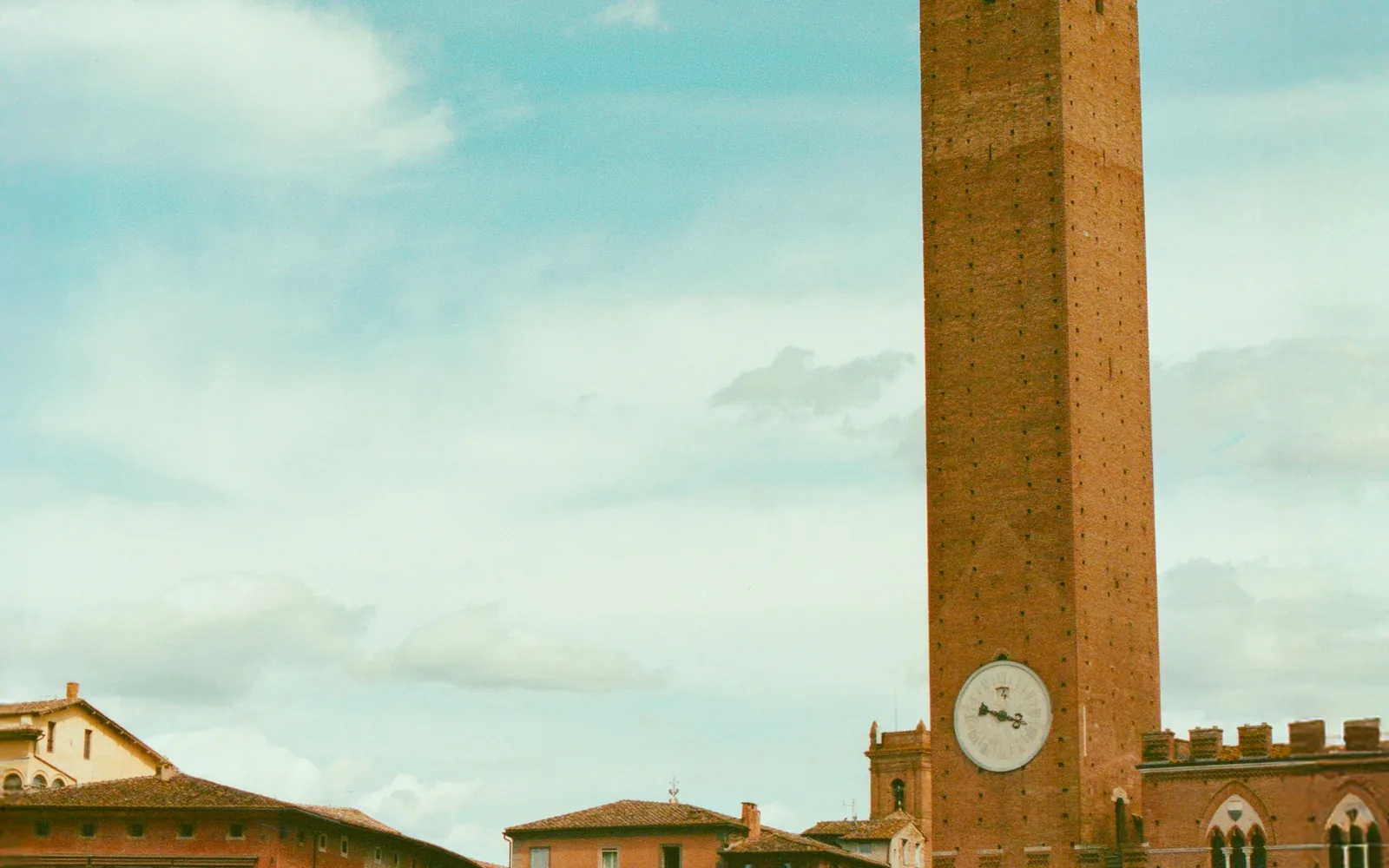
Torre del Mangia: Tickets, the No-Booking Rule and the 25-Person Cap
The Torre del Mangia cannot be booked online, admits 25 people every 45 minutes, closes its ticket counter before the museum shuts, and — on a combined ticket — insists you climb before you visit anything else. This guide sets out the 2026 prices, the rules that wreck Siena afternoons, who the Comune advises not to climb, and when the Facciatone is the better view anyway.
The Torre del Mangia is the climb everyone photographs from below and a surprising number never make. Not because it is sold out in the way Florence's museums are, but because of two rules that almost no guide states plainly — and that quietly wreck a lot of Siena afternoons.
Quick answer
You cannot pre-book it. Tickets that include the tower are not bookable online and are sold only at the Museo Civico and Torre del Mangia ticket office in the Palazzo Pubblico. Every "skip the line Torre del Mangia" offer you find elsewhere is selling you something else.
Ascents run every 45 minutes for a maximum of 25 people. That is roughly 25 people per slot, twelve slots a day in summer. On a busy afternoon the next available slot can be hours away, and it is allocated at the counter, not by an algorithm.
And the rule that ruins itineraries: if you buy a combined ticket, your first entry must be at the tower. Museum first, tower second is not permitted. Plan the day around the tower slot and fit the Museo Civico around it.
The move: go to the ticket office early — before 10:00 if you can — buy the €15 Museo Civico + Torre combination, take the earliest slot offered, and see the Lorenzetti frescoes afterwards. If the slots are gone or the weather is wrong, the Facciatone is a genuine substitute and is covered below.
The 2026 prices
Published by the Comune di Siena and checked on 16 August 2026. Note that the booking surcharge exists only on tickets that do not include the tower — because tower tickets cannot be booked at all.
| Ticket | Price | Notes |
|---|---|---|
| Torre del Mangia only | €10.00 | Ticket office only |
| Torre del Mangia, family | €25.00 | 2 adults + minors aged 11–18 |
| Museo Civico only | €10.00 | €11.00 with booking |
| Museo Civico + Torre del Mangia | €15.00 | Valid 1 day; not bookable |
| Museo Civico + Santa Maria della Scala | €14.00 | Valid 2 days; €15.00 with booking |
| Museo Civico + Santa Maria della Scala + Torre | €20.00 | Not bookable |
The €15 combination is the obvious buy. The tower alone is €10 and the museum alone is €10; together they are €15, so the museum effectively costs five euro. The Museo Civico holds Ambrogio Lorenzetti's Allegory and Effects of Good and Bad Government — the most important secular painting cycle to survive from medieval Europe, painted in the room where the men it was lecturing actually sat. Five euro is not a price for that. It is a rounding error.
The €20 triple adds Santa Maria della Scala across the piazza from the cathedral — the vast former hospital that is the most underrated building in Siena. If you have a full day, take it.
The three rules that catch people out
1. No booking, ticket office only
Tickets including the tower are not reservable and are sold exclusively at the Museo Civico and Torre del Mangia ticket office. There is no official online slot release, no timed-entry email, no app.
The practical consequence: your position in the day is decided by when you physically arrive at the counter. This is unusual enough in 2026 that visitors assume they have simply failed to find the booking page. They have not. It does not exist.
2. On a combined ticket, the tower comes first
The Comune's own condition is explicit: where a combined ticket is purchased, the first entry must be made at the Torre del Mangia. You cannot spend two hours in the Museo Civico and then climb.
This inverts the instinctive order — most people want to do the indoor thing first and save the view for late light — and it is the single most common reason a Siena afternoon collapses. Build the day the other way round.
3. Twenty-five people, every forty-five minutes
Ascents are released in slots of 45 minutes with a cap of 25 people. In the summer season the published ascent times are 10:00, 10:45, 11:30, 12:15, 13:00, 13:45, 14:30, 15:15, 16:00, 16:45, 17:30 and 18:00.
Twelve slots at twenty-five people is a ceiling of about three hundred climbers a day. Siena receives many multiples of that in high season. The arithmetic is the whole story: this is a scarce ticket that behaves like an unscarce one, because nothing warns you until you are at the counter.
Who should not climb, stated as the Comune states it
The official warnings are firmer than the cheerful tone of most travel writing about this tower, and they deserve repeating without softening.
The climb is strongly advised against for people with heart conditions, respiratory illness, claustrophobia, vertigo or diabetes, for pregnant women, and generally for anyone in poor health. Children under 14 may climb only accompanied by an adult.
There are around 400 steps and no lift. The stairway narrows as it rises, the final sections are enclosed and steep, and there is no way to turn back easily once a group is moving — twenty-five people on a spiral staircase means the person behind you decides your pace as much as you do. Claustrophobia is on that list for a reason.
The tower closes in bad weather, and for restoration and maintenance. A wet or windy morning is not a "we will see when we get there" situation; it is a closed tower.
Torre del Mangia or the Facciatone?
Siena has two great climbs and almost nobody compares them properly, so here it is.
Torre del Mangia — €10, or €15 with the museum
You climb out of the Campo and look down into it. That is the decisive difference: the Torre is the only place you see the shell shape of the Piazza del Campo as a shape, with the paving's nine segments legible below you and the whole city fanning out beyond. It is the view Siena is famous for from the inside.
Against it: 400 steps, no lift, the health restrictions above, no booking, capped slots, weather closures.
The Facciatone — included in the OPA SI Pass
The panorama from the unfinished façade of the "New Cathedral" is included in the OPA SI Pass (€13, or €15 while the marble floor is uncovered), so if you were buying that pass anyway the view costs you nothing extra. It is a shorter climb, and it delivers the one thing the Torre cannot: a view with the Torre del Mangia in it. From up there you also stand on the wall of the cathedral Siena started and never finished after the Black Death — the view and the history are the same object.
Against it: it is a narrow terrace, it can feel exposed, and it does not give you the Campo from directly above.
The honest verdict
If you can only do one and you are fit: the Torre. The Campo from above is the memory people keep.
If you are buying the OPA SI Pass anyway, or the tower's restrictions apply to you, or it is raining: the Facciatone, without regret. It is not a consolation prize — several people who do both prefer it, because a photograph of Siena is better with the tower in it than taken from the tower.
If you have a full day: do both, in that order, and notice that each one contains the other.
What you see from the top
The reason the climb is worth its complications is directly below you, and it is a piece of design rather than a view.
The Campo reads as a diagram from up there. The paving — laid between 1327 and 1349 in knife-shaped red brick — is divided by ten lines of white travertine into nine segments, all converging on the Palazzo Pubblico beneath your feet. The nine are the Governo dei Nove, the merchant oligarchy that ran Siena from the 1280s to the 1350s and commissioned most of what you have come to see; the same nine folds are read as the folds of the Virgin's cloak, Siena's patron and, in the city's own account of itself, its actual sovereign. At ground level it is a handsome slope. From 87 metres it is a government explaining itself in brick.
The cathedral sits at eye level, and that is the point. The tower was raised to match the height of the Duomo's campanile — civic authority and church authority at the same altitude, which in a fourteenth-century city-state was a position rather than a coincidence. Look left of the cathedral and the Facciatone stands there too: the wall of the enormous new cathedral Siena began in the 1330s and abandoned after the plague, with people on top of it looking back at you.
Beyond the roofs, the contrade. Siena's seventeen districts are not neighbourhoods on a map so much as territories, and from above you can follow the ridgelines the city is built along and see how the tiled roofs break into separate quarters down each spur. Our contrade guide explains what you are looking at; the tower is the only place you can see the whole system at once.
And then the countryside starts, immediately. Siena has no suburbs to speak of in the medieval direction — the walls end and the hills begin. On a clear day that abruptness is the most surprising thing about the view, and the best argument for climbing in the morning before the haze sets in.
Hours, seasons and the Palio
Published hours for the Museo Civico, checked 16 August 2026:
- Summer, 1 March to 31 October: 10:00–13:45 and 14:30–19:00, with the ticket office closing at 18:15.
- Winter, 1 November to 28 February: 10:00–13:00 and 13:45–16:00, with the ticket office closing at 15:15.
Read the ticket-office time, not the closing time. Arriving at 18:00 in July means the museum is open and the counter is about to shut — and since the tower cannot be bought anywhere else, a closed counter is a closed tower.
Winter shortens the day severely. A 15:15 ticket-office cut-off means a winter visitor who lunches slowly has lost the tower entirely. In November to February, do the climb in the morning.
Palio periods change everything. The Palio runs on 2 July and 16 August, and the Campo is transformed for days around each race — track laid, stands built, the piazza closed to ordinary use. The Comune publishes special Museo Civico and Torre opening hours for those periods. If your dates fall in late June, early July or mid-August, treat the standard schedule above as not applying and check the announcements for your day.
What you are actually climbing
The tower went up between 1338 and 1348 — finished, in other words, in the year the Black Death reached Siena and ended the city's century. It stands about 87 metres, or 102 counting the lightning rod, built in brick with the upper section in travertine, the work of the Sienese sculptor Agostino di Giovanni to a design attributed to Lippo Memmi, on a tower built by the brothers Francesco and Muccio di Rinaldo.
It was built deliberately to match the height of the cathedral's campanile — civic power and church power at the same altitude, which in a fourteenth-century Italian city-state was an argument rather than an aesthetic choice. Standing at the top with the Duomo at eye level is the argument still being made.
The name is a joke that stuck. The first bell-ringer, Giovanni di Balduccio, was nicknamed il mangiaguadagni — the earnings-eater — for spending his wages on food. Seven hundred years later Siena still calls its most famous building after a man who was bad with money.
The great bell at the top, the Campanone or Sunto — dedicated to Mary of the Assumption — was installed in 1666 after several failed castings. It is rung for the Palio, and if you are on the stairs when it sounds you will not forget it.
Fitting it into a day in Siena
The Torre sits in the Piazza del Campo, which means it is three minutes from almost everything and the temptation is to treat it as a drop-in. Do not. It is the one sight in Siena whose availability is decided before 11:00.
A workable order for a full day: ticket office at opening, tower slot, Museo Civico, lunch away from the Campo, cathedral complex in the afternoon on the OPA SI Pass with the Facciatone at the end for the light. Our one day in Siena itinerary lays out the walking, and the day trip versus overnight comparison is worth reading first if you are arriving from Florence — a day-tripper who reaches the ticket office at noon has usually already lost the tower.
How we checked these details
Checked 16 August 2026, by web research against the Comune di Siena's and the Museo Civico's published material; direct page fetches are blocked in our environment, so this rests on search-surfaced official content rather than pages we opened.
Verified: the Torre del Mangia single ticket at €10.00 and the family ticket at €25.00 for two adults plus minors aged 11–18; the Museo Civico at €10.00 (€11.00 with booking) and its €4.50/€5.50 reduced rates; the combined tickets at €15.00 (Museo Civico + Torre, one day), €14.00/€15.00 (Museo Civico + Santa Maria della Scala, two days) and €20.00 (all three); the rule that tickets including the tower are not bookable and are sold only at the Museo Civico and Torre del Mangia ticket office; the condition that on a combined ticket the first entry must be at the tower; ascents every 45 minutes capped at 25 people, with the summer ascent times of 10:00 through 18:00 as listed; approximately 400 steps and no lift; the official warnings against climbing for those with heart, respiratory, claustrophobia, vertigo or diabetes conditions, for pregnant women and for anyone in poor health, and the requirement that under-14s be accompanied; closure in bad weather and for restoration and maintenance; the summer hours of 10:00–13:45 and 14:30–19:00 with the ticket office closing at 18:15, and the winter hours of 10:00–13:00 and 13:45–16:00 with the office closing at 15:15; and the existence of special published Museo Civico and Torre hours around the Palio. The tower's construction between 1338 and 1348, its height of about 87 metres (102 with the lightning rod), its builders Francesco and Muccio di Rinaldo, the travertine upper section by Agostino di Giovanni to a design attributed to Lippo Memmi, the mangiaguadagni nickname of the first bell-ringer Giovanni di Balduccio, and the 1666 installation of the Sunto bell were checked against regional tourism and reference sources, as were the Campo's paving dates of 1327–1349, its division by ten travertine lines into nine segments, and the reading of those nine as both the Governo dei Nove and the folds of the Virgin's cloak.
Flagged as unconfirmed: the winter ascent timetable, which we could not retrieve in the same detail as the summer list; whether the published Museo Civico midday break applies to the tower's own ascent schedule, which shows no gap; the exact Palio-period hours for 2026, which the Comune publishes close to each race; and reduced or free entry categories for the tower specifically. The Facciatone pricing comes from the Opera del Duomo's OPA SI Pass and is documented in our cathedral ticket guide, including the ticketing restructure the Opera made in March 2026.
We have no commercial relationship with the Comune di Siena, the Museo Civico or any ticket seller. No booking made from this page pays us anything, and no reseller is recommended — which matters here more than usual, because the tower cannot legitimately be pre-booked at all.
Final thoughts
Almost everything that goes wrong at the Torre del Mangia goes wrong before anyone reaches the stairs. The ticket cannot be booked, the counter shuts earlier than the museum, the slots are capped at twenty-five, the combined ticket makes you climb first, and rain closes it outright.
None of that is difficult once you know it. Arrive at the ticket office when it opens, take the first slot you are offered, and the rest of the day arranges itself around a climb that is worth arranging a day around. And if the tower says no — wrong weather, wrong health, wrong hour — walk up to the Facciatone instead and photograph the tower from the cathedral it was built to rival.