Where to Eat in Siena: The Map, Not the List
Individual restaurants change hands, chef and quality faster than any guide can track. The geography does not. This page maps Siena's eating by street — the three arms running off the Croce del Travaglio, what the Campo terraces actually buy you, and how far you have to walk before prices and crowds break.
This page does not list restaurants. Individual places change hands, change chef and change quality faster than any guide can track, and a list is the least durable thing anyone can give you about a city.
What does not change is the geography — which streets carry which kind of eating, what you are paying for on the Campo, and how far you have to walk before prices and crowds break. That is a map you can still use in five years, and it is what this page is.
Quick answer
The eating map follows the same Y as the street plan. Three arms run off the Croce del Travaglio above the Campo, and each has a different character: Via di Città toward the cathedral is the smart, visitor-facing arm; Banchi di Sotto and the lanes off it are the closest thing to everyday Siena within two minutes of the square; Banchi di Sopra running north toward Camollia is where the city stops performing.
The rule that does most of the work: two streets. Prices fall and quality rises within about two streets of the Campo. That is not a slogan — it is what the rent map does, and it holds in almost every direction.
For the mechanics — the coperto, why your bill exceeds the menu, when the kitchen is actually open, and why the same coffee costs more at a table — see our companion guide, how eating out works in Siena. This page is where; that one is how.
The Campo: what you are actually buying
The terraces around Piazza del Campo charge a multiple of the same drink two streets away, and that is a legitimate transaction rather than a scam. You are renting an hour in one of the great rooms of Europe, in a square that slopes toward the Palazzo Pubblico with the Torre del Mangia throwing its shadow across the brick.
Do it once, deliberately, at the hour you most want to be there — the hour before sunset is the one. Read the price list before you sit, because table service and terrace surcharges are normal and legal, and the difference between standing at the bar and sitting outside is real money.
What not to do is eat a full meal there by default. The kitchens on a square that never lacks customers are not under the pressure that makes restaurants good, and the two-street rule has never been easier to apply: you are, by definition, two streets from everywhere.
And you cannot picnic on the Campo. A municipal ordinance running to 30 September 2026 prohibits consuming food on the square in front of the Palazzo Pubblico, with sanctions to €480. Sitting is fine; the sandwich is not.
The three arms, and what each is for
Via di Città — the smart arm
West and uphill from the Croce del Travaglio toward the cathedral. Historically Via Galgaria, after the shoemakers and leather workers, and still the most elegant of the three streets: palazzi, specialist shops, and eating that is generally polished and generally priced for people on their way to the Duomo.
Use it for: a good coffee mid-walk, food shops worth going into, and lunch when your day is built around the cathedral complex and you do not want to lose twenty minutes walking.
Be aware: this is the arm with the most through-traffic of visitors in the city, and prices reflect it. The lanes dropping off it to the south lose the crowd within a minute.
Banchi di Sotto and Via del Porrione — the closest real food
East from the junction, along the Terzo di San Martino. Via del Porrione runs parallel to the Campo just behind it and is the single most useful street on this page: you are metres from the square and already out of its pricing.
Continue east and the street becomes Via dei Pispini, which carries osterie serving a more local room the further out you go. This is the direction that rewards walking the most per minute spent.
Use it for: lunch or dinner when you want Sienese cooking without a project. If you have one meal in Siena and no research time, walk out of the Campo on this side.
Banchi di Sopra toward Camollia — where the city stops performing
North from the junction along the Terzo di Camollia, past the smart shopping stretch and out along Via di Camollia, with Via dei Rossi running off it. Both carry trattorie aimed at people who live here.
This is furthest from the Campo — fifteen minutes rather than two — and it is the arm where an evening feels least like a visit. It is also, not coincidentally, the side the 131R bus from Florence arrives on, so it is the natural dinner direction if you are staying near Porta Camollia.
Use it for: a second or third evening, when you have stopped trying to see things and started trying to be somewhere.
Below the Campo: Piazza del Mercato
Behind the Palazzo Pubblico, reached in three minutes from the shell. The square is largely a car park and looks like nothing, and then the land falls away and you are looking at open countryside from inside a city.
It is worth knowing for two reasons: there is eating around its edges that is priced for a working square rather than a monument, and it is the gateway down to the Orto de' Pecci, the walled garden below the city — which is where your picnic goes, now that the Campo is out.
What to actually order
Siena's own dishes rather than the general Tuscan repertoire:
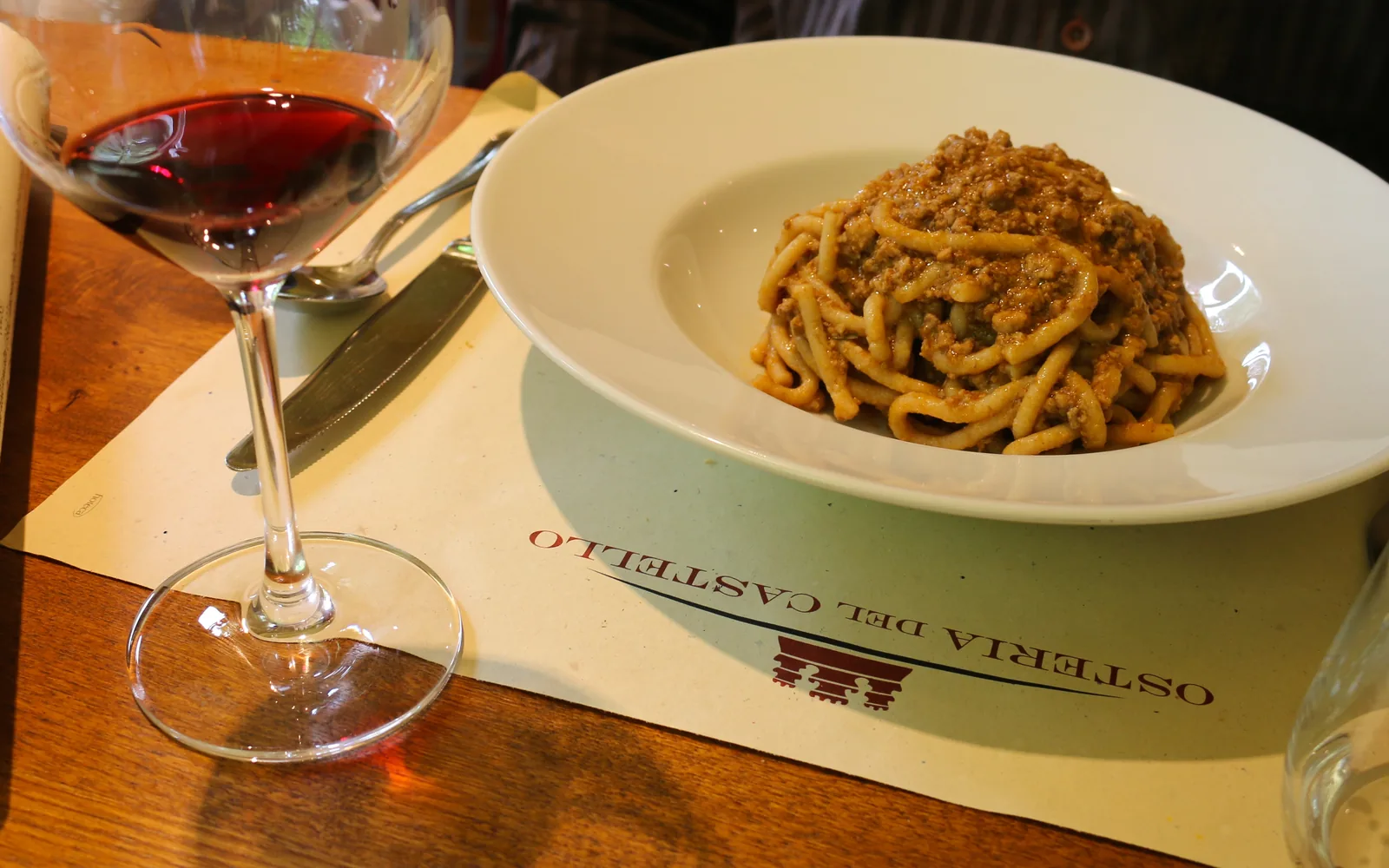
- Pici — thick hand-rolled pasta, the city's signature. Usually served all'aglione (a slow garlic and tomato sauce) or with a wild-boar or duck ragù. If you eat one thing in Siena, this is it.
- Pecorino — the sheep's cheese of the hills south of here, at several ages. A cheese course is not an afterthought in this province.
- Cinta Senese — the belted Sienese pig, a local breed, in salumi and roasts.
- Ribollita and pappa al pomodoro — the bread soups, better in cold months and genuinely different from their summer selves.
- Panforte and ricciarelli — Siena's own sweets, sold everywhere and best from a proper pasticceria rather than a souvenir shop.
What is worth eating shifts across the year, and our Tuscan food calendar maps the dishes to the months — including the September and October arrivals that make autumn the best eating season here.
Picnics, markets and eating without a restaurant
A picnic is often the better lunch in Siena: it costs a fraction, it frees the middle of the day, and the alimentari and bakeries do the work for you.
Where to buy: the food shops along Via di Città and the smaller alimentari on the Camollia arm, plus the bakeries for schiacciata.
Where to eat it — and this matters now: not on the Campo. The Orto de' Pecci below the walls and the Fortezza Medicea ramparts on the north side are the two obvious places, both free, both with a view, both a few minutes' walk.
Where to eat, by situation
The map above answers "which street". This answers "which street for me".
| Your situation | Walk | Why |
|---|---|---|
| Day trip, 90 minutes, fixed return bus | Via del Porrione, behind the Campo | Real cooking two minutes from the square; no walking budget spent |
| One dinner, want it to feel like Siena | Via di Camollia / Via dei Rossi | Fifteen minutes out, and the room stops being for visitors |
| Lunch built around the cathedral | Lanes dropping south off Via di Città | Keeps you on the uphill arm but loses the through-traffic in a minute |
| With children, needing speed and space | Piazza del Mercato edges, or a picnic at the Orto de' Pecci | Room to sit, no formality, and an escape hatch if patience runs out |
| The one deliberate splurge on the view | A Campo terrace, hour before sunset | You are buying the room, not the kitchen — and it is worth buying once |
| Arrived late, everything looks shut | Banchi di Sopra toward Camollia | The least visitor-dependent arm, so the least likely to have closed early |
What to drink, and where
Siena sits at the centre of one of the most concentrated wine regions in Italy, and the four names worth knowing are all within an hour of the city.
- Chianti Classico — the zone that begins immediately north of Siena, marked by the Gallo Nero, the black rooster. This is the house wine of the city in the literal sense.
- Brunello di Montalcino — south, from the slow-ripening Sangiovese Grosso. The expensive one, and the one to order by the glass rather than the bottle unless the evening is the occasion.
- Vino Nobile di Montepulciano — south-east, and consistently the best value of the three reds on a Sienese list.
- Vernaccia di San Gimignano — west, and the answer when someone at the table does not want red.
Where: an enoteca rather than a restaurant if tasting is the point — you get range by the glass and someone to ask. Restaurants along the Camollia arm tend to price wine for people buying it weekly rather than once. If you want to see where any of it comes from, our Chianti versus Val d'Orcia comparison is the decision behind the day trip.
And breakfast, which surprises people
Italian breakfast is small and standing: a cornetto and a coffee taken al banco at a bar, in about seven minutes. It costs a fraction of a hotel buffet and it is what the street around you is doing.
The one thing worth knowing is the pricing rule that catches visitors everywhere in Italy — the same coffee costs more at a table than at the counter, legally and openly. That, and the rest of the bill mechanics, are in the companion guide.
Timing: the part that decides whether you eat at all
Geography gets you to the right street. Timing gets you fed.
- Kitchens keep hours. Italian restaurants do not serve food all day. Arrive at 15:30 hoping for lunch and you will get a sandwich at best — the mechanics are covered in the companion guide, and they are the single most common way visitors go hungry.
- Most places close one day a week, and Sunday evening and Monday are the common ones. On a short stay, check before walking across town.
- Day-trippers eat in the worst window. Coach arrivals concentrate lunch between 12:30 and 14:00 on exactly the streets nearest the Campo. Eat at 12:00 or 14:15 and the same street is a different place.
- Aperitivo runs early evening, and it is the cheapest way to sit somewhere good. It is also the hour the Campo is most worth paying for.
If you are visiting on a single day from Florence, this timing question is most of your food planning — our day trip versus overnight comparison covers what a fixed return bus does to an evening, which is: ends it.
When the city eats differently
Two periods break every rule above, and both catch people out.
Palio week. Around 2 July and 16 August the contrade set long tables through their own streets for members' dinners, restaurants near the Campo book out, and parts of the centre are given over to the race. The food is not the problem — the availability is. Book anything you care about well ahead, expect the streets nearest the track to be unusable, and read our Palio week guide for what closes and when. The tables in the street are members' events, not open sittings.
August ferie. Italian businesses take holidays in August, and family-run places — precisely the ones this page sends you toward on the Camollia and Pispini arms — are the most likely to shut for a fortnight. A chiuso per ferie sign on the door of the trattoria you walked twenty minutes for is the classic August disappointment. In August, check before you walk, and treat the busier visitor-facing arms as the reliable ones for once.
The inverse is worth saying too: from mid-September the city is at its best for eating. The kitchens are back, the day-trip volume has fallen, the autumn produce arrives, and the streets this page recommends stop being a trade-off against convenience.
Two things this page will not do
It will not name restaurants. Not from caution but from usefulness: a named list is the fastest-decaying content in travel writing, and recommending a kitchen we have not eaten in this year would be a worse service than the map above. Read current reviews for individual places, and use this page to decide which street to read them on.
And it will not tell you the contrada dinners are open to you. The long outdoor tables you may see set up in a street belong to a contrada and are its members' event, not a supper club. Watching from a respectful distance is fine; assuming a seat is not.
How we checked these details
Checked 16 August 2026, by web research; direct page fetches are blocked in our environment, so this rests on search-surfaced material rather than pages we opened.
Verified: the three-street structure meeting at the Croce del Travaglio and the terzi they serve; Via di Città's former name Via Galgaria and its trade origin; the presence of trattorie and osterie along Via del Porrione, Via dei Pispini, Via di Camollia and Via dei Rossi, from Italian business directories; and the municipal ordinance running to 30 September 2026 that prohibits consuming food on Piazza del Campo in front of the Palazzo Pubblico, with sanctions from €50 to €480.
The four wine denominations named — Chianti Classico and its Gallo Nero mark, Brunello di Montalcino, Vino Nobile di Montepulciano and Vernaccia di San Gimignano — are consistent with our existing regional coverage. Deliberately not claimed: the quality or current standing of any individual restaurant on any of these streets — we have not eaten in them, and the directories that list them do not assess them. Price levels are described comparatively rather than in figures, because we could not verify a current average cover for each area. The two-street rule is a pattern we describe as such, not a measured finding.
We have no commercial relationship with any restaurant, bar or food business in Siena, and none has been recommended. No booking made from this page pays us anything.
Final thoughts
The single decision that most changes what you eat in Siena is not which restaurant you pick. It is which direction you walk out of the Campo, and how far.
Two streets is enough to change the price. Ten minutes is enough to change the room. And an evening on the Camollia arm, at a table where nobody is speaking English and the kitchen closes when it closes, is the meal people remember — not because it was the best food in Tuscany, but because it was not staged for them.