Bagno Vignoni & Bagni San Filippo: The Val d’Orcia Hot Springs, Finally Explained
Can you actually bathe at Bagno Vignoni? What does Bagni San Filippo cost? The Val d’Orcia hot springs answered honestly — rules, prices and access.
In this guide
- Quick answer
- Bagno Vignoni: the village where the piazza is a pool
- Where you can get in the water at Bagno Vignoni — and the fine print
- The paid option: Bagno Vignoni’s spa hotels
- Bagni San Filippo: the free one that delivers
- The Bagni San Filippo ticket question, honestly
- Getting there: the bus truth and the driving option
- When to go — the counterintuitive answer
- How we checked these details
- Final thoughts
- FAQ
Quick answer
Half the internet says you can bathe in the Val d'Orcia's hot springs for free; the other half says you cannot. Both halves are quoting fragments of the truth, so here is the whole of it, checked and dated.
Bagno Vignoni: you cannot bathe in the famous square. The steaming Renaissance basin that fills the village's central piazza is view-only — and has been for good reason for a long time. What you *can* do: soak your feet in the warm channels of the free Parco dei Mulini below the village, or pay for a proper thermal pool at one of the village's spa hotels.
Bagni San Filippo: yes, you can bathe — in the right places. The Fosso Bianco woodland stream with its white calcium-carbonate cascades is free, open year-round and genuinely bathable, hottest near the source and cooler downstream. The two things you must not do: climb on the great Balena Bianca formation, or slip past fences into the closed Bollore area above the village. A modest entry charge has come and gone in recent seasons — carry a couple of euros and expect either outcome.
Both are weekday, wheels-favoured trips. The bus from Siena along the Abbadia San Salvatore corridor serves both, thinly; Sundays are effectively car-only. Everything below is the detail: the history, the rules with their fines, the spa prices, the parking, and the honest state of every claim we could not fully pin down.
Bagno Vignoni: the village where the piazza is a pool
Bagno Vignoni's centre is unlike anywhere else in Tuscany: where a village square should be, there is a great stone basin of steaming water, fed by a spring that has drawn bathers since Roman times. The basin in its present form dates to the sixteenth century, and its guest book outclasses most cities — St Catherine of Siena took the waters here, as did Pope Pius II (builder of nearby Pienza) and Lorenzo de' Medici, seeking relief for his ailments.
The water rises hot — credible sources put the source temperature in the 49–52°C range, among the hottest in Tuscany — and on cool mornings the whole piazza smokes like a cauldron, which is precisely the photograph everyone comes for.
And that photograph is the extent of it: bathing in the central basin is not permitted. Guides agree on the rule even while noting the village posts little explicit signage about it — do not let the absence of a sign, or the occasional influencer photo, persuade you otherwise. The piazza pool is the village's monument, not its bath. Where the bathing actually happens comes next.
Where you can get in the water at Bagno Vignoni — and the fine print
Walk downhill from the square and the thermal overflow becomes the Parco dei Mulini — the free mill park where the village's water, having done its scenic duty above, runs down through carved channels (*gorelli*) toward the old mills and collects in pools on the slope, with the Val d'Orcia opening out below. Entry is free, year-round, and the setting is glorious.
Two honesty notes before you pack a towel. First, the water down here is markedly cooler than at the source — it has travelled downhill in open channels, and by the lower pools it is warm-ish rather than hot, which disappoints visitors expecting the steam of the piazza. Second, the legal position is messier than most guides admit: foot-soaking in the channels is the safe, accepted practice, while full-immersion bathing in the lower pools is reportedly restricted by a years-old municipal ordinance carrying fines — enforcement is described as inconsistent, and visitor accounts of untroubled soaking are easy to find, but we will not tell you a rule does not exist because it is loosely policed. Soak your feet freely; treat anything more as at-your-own-risk in a place that has, on paper, said no.
If that sounds like a lawyer wrote it, the springs two sections down offer the uncomplicated version.
The paid option: Bagno Vignoni’s spa hotels
For actual hot-water immersion in Bagno Vignoni, the answer is the village's two thermal hotels, both of which admit day visitors on their own terms.
La Posta Hotel & Thermal Spa — the former Albergo Posta Marcucci, directly in the village — sells day access: its published Day Spa package runs to €130 per person, bundling the thermal pools (listed at 28–32°C and 35–38°C), sauna, hydrotherapy and a treatment. The plain pool-only tariff is published by the hotel itself: at our August 2026 check, €27 weekdays / €39 weekends for the full day, dropping to €22 / €30 after 14:00 — a far kinder route to the hot water than the full package, though still worth confirming when booking.
Adler Spa Resort Thermae, the luxury resort at the village edge, admits external visitors only via bookable day-spa packages — thermal pool park, an extensive sauna circuit, classes and a snack buffet across a roughly 8:30–19:30 day — with no standalone pool ticket. Prices vary by season and package; book ahead through the resort.
The honest framing: Bagno Vignoni's paid tier is a spa-day destination, priced accordingly, not a cheap swim. If what you want is simply hot water on skin without a wallet event, that is Bagni San Filippo's department.
Bagni San Filippo: the free one that delivers
Seventeen kilometres further south, in the wooded folds under Monte Amiata, Bagni San Filippo — in the comune of Castiglione d'Orcia — is the spring the free-bathing rumours are actually about. (From here the Cassia runs on south to Radicofani's fortress crag, the valley's far end.) The Fosso Bianco — the "white ditch" — is a stream in the forest below the village where thermal water at about 48°C at source tumbles over decades of accumulated calcium-carbonate, building dazzling white terraces and warm pools among the trees. It is free, ungated, open year-round with no fixed hours, and bathing is what it is for.
The geometry is simple and worth knowing: the pools nearest the source are the hottest, cooling progressively downstream — so the upper pools fill first and the lower ones stay quieter and milder, a genuine choice rather than a compromise. The landmark is the Balena Bianca, the White Whale: a vast frozen cascade of mineral deposit that is the site's photograph and its most protected feature. Climbing on the formation is banned by municipal ordinance — for collapse and slip danger as much as conservation — and bathing in the pool directly beneath it is likewise off-limits, rules that press reports say visitors still test and staff still enforce.
One more boundary that matters: above the village, the separate Bollore area — an old industrial site — is formally closed, fenced private land under court administration with an access-ban ordinance. The closure is not bureaucratic caution: health-authority testing found carbon-dioxide and hydrogen-sulphide emissions at potentially lethal concentrations in the pools there. The fences keep being torn down and the ban keeps being reinstated; do not be the visitor who finds out why the hard way. The Fosso Bianco below has everything you came for, legally.
The Bagni San Filippo ticket question, honestly
Does the Fosso Bianco cost money? The truthful answer is: it has, it has not, and it may again — and any page giving you a flat yes or no is behind the story.
The sequence, as Italian press and local notices tell it: mounting summer crowds pushed the comune toward an entry ticket and a daily capacity cap, which was announced and then postponed; a €2 entry charge with a wristband (one euro refunded when you hand the wristband back) was subsequently in force at a checkpoint past the access bridge under the site's management; and the weight of the most recent accounts describes walking in free — while the comune retains both the precedent and the machinery to reinstate the charge whenever crowds demand it.
The practical translation costs you nothing: arrive with a few euro coins and no expectations either way. The same applies to parking — the paid blue-line spaces on Via Fosso Bianco at the village entrance, five to ten minutes' walk from the water, carried rates in the €1.50–2.50 per hour band across our August 2026 sources; pay by the machine's actual tariff, and treat any specific figure you read online (including here) as a snapshot. The village's own paid spa hotel, for completeness, has been closed for renovation with its reopening date unclear — during the closure, the free stream is the village's only bathing.
Getting there: the bus truth and the driving option
By bus, this is Abbadia corridor territory. The Val d'Orcia towns bus from Siena — line 112, of Pienza and Montepulciano fame — gets you only as far as San Quirico d'Orcia. Bagno Vignoni's own stop (Bagno Vignoni Centro) sits on the Siena–Abbadia San Salvatore axis, whose weekday service is thin and whose Sunday service is minimal to nonexistent — the timetable aggregators show weekday-and-Saturday runs only at our check, so verify any holiday plan on the at-bus planner before building a day on it. Bagni San Filippo's stop on the same corridor sees a handful of runs a day, and its name — "Bv. Campiglia", the *bivio* or junction — is your warning to confirm on the at-bus planner whether your bus enters the village or drops you at the turn-off on the main road. The car-free verdict, honestly: Bagno Vignoni is a feasible weekday bus trip for the determined; Bagni San Filippo is effectively a car destination, exactly as our car-free flagship concluded.
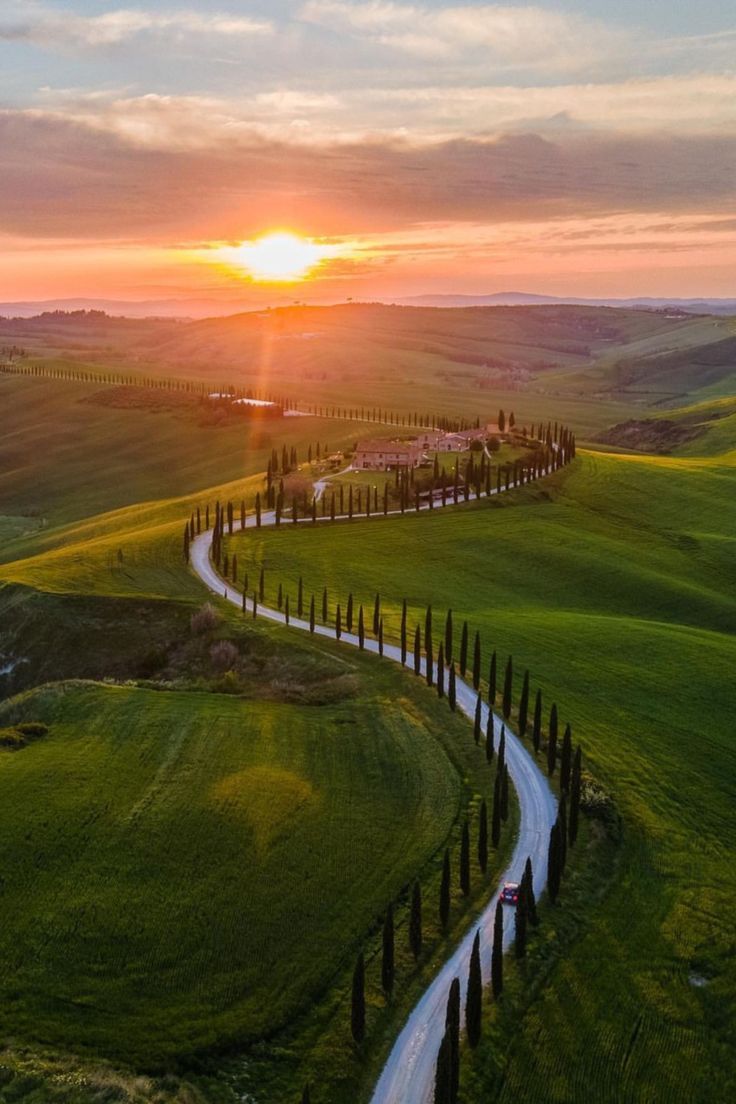
*The Val d'Orcia along the road south — the springs hide in its folds; we have not yet photographed the pools themselves.*
By car, both are easy Cassia runs: Bagno Vignoni sits about 50 km south of Siena off the SS2 — roughly 45 minutes to an hour — with Bagni San Filippo some 17 km further, its village two kilometres off the main road. The pairing makes a natural single day: the piazza and mill park in the morning, the Fosso Bianco's pools after lunch, the Val d'Orcia's postcard roads in between — and if the day stretches, San Quirico d'Orcia sits conveniently between the two for an evening passeggiata before the drive home. Where to collect the car and the rules that come with it are covered elsewhere; neither village involves ZTL anxiety, just small car parks that fill on summer weekends.
When to go — the counterintuitive answer
Hot springs invert the tourist calendar. Winter and the shoulder seasons are the Fosso Bianco at its best: a 48-degree source keeps bathing gloriously comfortable in cold air, the steam turns photogenic, the forest is quiet, and a weekday soak in November or February can feel private. July and August, by contrast, deliver the site's worst version — warm water in hot weather, car parks filling by mid-morning on weekends, and the crowd pressure that produced the ticket saga above.
For a September or October trip — the season the rest of the valley is at its finest — aim for weekdays and the edges of the day. And pack by the rules, which exist because everything here drains straight into a living stream: no soap or shampoo in the water, no night bathing (the site is unlit and ungated, not invigilated), dogs on leads on the paths but out of the pools, and swim shoes if you have them — travertine is beautiful and slippery in equal measure.
How we checked these details
Checked 9 August 2026, via web research: the Bagno Vignoni central-basin bathing ban, basin history and famous bathers from consistent heritage and guide sources (source temperature given as the 49–52°C range the sources span, rather than a single unqualified figure); the Parco dei Mulini's free access and cooler water from the same corpus, with the foot-soak-versus-immersion legal position presented at exactly the confidence the sourcing supports — the restricting ordinance and fines are reported, enforcement is reported inconsistent, and we say both; La Posta's €130 Day Spa from the hotel's published offer, with the cheaper pool-only figures flagged as unconfirmed against the hotel's own pages; Adler's package-only day access from the resort's published information; Bagni San Filippo's free status, 48°C source, Balena Bianca climbing ban, Bollore closure and conduct rules from municipal-ordinance reporting and press coverage; the ticket saga (announced cap, postponement, the €2 wristband, current-season uncertainty) from Italian press including La Nazione, presented as the unresolved sequence it is; and bus realities from Autolinee Toscane corridor information and press coverage of the holiday timetable. Parking rates conflicted across every source and are deliberately given only as an order of magnitude. Ordinances, charges and timetables here change more often than anywhere else we cover — re-verify against the comune notices and the at-bus planner before travelling. We have no affiliate relationship with either spa hotel or any operator named; recommendations are editorial.
Final thoughts
The Val d'Orcia's springs suffer from being written about in halves: the famous photograph without the bathing ban, the free pools without the ordinances, the €2 ticket without the saga around it. Taken whole, the picture is better than the fragments — a Renaissance piazza that steams like a myth, a mill park where warm water and a valley view cost nothing, a forest stream that delivers the real soak the square only promises, and rules that mostly amount to respecting a fragile, beautiful accident of geology. Go on a weekday, carry coins and a towel, keep the soap in the bag, and let the hottest pool you can politely claim do the rest.
Helpful summary
The short version
Can you actually bathe at Bagno Vignoni? What does Bagni San Filippo cost? The Val d’Orcia hot springs answered honestly — rules, prices and access.
Frequently asked
FAQ
Keep reading
San Galgano: The Roofless Abbey and the Real Sword in the Stone, an Hour from Siena
San Galgano: the roofless Cistercian abbey (€6), the real twelfth-century sword in the rock (free), the 27 September closure and how to get there.
11 min read · Updated 2026-09-27
Sant’Antimo: The Romanesque Abbey That Still Sings, Nine Kilometres from Montalcino
Sant’Antimo below Montalcino: the Charlemagne legend, the 1118 travertine church, onyx capitals, the monks’ chant times, free entry and hours.
11 min read · Updated 2026-09-22
Lucca Comics & Games 2026: Lucca Is Already Full — Here Is How to Go Anyway
Lucca Comics & Games 2026 runs 28 Oct–1 Nov, the 60th edition. Tickets, the 99%-booked centre, and the Pisa, Viareggio and Florence bases that still work.
11 min read · Updated 2026-09-15