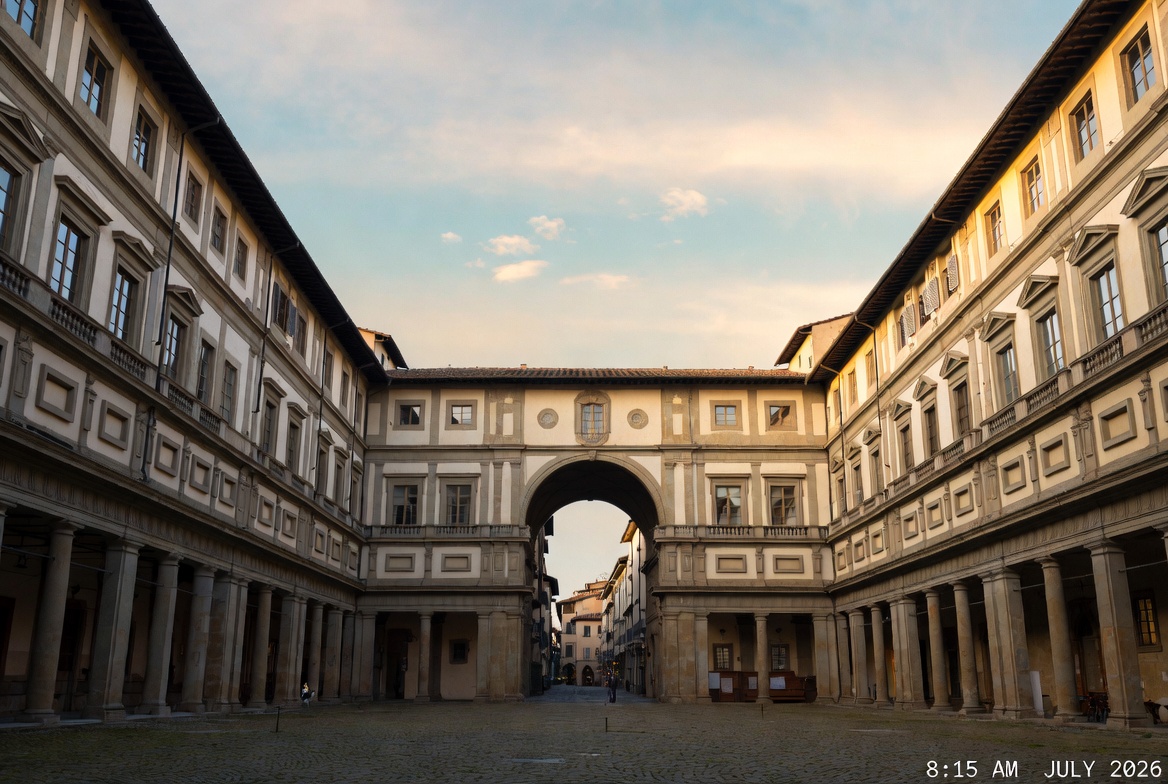
Uffizi Tickets Sold Out? What Actually Works, and What Wastes Your Money
Uffizi sold out for your dates? The honest options — the same-day afternoon ticket, the phone line, real Plan B museums — and the traps to avoid.
In this guide
- Quick answer
- Why it sells out — and why waiting for cancellations fails
- The same-day route, properly explained
- The paid routes that actually get you in
- The trap: lookalike resellers
- Plan B: the museums that are genuinely open
- Planning so this never happens again
- How we checked these details
- Final thoughts
- FAQ
Quick answer
The official site shows nothing for your dates and every blog says "book in advance", which is useless advice to someone standing in Florence tomorrow. Here is what actually works, in order.
First, check you are on the right site. The Uffizi changed ticketing concessionaire on 13 October 2025 — CoopCulture took over, and the official booking address is now tickets.uffizi.it. Older guides still point at the previous platform. (Confusingly, the Accademia and San Marco remained on the old one, so a mismatch is not proof you are being scammed — but for the Uffizi, use uffizi.it and tickets.uffizi.it and nothing else.)
Second, the counterintuitive fact that solves most cases: at the Uffizi, buying on the day is cheaper than booking ahead. The official fare structure prices advance purchase *higher*. The standard adult ticket is €25 at the ticket office on the day in high season, and — the single most useful number in this article — an "Afternoon" ticket for entry from 16:00 costs €16 on the day against €20 in advance, introduced on 1 January 2026. If the online calendar is empty, the same-day fare is not a queueing penalty — it is simply the cheap fare, and same-day tickets can be bought online at tickets.uffizi.it as well as at the window, so you may not need the queue at all.
Third, phone them. The call centre (800 615615 in Italy, +39 055 0354135 from abroad, 08:00–19:00 daily) sometimes places what the website will not show you.
And the thing to stop hoping for: Uffizi tickets are non-refundable and non-changeable, so almost nothing returns to inventory. Refreshing for cancellations is a poor use of a holiday.
The rest of this guide covers the walk-up reality, the legitimate paid routes in, the resale trap, and the Plan B museums that are genuinely open when the Uffizi is not.
Why it sells out — and why waiting for cancellations fails
Two structural facts explain the wall you have hit, and neither is bad luck.
Tickets are nominative. Every Uffizi Galleries entrance ticket is personalised: you supply identification details at purchase, and if the name on the ticket does not match your ID, entry is refused. That kills the informal resale market that softens sell-outs at other attractions — you cannot buy a stranger's spare.
Tickets are non-refundable and cannot be changed once purchased. Combine those two and the consequence is stark: a buyer whose plans change has no incentive to release the slot, because releasing it returns nothing. This is why the common advice to "keep refreshing for cancellations" underperforms at the Uffizi specifically. Some inventory does move, but the pool is far smaller than at museums with flexible tickets, and a holiday spent refreshing is a holiday spent refreshing.
For completeness on the release cycle: tickets are reported to open roughly two months ahead on a rolling basis — one account cites bookings for April–December 2026 opening on 2 February 2026 — and multiple sources now carry both the rolling pattern and that date, so treat it as the museum's deliberate distribution policy — the 2027 release calendar was not published at our check. Purchase limits are firmer: a maximum of 10 tickets per account per day, and five for the Vasari Corridor.
The same-day route, properly explained
The Uffizi is open Tuesday to Sunday, 08:15–18:30, closed every Monday, plus 1 January, 1 May and 25 December — though Monday closure has occasional announced holiday exceptions, so a Monday date is worth checking rather than assuming. The ticket office closes at 17:30, and at 18:30 visitors are moved toward the exit.
Walk-up same-day entry normally exists. That is the fact most "sold out" panic overlooks: the online allocation and the door are not the same inventory. Two caveats before you build a morning around it. First, it is not guaranteed — the museum can suspend walk-ups at short notice, and it did exactly that from 24 to 28 June 2026, when an air-conditioning failure during the heatwave pushed gallery temperatures toward 28°C, forced capacity to 50% and suspended new ticket sales; normal sales resumed on 30 June. Check the official site's notices the night before. Second, you are queueing, and the queue is worst in the middle of the day.
Play the pricing. Because same-day is cheaper than advance at this museum, the same-day plan is not a compromise:
- Standard, same-day: €25. Booked in advance the same ticket is €29 — the €4 is a per-ticket booking fee, the same €4 that separates the €16 and €20 afternoon fares.
- Afternoon ticket, entry from 16:00: €16 on the day — against €20 booked ahead. Introduced 1 January 2026, and the cheapest legitimate way in during high season.
- Low season is cheaper still: Italian regional reporting puts the Uffizi and Pitti at €12 from 1 November to 28 February — a full day for less than the afternoon ticket. Sources differ on the exact seasonal boundaries, so check the fares page for your date.
Time it deliberately. Availability and crowding are reported to be lowest November to March, on Wednesdays and Thursdays, in the first ninety minutes after the 08:15 opening, and again from 16:00 to last entry at 17:30 — with Tuesday unusually busy because it absorbs the Monday-closure spillover. The 16:00-onward window is doubly attractive: it is both the quietest stretch and the cheap ticket. Two and a half hours is enough for the Botticellis, the Leonardos, the Caravaggios and the corridor views if you walk with intent.
Free first Sundays are the exception that helps least: admission is free on the first Sunday of the month under the national #Domenicalmuseo scheme, and on those days general visitors cannot book — the free ticket is issued at the entrance on arrival. Free means crowded; go early or treat that Sunday as a Plan B day.
The paid routes that actually get you in
When the calendar is empty and you need certainty rather than a queue, three routes are legitimate.
The call centre. Reservations can be made by phone on 800 615615 (freephone within Italy) or +39 055 0354135 from abroad, 08:00–19:00 daily. This is the most underused option in Florence: phone inventory and web inventory are not always identical, and a two-minute call has rescued more visits than any refresh loop.
A guided tour. Tour operators hold ticket allocations that never enter the public online inventory, which is precisely why a tour can show availability on a date the official site cannot. That is not a trick; it is how museum allotments work. The corollary is worth knowing too: when an operator's own allotment sells out, they are as stuck as you are. You will pay for the guide on top of admission — the honest trade is money and a fixed group pace in exchange for a guaranteed entry on a date that otherwise has none.
A combined or multi-site ticket. The Uffizi + Pitti Palace + Boboli Gardens ticket is valid 5 consecutive days with one priority admission to each, at €40 (€58 with the Vasari Corridor supplement). Its value here is the flexibility: five days is a wide net when a single date is impossible. The Firenze Card (€85, 72 hours, 60-plus museums, booking costs included, under-18s free within the cardholder's family) is worth the arithmetic only if you are museum-intensive across three days — for a single Uffizi rescue it is expensive.
And the Vasari Corridor, reopened on 21 December 2024 after eight years and a refurbishment reported at around €11 million, is a genuine alternative experience above the Ponte Vecchio: €43 with Uffizi entry bought on the day, €47 in advance, or a €20 supplement for existing Uffizi ticket or Passepartout holders. Arrive five minutes before your slot or forfeit entry; tickets are personalised and capped at five per purchase. Note for anyone reading this in the publication window: an evening opening runs every Friday from 3 July to 20 November 2026, 19:00–23:00 with last admission 21:50, on a separate *Vasari Corridor – Special Openings* ticket at €20 on the day / €24 in advance, booking compulsory and groups capped at 25 — a live availability window worth checking when the daytime museum is full.
The trap: lookalike resellers
Search "Uffizi tickets" under time pressure and the first results will include official-sounding domains that are not the museum. Travellers report paying close to double after booking through them, and the sites are engineered to look institutional.
The rule is simple: the official addresses are uffizi.it for information, tickets.uffizi.it for booking, and coopculture.it — the concessionaire's own site, which sells the same tickets at the same fares. Anything else is either a licensed tour operator selling a genuine product with a service fee — legitimate, if you know that is what you are buying — or a markup for nothing.
Two clarifications that keep honest people out of trouble. A booking fee is not automatically a scam: official online purchases carry service fees, and tour operators legitimately price their allocation plus guiding. What you are checking for is proportion and transparency — a site that hides the face value or charges a multiple of it. And a third-party platform showing availability when the official site shows none is not proof of fraud either; that is the allotment mechanism described above. Judge by price and disclosure, not by the mere existence of stock.
One more mismatch that panics people unnecessarily: as noted at the top, the Accademia and San Marco still sit on the previous ticketing platform while the Uffizi moved to CoopCulture in October 2025. Encountering two different official-looking systems for two Florentine museums is expected, not evidence of a fake.
Plan B: the museums that are genuinely open
If the Uffizi truly cannot happen on your dates, Florence is not short of alternatives — but the quality of the alternatives varies enormously, and the usual listicle ranks them wrongly.
The Bargello is the strongest same-day Plan B. Sculpture rather than painting — Donatello, Michelangelo, the Ghiberti competition panels — in a magnificent medieval palace, on the unified Tuesday–Sunday 08:15–18:50 schedule — and through November 2026 both run a programme of special and evening openings, some on normally closed days, so check their calendar before writing off a date. Since 15 March 2026 the Accademia and the Bargello museums operate as a single institution across seven sites, with combined tickets at €26 valid 48 hours (Accademia plus Bargello) and €38 valid 72 hours for the wider circuit, each plus the €4 booking fee. The Bargello alone is €12 since 1 February 2026 — the cheaper move if David is not on your list. The Bargello rarely sells out in the way the headline museums do.
Pitti Palace + Boboli Gardens is the most reliable large-scale substitute: a combined one-day ticket at €22 on the day, €25 in advance, covering the Pitti museums, Boboli and the Bardini Garden. It is a half-day minimum and a full day if the gardens catch you — and, like the Uffizi, it is cheaper bought on the day.
The Accademia is a weak rescue, despite being everyone's first suggestion. It sells out on the same pattern as the Uffizi, and its full price rose from €16 to €20 on 1 February 2026 plus a €4 reservation fee. If David is the goal, treat it as a second booking problem, not a solution to the first — and one with a different answer: unlike the Uffizi, the Accademia's box office sells on the day even when the website shows nothing, which is worth knowing before you queue for either.
The Duomo complex is a different kind of day entirely, sold on passes: Brunelleschi Pass €30 full / €12 reduced (timed Dome climb, Baptistery, Campanile, Santa Reparata crypt and the Opera del Duomo Museum, valid 3 days) or Giotto Pass €20 / €7 for everything except the Dome. Note that since 1 March 2025 an identity document must be presented with the ticket for the Dome climb.
Palazzo Vecchio covers the civic-power half of Florence's story; the Comune di Firenze's tariff revision took it to €18 full (€12 reduced for 18–25s) on 1 February 2026. San Marco, for Fra Angelico's cells, is €11 full (€2 for EU 18–25s) since 26 September 2025, per the regional museums directorate — and has had refurbishment closures, so check before crossing town for it.
And the option nobody suggests: Florence's churches hold a museum's worth of art for less than a gallery ticket — though most are not free. Santa Croce is €10 and the Brancacci Chapel €15 (€10 for 18–25s), while Santa Maria Novella and the cathedral's own nave cost less or nothing. A sold-out Uffizi is a good day to discover that the Renaissance did not confine itself to one building.
Planning so this never happens again
Three habits prevent the sold-out morning entirely.
Book at the release, not at the trip. The rolling window is reported at roughly two months ahead; the practical rule is to secure the Uffizi the moment your dates are fixed, and — because same-day is cheaper here — to decide consciously whether you are paying the advance premium for certainty or backing yourself to walk up.
Aim at the quiet seams. November to March, midweek, first thing or after 16:00. A Florence trip built around those windows barely encounters the problem this article solves.
Or move the base. The travellers who suffer worst from Florence's ticketing are those who gave the city a single, immovable day. Staying in Siena and treating Florence as a day trip on the 131R sounds like it would make booking harder; in practice it makes the calendar flexible, because a Siena base has other days to spend if the museum says no. It is the same logic behind choosing Florence or Siena as your base at all — and it is the reason a sold-out Uffizi ruins a Florence-only itinerary and merely reshuffles a Tuscan one.
How we checked these details
Checked 9 August 2026, via web research (direct page fetches are blocked in our environment, so all of this rests on search-surfaced material rather than pages we opened). Verified from official and official-adjacent sources: the Uffizi's Tuesday–Sunday 08:15–18:30 opening with Monday and holiday closures and the 17:30 ticket-office cut-off; the 13 October 2025 transfer of ticketing to CoopCulture and the move to tickets.uffizi.it, with the Accademia and San Marco remaining on the previous platform; the €25 same-day standard admission and the official high-season definition; the advance-costs-more structure, evidenced by the €43-same-day versus €47-advance Vasari Corridor pricing and the €16/€20 Afternoon ticket introduced 1 January 2026; the nominative-ticket and ID-match rules; the non-refundable, non-changeable terms and the 10-per-account daily cap; QR delivery by email since 6 May 2024; the call-centre numbers and hours; the #Domenicalmuseo free-first-Sunday arrangement and its no-booking rule; the 24 June 2026 heatwave notice suspending walk-ups; the Vasari Corridor's December 2024 reopening, pricing, five-minute rule and the Friday-only 3 July–20 November 2026 evening opening on its separate €20/€24 ticket; the €40 Uffizi–Pitti–Boboli five-day ticket and €22/€25 Pitti+Boboli; the Accademia's 1 February 2026 rise to €20 and its 15 March 2026 unification with the Bargello on €26/€38 combined tickets; the Duomo passes and the 1 March 2025 ID requirement for the Dome climb; and the €85 Firenze Card terms. Corrected against primary sources after an adversarial check: Palazzo Vecchio's €18 full / €12 reduced from 1 February 2026 per the Comune di Firenze tariff revision; San Marco's €11 since 26 September 2025 per the regional museums directorate; the €29 advance total and the two-month rolling release, both of which multiple sources carry; and the paid status of Santa Croce (€10) and the Brancacci Chapel (€15). Still flagged as unconfirmed: current Passepartout pricing, and the reported €12 low-season fare, whose seasonal boundaries sources describe differently. Museum prices and policies in Florence changed repeatedly across 2025–2026 — verify on the official channels for your dates before relying on any figure here. We have no affiliate relationship with any museum, ticketing platform or tour operator named; no booking on this page pays us, and no reseller is recommended.
Final thoughts
"Sold out" at the Uffizi means the online allocation for one date is gone. It does not mean the museum is closed to you, and it certainly does not mean you should pay a lookalike site double to fix a problem that a phone call, an afternoon ticket or a Wednesday would have solved for less than the original price.
Try the official channels in this order — tickets.uffizi.it, the phone line, the same-day afternoon window — and if none of them yields, spend the day in the Bargello or at Pitti and come back at 16:00 tomorrow for sixteen euro. Florence has been overwhelming visitors for six centuries; it has never had only one room worth entering.
Helpful summary
The short version
Uffizi sold out for your dates? The honest options — the same-day afternoon ticket, the phone line, real Plan B museums — and the traps to avoid.
Frequently asked
FAQ
Keep reading
Accademia Sold Out? The Box Office Still Sells Tickets on the Day
Accademia calendar empty for your dates? The gallery itself says the box office still sells on the day. The queue, the price, the free days, the Plan B.
17 min read · Updated 2026-09-03

Florence Summer Heat Survival Tips 2026: Stay Cool & Beat the Heat
Practical ways to handle Florence’s 35°C+ summer days in 2026: timing, shade routes, water fountains and cooler alternatives.
5 min read · Updated 2026-08-06
Avoid Crowds in Florence July 2026: Smart Strategies for Independent Travellers
Proven ways to dodge Florence’s July 2026 crowds: skip the Uffizi and Duomo queues, explore quieter Oltrarno, and time your day right.
6 min read · Updated 2026-07-17