Tuscany in March 2027: Easter Fire, the First Blossom and the Turning Month
Tuscany in March 2027, when Easter lands early: Florence’s exploding cart, Pitigliano’s fire festival, the season’s reopenings and honest spring advice.
In this guide
- Quick answer
- The case for March: the turning month
- The weather, honestly
- Easter 2027: the early one
- The Scoppio del Carro: Florence’s exploding Easter cart
- The Torciata di San Giuseppe: fire in Pitigliano
- The 25th of March: Florence’s other New Year
- The reopening month: what wakes up (and what doesn’t yet)
- The March table: artichokes, agretti and the last of winter
- Where to base yourself in March
- A late-March 2027 week that catches everything
- How we checked these details
- Final thoughts
- FAQ
Quick answer
March 2027 is the rare March with fireworks — literally. Easter falls early, on 28 March 2027, pulling Holy Week and Florence’s extraordinary Scoppio del Carro — the exploding cart of Easter morning — inside the month, alongside Pitigliano’s Torciata di San Giuseppe fire festival on the 19th and Florence’s own old New Year, the Capodanno Fiorentino, on 25 March. Around the spectacle, March remains what it always is: the turning month — daytime highs climbing from about 13°C toward 17°C, the first blossom, artichokes and agretti in the markets, the season’s attractions reopening one by one, and low-season prices holding almost to the month’s end. Pack layers, keep one indoor option per day, and know that in 2027 the clocks spring forward on Easter Sunday morning itself — the month literally ends by handing you an extra hour of evening light. The details, honestly flagged where 2027 programmes are not yet published, below.
The case for March: the turning month
March is Tuscany changing gear in real time. The month opens as late winter — bare vines, quiet squares, museum-first days — and closes as unmistakable spring: blossom in the sheltered corners, café tables recolonising the pavements, the first outdoor lunches that need no justification. Travellers who can only compare “winter Tuscany” and “summer Tuscany” are missing the month where you can watch one become the other.
The practical appeal stacks up: low-season prices persist for most of the month (Easter week 2027 being the loud exception — more below); the great museums remain at gentle density; the thermal springs still steam in the cool air; and the countryside, while not yet the postcard, begins rehearsing — green wheat, first leaf, working farms waking up.
The honest counterweight is volatility. March weather swings — a spring afternoon can hand over to a cold, wet evening without notice, the tramontana wind still delivers the occasional frost-edged morning, and rain days remain frequent. This is the month for the flexible itinerary: every outdoor plan with an indoor understudy, exactly the pattern our winter guides drill.
The weather, honestly
Long-term climate averages, as checked in August 2026: Florence climbs from daytime highs around 13°C in early March to about 17°C by the month’s end, with overnight lows of 4–5°C and rain on up to a dozen or so days, totals varying by dataset; Siena runs a degree or so cooler — highs near 13–14°C, nights around 4°C — and keeps an outside chance of a flurry, March being the last month with any realistic snow possibility. (Siena’s March rainfall figure genuinely varies between climate sources, so we decline to print one; assume Florence-like frequency and pack accordingly.)
The within-month gradient matters more than the averages: early March is late winter, late March is early spring, and the difference is felt in every category — terrace viability, daylight, countryside colour. Day length crosses twelve hours at the equinox around 20 March, and in 2027 summer time begins on Sunday 28 March — Easter morning, under the EU’s standing last-Sunday-of-March rule — pushing sunset an hour later exactly as the holiday crowds arrive to use it.
Packing is the layered shoulder-season kit: a real waterproof, warm mid-layers for evenings that still touch single digits, and shoes for wet cobbles. The month rewards the traveller who dresses for two seasons a day, because that is what March delivers.
Easter 2027: the early one
Easter is the month’s calendar event in 2027 — Easter Sunday falls on 28 March, near the earliest end of its range, with Easter Monday (Pasquetta) on the 29th, a full Italian public holiday. The practical consequences arrive in both directions.
The costs: Holy Week concentrates the month’s demand into its final days — accommodation in Florence and Siena prices up and books out, and the Easter weekend brings holiday transport timetables, fuller museums and the year’s first genuinely crowded piazzas. Pasquetta itself runs on the classic Italian holiday pattern: offices shut, families decamp for the traditional countryside picnic, and Sunday-style schedules apply — the same holiday mechanics our other guides map.
The rewards: Holy Week in Tuscany is genuinely moving — processions, packed vigils, churches at their liturgical peak — and it culminates in the single most theatrical fifteen minutes of the Tuscan spring, which gets its own section below.
The booking translation: for late-March 2027 travel, reserve rooms early and treat the 26–29 March block like high season; for the low-season version of March, aim at the first three weeks, which remain quiet, cheap and blissfully unbooked.
The Scoppio del Carro: Florence’s exploding Easter cart
On Easter Sunday morning, Florence stages a ritual that sounds invented and has run in essentially this form for centuries. The Scoppio del Carro — the Explosion of the Cart — sends an antique tower-cart nicknamed the Brindellone, hauled by flower-garlanded white oxen and escorted by a costumed historical procession some 150 strong, from the Porta al Prato district to the space between the Duomo and the Baptistery. There, at the singing of the Gloria in the Easter Mass — around 11:00, with the procession under way from about 10:00 — the Archbishop lights the colombina, a dove-shaped rocket that flies down a wire from the cathedral’s high altar, out through the doors, and into the cart, detonating it into a tower of fireworks in front of the façade.
Tradition ties the rite to the First Crusade — the legend of Pazzino de’ Pazzi returning from Jerusalem with flints from the Holy Sepulchre — and reads a smooth flight of the dove and a full, roaring burn as the good omen for the year’s harvest, a verdict Florentine farmers were said to await as anxiously as any forecast.
Practicalities, stated with our usual honesty: the event is free and unticketed, the crowd is enormous, and the travel wisdom is to be in position by around 9:00 for a sightline between Duomo and Baptistery. And the 2027 flag: as of our August 2026 check, no 2027-specific programme has been published — the 28 March date follows from the Easter calendar, but confirm timings on Florence’s official channels closer to the day, as we advise for every pattern-based event.
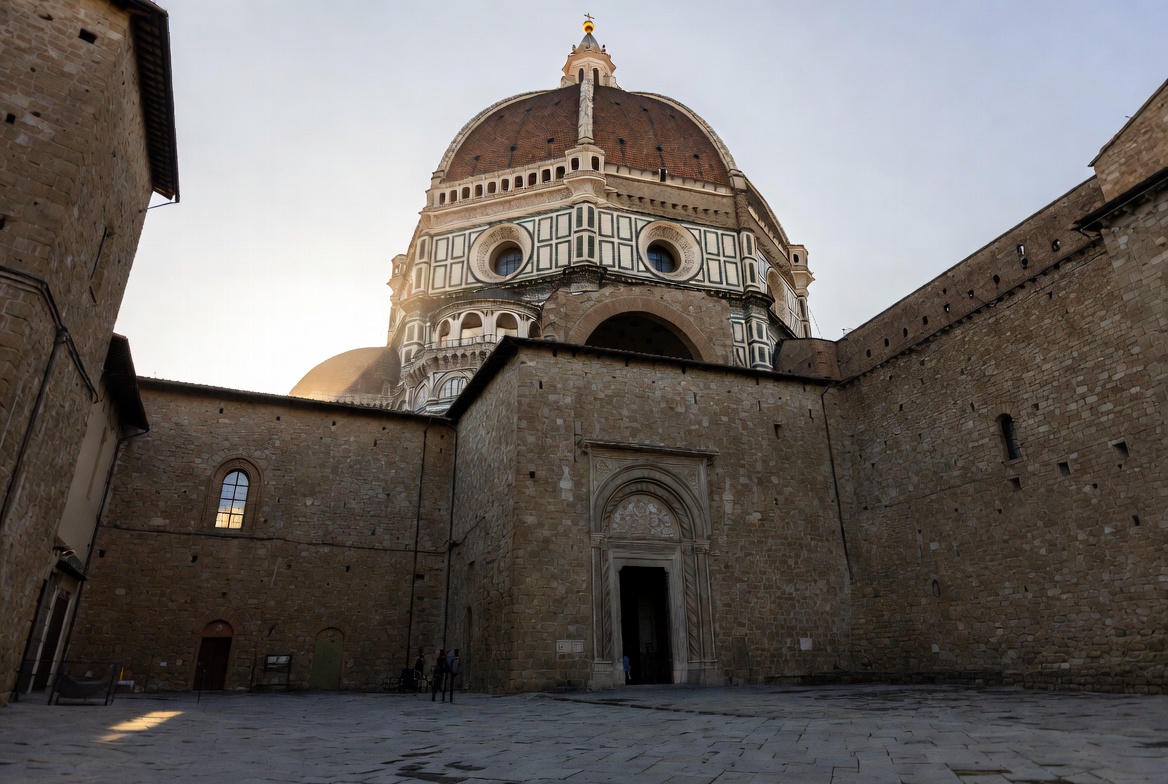
*Piazza del Duomo: the Scoppio’s stage — claimed early on Easter morning.*
The Torciata di San Giuseppe: fire in Pitigliano
Nine days before Easter, the month’s other fire ritual burns at the opposite end of Tuscany. On 19 March — a Friday in 2027 — the tufa-cliff town of Pitigliano in the deep Maremma marks St Joseph’s feast with the Torciata di San Giuseppe: torch-bearers in rough brown robes process through the medieval centre carrying burning bundles of reeds, and the night climaxes with the burning of the invernacciu — a reed effigy of winter, built storeys high — in Piazza Garibaldi, spring declared by incineration. Local tradition traces the rite toward pre-Christian equinox fires, possibly Etruscan; the folklore is presented as folklore, and the spectacle needs no certificate of origin.
Recent editions have run the main procession and bonfire in the evening, with family events earlier — but programme times are year-specific, and the 2027 programme was unpublished at our August 2026 check: verify locally before building the evening around an hour.
The honest logistics: Pitigliano is a far-southern outpost — rewarding, spectacular on its cliff, and a genuine expedition from a Siena or Florence base, firmly in rental-car territory. Treat the Torciata as the anchor of a Maremma overnight rather than a day-trip dash, and the far south — Pitigliano, Sovana, the springs at Saturnia — becomes March’s best two-day detour.
The 25th of March: Florence’s other New Year
March 2027 carries a third, quieter tradition that most visitors walk past without knowing. Until the Grand Duchy adopted the modern calendar in the mid-eighteenth century, Florence began its year on 25 March — the feast of the Annunciation — and the city still celebrates the Capodanno Fiorentino each year: a costumed historic procession through the centre to Piazza Santissima Annunziata, flag-throwers, and a cluster of civic and cultural events around the date. Recent editions have run the parade in the late afternoon, with the 2026 edition folding into a week-plus of citywide events; 2027’s programme, as with everything this far out, awaits publication.
For a traveller it is the best kind of festival: real, local, uncrowded by international tourism, and landing — in 2027 — on a Thursday three days before Easter, which turns the month’s final week into a genuine festive sequence: old New Year on the 25th, Holy Week rising, the Scoppio on the 28th, Pasquetta on the 29th, with the clocks changing and the evenings stretching as it all unfolds.
If your March trip has to choose one week, that is the week — booked early, with the Florence-or-Siena decision tilting toward Florence for once, since the month’s three headline events all stage there or need it as a base.
The reopening month: what wakes up (and what doesn’t yet)
March is when seasonal Tuscany switches back on — unevenly, and knowing the pattern saves wasted drives.
Waking in March: Siena’s Santa Maria della Scala has historically moved to its longer summer schedule from mid-March (daily opening with evening hours — confirm current times on official channels, as our museum guides always advise); the great villa gardens begin stirring, with Villa Reale di Marlia’s grounds near Lucca among the early-March reopeners in recent seasons; and countryside accommodation, restaurants and cellars reopen in waves through the month as the rural winter shutdown unwinds.
Still asleep until April: some of the region’s most famous gardens hold to a 1 April season start — recent seasons at both La Foce in the Val d’Orcia and the Tarot Garden at Capalbio began then — so a late-March itinerary built around them meets locked gates. Season dates are year-specific and 2027’s were unpublished at our check: verify before driving.
The meta-rule for March: check opening days for anything rural or seasonal, every time — the month’s calendar is a patchwork, and the difference between a triumph and a wasted afternoon is one look at an official page.
The March table: artichokes, agretti and the last of winter
March eating is the year’s hinge, and the food calendar’s logic applies at full strength. The arrivals: artichokes — including Tuscany’s violet-tinged varieties — worked into everything from fried wedges to risotto; agretti, the grassy, briefly-available spring green that locals pounce on precisely because it vanishes; and, as the month turns, the vanguard of peas, favas and asparagus that will define April. Lucca’s garmugia, the old spring soup built to celebrate exactly this moment, is the season in a bowl where you find it.
Still on the table from winter: ribollita and the bread soups earning their last ovations, wild-boar pappardelle, bistecca with no seasonal apology, and the citrus and black-truffle tail of the cold months. Easter week adds its own layer — lamb on menus, traditional Easter breads and eggs in the pasticcerie — before April’s full spring takes over.
March restaurant craft is winter’s, still: kitchens cooking for locals, walk-ins plausible outside Easter week, and the blackboard outperforming the printed menu — enjoy it before the season’s crowds return the favour.
Where to base yourself in March
The winter basing rules soften but do not yet invert. Cities still win for the first three weeks: reliable opening hours, indoor depth for the wet days, and the evening life that rural March cannot yet offer. Florence takes the month’s crown in 2027 — the Scoppio, the Capodanno and Holy Week’s peak all stage there — extending the winter run of Florence-first advice, against our usual Siena verdict, into a third month; Siena remains the calmer, cheaper base and a fine Easter alternative if Florence’s prices spike beyond reason.
The countryside becomes arguable in late March: reopening agriturismi at pre-season rates, blossom beginning, and the Val d’Orcia green and empty — but confirm heating, restaurant days and what is actually open before committing, and keep the car if you go rural, because March’s thin bus timetables have not yet thickened for summer.
And one March-specific booking note: the 26–29 March 2027 block is the month’s high season — Easter weekend rooms in Florence will not wait for deciders. Book the holiday weekend first, then build the quiet weeks around it.
A late-March 2027 week that catches everything
Monday 22 – Tuesday 23 — Siena, quietly. The low-season city’s last quiet days: museums, the winter table, an afternoon at the springs if the weather argues for steam.
Wednesday 24 — the Val d’Orcia, waking. Green wheat, first blossom, reopened cellars — the loop at its emptiest and strangest, with everything ahead of it.
Thursday 25 — Florence for the Capodanno Fiorentino. Arrive, watch the old New Year’s procession reach Santissima Annunziata, and settle in for the festive sequence.
Friday 26 – Saturday 27 — Holy Week Florence. The museums between liturgies, the pasticcerie in Easter dress, the city filling with purpose.
Sunday 28 — the Scoppio del Carro. In position by 9:00, the oxen and the procession, the dove’s flight at the Gloria, the cart in glorious detonation — and that evening, an extra hour of light, courtesy of the clocks.
Monday 29 — Pasquetta. Do as the Italians do: an unambitious, outdoor, picnic-shaped day — the Cascine park, a riverside walk, or the first countryside lunch of the year — before the journey home. (Skip the Boboli for this one: its Monday-closure pattern would normally shut it on the month’s last Monday, and a Pasquetta exception was unconfirmed at our check.)
One week, three festivals, two seasons, and the year’s pivot witnessed from the front row — with one covering rule: every timed event in this plan follows the annual pattern, since 2027 programmes were unpublished at our check — confirm each on official channels before travelling.
How we checked these details
Checked in August 2026 through parallel research with per-fact confidence grading: the Easter 2027 dates (Sunday 28 March, Pasquetta 29 March — multiple independent calendar sources) and Pasquetta’s public-holiday status; the Scoppio del Carro’s form, procession and timing pattern (regional and city tourism sources) with its Pazzino legend presented as tradition; the Torciata di San Giuseppe’s 19 March date, invernacciu bonfire and programme pattern; the Capodanno Fiorentino’s 25 March tradition and parade pattern — with the calendar-reform year, which sources split on, deliberately phrased as “mid-eighteenth century”; March climate temperature averages for Florence and Siena; the DST start on 28 March 2027 (last Sunday of March, assuming the EU’s standing clock-change rules remain in force); March rainfall figures for both cities vary by dataset, so Florence is given as a range-shaped claim and Siena’s number declined; and the reopening calendar (Santa Maria della Scala’s mid-March pattern, Villa Reale di Marlia’s early-March season, La Foce’s and the Tarot Garden’s 1 April starts), all from recent-season documentation. No 2027-specific programmes, times or season dates had been published for any event at our check — every timing here is the established annual pattern, and readers should confirm on official channels near their dates. Conflicting research findings (the cart’s height, a dove-speed figure, one rainfall number) were excluded per our standards. We have no affiliate relationship with any venue, festival or property named here; recommendations are editorial.
Final thoughts
Every month guide in this series ends by telling you what its month is for, and March 2027 makes it easy: it is for the turn — the one week a year when Tuscany burns winter in a piazza, celebrates a new year three months late, detonates a cart of fireworks for the harvest’s sake, and moves its clocks so the evening can watch. Come in the quiet first half for the last of the winter prices, or aim everything at that extraordinary final week — but come knowing that March is the month the region stops being a museum of its seasons and starts performing them, live, with fire.
Helpful summary
The short version
Tuscany in March 2027, when Easter lands early: Florence’s exploding cart, Pitigliano’s fire festival, the season’s reopenings and honest spring advice.
Frequently asked
FAQ
Keep reading
Tuscany in February 2027: Carnival Month, Honestly Reviewed
Tuscany in February 2027: Viareggio Carnival’s parade dates, Carnival sweets, a Valentine’s Sunday, the sales’ tail end and honest winter advice.
12 min read · Updated 2026-08-11
Tuscany in January 2027: The Quietest Month, and Who It’s Secretly For
Tuscany in January 2027: the year’s emptiest month — winter sales, thermal springs, Viareggio Carnival’s 30 January opening and honest cold-season advice.
12 min read · Updated 2026-08-10
Tuscany in October 2026: The Golden Month Between Two Harvests
Tuscany in October 2026: the late wine harvest, the first olive pressings, the uncovered Duomo floor all month, weather averages and honest advice.
12 min read · Updated 2026-08-06