
Italy Entry Requirements 2026: EES Is Live, ETIAS Is Delayed — What You Actually Need
Italy entry requirements in 2026, straight: the EES biometric border is live, ETIAS is delayed with no confirmed date, and the 90/180 rule now has teeth.
In this guide
- Quick answer
- EES vs ETIAS: the one-minute distinction
- EES in practice: what actually happens at the border
- The 90/180 rule: old law, new enforcement
- The ETIAS delay: what happened in July 2026
- The scam layer: who not to pay
- The checklist, nationality by nationality
- What this means for a Tuscany trip, concretely
- The timeline at a glance
- How we checked these details
- Final thoughts
- FAQ
Quick answer
Two systems dominate every headline about entering Italy in 2026, and travellers keep conflating them. The status, as checked at the end of July 2026:
EES (Entry/Exit System) — live now. Since 10 April 2026 the EU’s biometric border system has been fully operational at every Schengen external border, Italy included. There is nothing to apply for and nothing to pay: it happens *at* the border, where your passport, fingerprints and photo are registered instead of a stamp. Budget extra time on your first arrival.
ETIAS — not live, and delayed. The €20 travel authorisation for visa-free visitors (Americans, Britons, Canadians, Australians and around 60 other nationalities) has no confirmed start date. In mid-July 2026 the EU removed its “last quarter of 2026” target from the official site — which now states simply that ETIAS is not in operation — and by early August the travel press was reporting the launch as delayed until at least 2027, with a revised timeline expected after September 2026. You do not need ETIAS to visit Italy today, and anyone charging you for one right now is not official.
Everything else — the 90/180-day rule, passport validity — is unchanged in law, but the new border computer enforces it to the day. The details, nationality by nationality, below.
EES vs ETIAS: the one-minute distinction
The two acronyms travel together in every news story, which is exactly why they get confused. They are different things at different stages.
EES is a border process. It replaces the passport stamp with a digital record: on your first entry to the Schengen area since 12 October 2025, a border officer (or self-service kiosk) registers your passport details, fingerprints and facial image; on later trips the system verifies you against that record. It applies when you arrive, requires no advance action, and costs nothing.
ETIAS is a pre-travel authorisation — closer to America’s ESTA than to a visa. Once it launches, visa-free visitors will apply online before travelling, pay €20 (with exemptions for under-18s, over-70s and certain family members of EU citizens), and receive an authorisation linked to their passport, expected to be valid for three years or until the passport expires. It is not a visa, and for the overwhelming majority approval is designed to be near-instant.
The operative difference in mid-2026: EES affects your trip now; ETIAS affects no trip yet. Plan for the first, ignore sales pitches about the second, and check the official EU travel site — travel-europe.europa.eu — for the only launch date that will ever count.
EES in practice: what actually happens at the border
The system went live on 12 October 2025, rolled out progressively, and has been fully operational at all external border crossing points since 10 April 2026 — the date manual passport stamping ended. By the EU’s own figures, it registered over 45 million border crossings in its first months.
What it means at an Italian airport: on your first EES entry, expect the full registration — passport scan, four fingerprints, facial image, and the standard questions about your stay. It adds minutes per traveller, which is why arrivals halls feel slower than the pre-2026 routine. On subsequent entries within three years, the check is verification against your existing record and runs faster, often at self-service gates where available.
The honest seasonal note: this is the system’s first full summer, and travel press has reported waits of two to five hours at some major Schengen hubs in peak periods — Amsterdam, Paris CDG, Frankfurt, Barcelona and Vienna among those named. Italian airports have not been the headline offenders, but if your route to Tuscany connects through a big northern hub, the practical advice is blunt: longer connection times than you used to book, documents ready, and patience budgeted like luggage.
One more consequence worth understanding: because entries and exits are now recorded digitally, the system counts your Schengen days automatically — which brings us to the rule that has not changed but suddenly has teeth.
The 90/180 rule: old law, new enforcement
Visa-free visitors to the Schengen area — which includes Italy and every neighbour a Tuscan itinerary touches — may stay 90 days within any rolling 180-day window. This is not new. What is new is that EES turned it from a rule enforced by squinting at passport stamps into a rule enforced by a database that knows your day count to the digit.
Practical implications for ordinary travellers are modest: a two-week Tuscany trip does not approach the limit. The people who need to count carefully are long-stay visitors, retirees wintering in Italy, remote workers stringing European months together, and anyone combining multiple EU trips in a half-year — the 180-day window is *rolling*, not calendar-based, and days in France or Spain count against the same allowance as days in Italy.
The passport rules are equally unchanged and equally enforced: for visa-free visitors, a passport must generally be issued within the last 10 years and valid for at least three months beyond your intended departure from the Schengen area. Check both dates before booking, not before flying — a passport that fails either test is the one entry problem no amount of queueing solves.
The ETIAS delay: what happened in July 2026
For two years the official line was that ETIAS would “start operations in the last quarter of 2026”. In mid-July 2026 that target quietly disappeared from the EU’s official ETIAS pages, and reporting — led by the Financial Times — indicates that eu-LISA, the EU agency building the system, has internally concluded a 2026 launch is no longer feasible. By early August the reporting had converged: US and European travel press now describe the launch as delayed until at least 2027, and the official pages state only that ETIAS is not currently in operation. A revised timeline is expected after the agency’s board meets in September 2026.
What this means for travellers, stated plainly:
- No trip you can book today requires ETIAS. Autumn 2026, the winter season, and in all likelihood well beyond it: nothing to apply for.
- When it does launch, the design includes a transitional period — the EU’s stated approach pairs the start of operations with a grace phase before authorisation becomes a hard requirement, so the first travellers affected will not be turned away for lacking a document that launched mid-trip.
- The only launch date that matters will appear on the official EU travel site and in an EU press release. Any blog, agency or “ETIAS portal” announcing a confirmed date before that is guessing — or selling.
Our own practice follows the same rule we apply to festival dates: we publish what the primary source says, date-stamp it, and flag what is genuinely unknown. As of the end of July 2026, the honest status of ETIAS is: designed, priced at €20, and unscheduled.
The scam layer: who not to pay
Every delayed government system grows a fringe of look-alike websites, and ETIAS has a flourishing one. Search for it and the results fill with polished, official-sounding portals — some openly commercial, some designed to be mistaken for the EU — offering to “pre-register”, “check eligibility” or process a future application for a fee several times the real €20.
The rules that keep you safe are short. Nothing can be applied for before launch, so any pre-launch payment buys nothing the EU recognises. The only application channel will be the official EU website and official mobile app — the address to remember is travel-europe.europa.eu. The real fee is €20, waived for under-18s and over-70s; a “service” charging €60 to submit a €20 form is legal in many jurisdictions but pointless in all of them. And no legitimate process will ever contact you by email or message asking for payment to “complete” an authorisation you never started.
This paragraph will age well or badly depending on the September announcement — which is precisely why the how-we-checked section below carries a date. When the launch is real, this article will say so; until then, keep your card in your pocket.
The checklist, nationality by nationality
US, UK, Canadian and Australian passport holders (and the other visa-exempt nationalities): no visa for stays up to 90/180; EES registration happens automatically at the border — first entry slower, repeat entries faster; no ETIAS yet, no action required; passport issued within 10 years and valid 3+ months beyond departure. That is the entire list.
EU and Schengen-country citizens: none of this applies — EES and ETIAS are for third-country nationals. Dual citizens travelling on an EU passport bypass both systems entirely, which makes the EU passport the better travel document for entering Italy where there is a choice.
Non-visa-exempt nationalities: the Schengen visa process is unchanged — ETIAS is not a visa and never replaces one; EES registration applies at the border alongside the visa.
Residents of Italy or another Schengen state with a valid permit: exempt from EES registration when travelling on that status — carry the permit alongside the passport.
For every category, one shared upgrade: because records are now digital, discrepancies surface immediately. Names that differ between bookings and passports, expired documents, and miscounted days used to slip through; the polite version of 2026 border reality is that they no longer do.
What this means for a Tuscany trip, concretely
Flying into Florence or Pisa directly from outside Schengen: arrive with the first-entry EES registration in mind — the regional airports process smaller volumes than the mega-hubs, which generally means gentler queues, but build slack into any onward connection like the Florence-airport-to-Siena run, whose bus will not wait for biometrics.
Connecting through a major hub (Amsterdam, Paris, Frankfurt): your EES registration happens at the *first* Schengen entry point, not in Italy — which is where this summer’s reported multi-hour waits live. Book connections you would have called generous in 2024, and treat sub-90-minute Schengen connections as optimistic until the system’s first summer settles.
Arriving by train or car from within Schengen — from France, Switzerland or Austria into Italy: no EES process; you crossed the external border wherever you first entered the zone.
Once inside, nothing changed. No internal checks, no papers between Florence and Siena, the same buses and the same freedoms. The 2026 border story is entirely about the perimeter — cross it once, correctly, with time in hand, and every guide on this site works exactly as written.
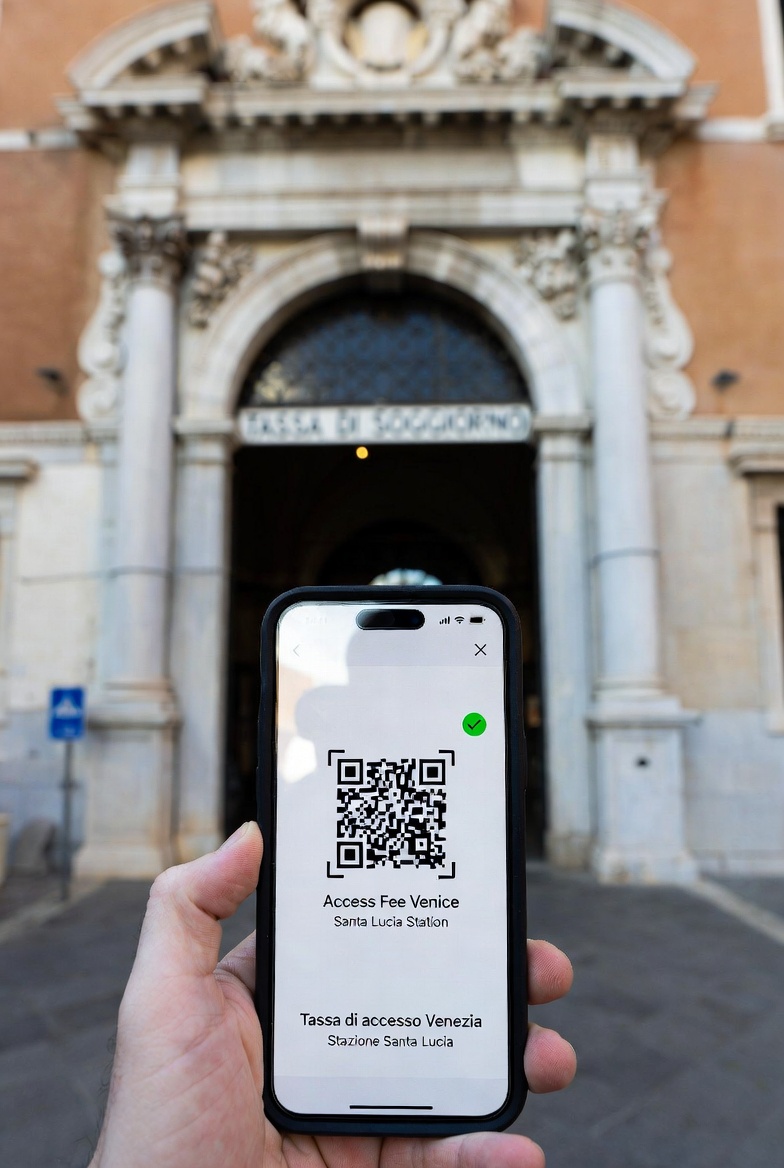
*The direction of travel: digital checks at Europe’s borders — and, as with Venice’s access fee, inside them.*
The timeline at a glance
12 October 2025 — EES begins operating, phased in progressively across Schengen external borders alongside passport stamping.
10 April 2026 — EES becomes fully operational at all external border crossing points; manual passport stamping ends. Every eligible arrival since is registered biometrically.
Summer 2026 — the system’s first peak season; travel press reports multi-hour waits at some major hub airports while first-time registrations dominate.
Mid-July 2026 — the EU removes the “last quarter of 2026” ETIAS launch target from its official pages; reporting indicates the agency building the system considers a 2026 start unfeasible.
September 2026 — the eu-LISA board meets; a revised ETIAS timeline is expected after it. This is the next date worth watching.
ETIAS launch (date unknown; reporting points to 2027 at the earliest) — whenever it comes, the stated design pairs it with a transitional grace period before the €20 authorisation becomes a hard entry requirement.
Bookmark this sequence rather than any single headline: most confusion in circulation comes from articles written at one point on this line and read at another.
How we checked these details
Checked at the end of July 2026 and re-checked 9 August 2026 (when the until-at-least-2027 reporting was added): the EES launch (12 October 2025) and full-operation date (10 April 2026, ending passport stamping) against the European Commission’s and Council’s published information, along with the EU’s reported figure of 45+ million registered crossings; the ETIAS design (€20 fee, under-18/over-70 exemptions, three-year validity, visa-exempt nationalities) against official EU descriptions; and the July 2026 removal of the “last quarter of 2026” launch target — with a revised timeline expected after eu-LISA’s September 2026 board meeting — against contemporaneous reporting led by the Financial Times. Summer 2026 queue reports at specific hub airports are press accounts, not official statistics. This is a fast-moving topic: treat travel-europe.europa.eu as the only authoritative source for launch dates, and expect this article to be updated when the September announcement lands. We have no affiliate relationship with any visa-service, portal or operator — and as the scam section explains, before launch you should not be paying anyone at all.
Final thoughts
The 2026 border story reads like alarming news and resolves, on inspection, into two calm sentences: the queue got slower once and smarter forever, and the €20 form is not for sale yet. Travellers who conflate EES and ETIAS book panic; travellers who separate them book flights. Register once, count your days honestly, keep your money away from look-alike portals, bookmark the official site for the real launch date — and then get back to the decisions that actually shape a Tuscan trip: which month, which base, and which hill town gets your one spare day. The border is administration. Tuscany is the point.
Helpful summary
The short version
Italy entry requirements in 2026, straight: the EES biometric border is live, ETIAS is delayed with no confirmed date, and the 90/180 rule now has teeth.
Frequently asked
FAQ
Keep reading
Italy’s Beach Rules 2026: Booked Beaches, Real Fines & How the System Works
Italy’s 2026 beach rules, verified: which beaches now require booking, the fines that are real (mats, smoking, the 5-metre strip) and how it all works.
12 min read · Updated 2026-08-12

Italy Hotels Without AC in 2026: The Honest Guide to Staying Cool in Tuscany & Siena
Shocked by Italy hotels without AC in Tuscany and Siena? Learn why many rooms hit 38°C, how to book real cooling, and 10 survival tips for summer heat.
9 min read · Updated 2026-07-26

Uffizi Tickets Sold Out? What Actually Works, and What Wastes Your Money
Uffizi sold out for your dates? The honest options — the same-day afternoon ticket, the phone line, real Plan B museums — and the traps to avoid.
14 min read · Updated 2026-09-01