Monteriggioni: Dante Put These Fourteen Towers in Hell, and You Can Walk Them in an Hour
Siena built Monteriggioni in 1213 to watch the Florence road, and Dante turned its towers into giants. What the walled village is honestly like to visit.
In this guide
- Quick answer
- What you are looking at: a border post that never grew up
- The giants: what Dante saw here
- Three centuries of holding — and one April morning of not
- The Assassin’s Creed question, briefly
- The visit: walls, square, and forty-five honest minutes
- Abbadia a Isola: the older, quieter half of the story
- Getting there from Siena (and fitting it into a day)
- How we checked these details
- Final thoughts
- FAQ
Quick answer
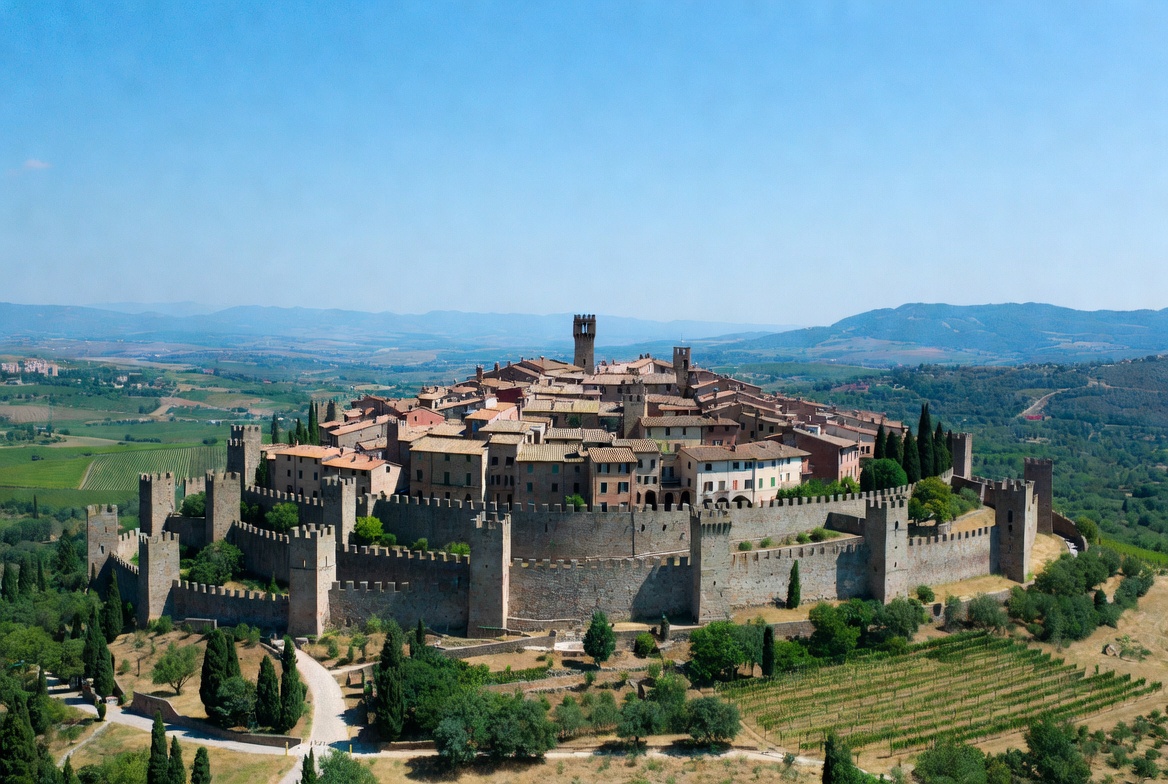
Monteriggioni is the walled village you have already seen, whether you know it or not: a ring of medieval towers on a low hill beside the Siena–Florence road, photographed from the valley for every second Tuscany calendar and rebuilt pixel by pixel as the home base of *Assassin's Creed II*. It is twenty minutes from Siena, it is genuinely intact — the full 570-metre wall circuit and all fourteen towers, built by the Republic of Siena between 1213 and 1219 as a border castle against Florence — and it is small. One street, one square, one church. An unhurried visit, wall-walk included, is one to two hours.
That size is the thing to get right in advance, because it sets both the correct expectation and the correct plan. As a destination in itself Monteriggioni can disappoint; as the best ninety-minute stop in the province — paired with a Siena day, a San Gimignano run or a Via Francigena walk — it is close to perfect. Dante thought the towers looked like giants standing waist-deep in a pit, and put the image into the *Inferno*. From the fields below, on the walk up from Abbadia a Isola, they still do.
This guide covers the history that makes the stones worth more than a photograph, the wall-walk and what it costs, the abbey below that most visitors skip, and the practical ways in from Siena — by bus, by car, and on foot along the pilgrim road the castle was built to watch.
What you are looking at: a border post that never grew up
Monteriggioni was never a town that acquired walls. It was walls that acquired a town — and that distinction explains everything you will see.
In the early thirteenth century the Republic of Siena and the Republic of Florence were two expanding city-states with a soft frontier between them, crossed by the most important road in Europe: the Via Francigena, the pilgrim and trade route from Canterbury to Rome. Between 1213 and 1219 Siena fortified the low hill of Monteriggioni to watch that road and hold that frontier — a purpose-built military installation, garrisoned and provisioned by the city, placed where it could see trouble coming from the north.
The result is the fortification you see today: a roughly circular circuit of about 570 metres, following the contour of the hilltop, studded with fourteen rectangular towers that rise from the outer face of the wall. Two gates pierce the ring, and their names are the whole geopolitical situation in miniature: Porta Franca or Romea, facing Siena and Rome — named for the Francigena itself — and Porta Fiorentina or San Giovanni, facing the Elsa valley and Florence. One road runs between them, through the single square, Piazza Roma (now signed as Piazza Dante Alighieri), where the plain church of Santa Maria Assunta, built in the same campaign as the walls, has stood since the beginning.
Here is why it survived. Successful towns rebuild themselves: they prosper, expand, demolish their old defences, spill into suburbs. Monteriggioni never prospered enough to do any of that. It stayed what it was built to be — a garrison village inside a military perimeter — and when the wars ended, it simply stopped mattering. Centuries of irrelevance are the best conservation policy ever devised. That is why all fourteen towers still stand at close to their original height, a completeness essentially unmatched among Tuscan fortifications, and why the view from the valley floor today is, tower for tower, the view a Florentine scout had in 1220.
The giants: what Dante saw here
Monteriggioni has one line of poetry to its name, and it is a good one — arguably the most vivid thing ever written about a wall.
In **Canto XXXI of the *Inferno*, written in the years after 1308, Dante and Virgil approach the ninth and final circle of Hell. Through the murk Dante sees what he takes for a ring of towers around the central pit, and asks what city he is looking at. They are not towers. They are giants**, standing in the pit with their upper bodies rising above its rim — and to explain the sight, Dante reaches for a real place his readers knew from the road:
*…come su la cerchia tonda / Montereggion di torri si corona…*
"As Monteriggioni crowns itself with towers upon its round enclosure" — so, Dante writes, the giants towered with half their bodies above the bank that rings the pit. A traveller on the Francigena in 1300 crested the rise near Abbadia a Isola, saw fourteen towers standing shoulder to shoulder above a circular wall on the skyline, and — if that traveller was Dante Alighieri — filed the image away for the bottom of Hell.
Two things make the simile land when you visit. First, it only works from below: from inside the village the towers are stubby and domestic, but from the fields on the north and west — the pilgrim's approach — they genuinely read as figures standing in a ring, half-emerged. See it from there if you can. Second, it tells you the castle was famous within a century of being built: Dante could use it as a unit of measurement because everyone travelling between Florence and Rome had seen it. The village returns the compliment — the square is now signed Piazza Dante Alighieri, and the annual festival takes its name, *Monteriggioni di torri si corona*, straight from the line.
Three centuries of holding — and one April morning of not
For over three hundred years Monteriggioni did its job. Florentine armies came at it repeatedly across the fourteenth and fifteenth centuries; the circuit held through siege and assault, which is precisely why the towers were worth Dante's simile — they were not decoration, they were the working armour of the Sienese frontier, and they kept working.
The end, when it came, involved no breach. In the final war between Siena and the Florentine-Imperial forces, the garrison was commanded by Giovannino Zeti, a Florentine exile to whom Siena had entrusted the castle. On 28 April 1554, with the Medici commander Gian Giacomo Medici, Marquis of Marignano, operating against the Sienese state, Zeti opened the gates and handed Monteriggioni over without a fight — in exchange, the accounts agree, for the restoration of his position in Florence. The fortress that three centuries of armies could not take was surrendered by the man holding its keys.
The rest of the story followed within the year: the Sienese field army was destroyed at the Battle of Marciano later that year, Siena itself capitulated in April 1555 after a starvation siege, and the Republic ceased to exist — its territory, Monteriggioni included, folded into the Medici state. The border the castle watched had been abolished, and with it every reason for the castle to be anything at all. Which, as the previous section argued, is exactly why it is still here.
In Siena's long memory Zeti sits in roughly the drawer where Dante kept his giants — the ninth circle was for traitors — and the fall of Monteriggioni is remembered as the beginning of the end. Walk the two gate-names again with that in mind: the castle faced Florence for 340 years and was never taken from that direction. It was opened from inside.
The Assassin’s Creed question, briefly
A measurable share of Monteriggioni's visitors come because of a video game, and the village knows it. *Assassin's Creed II* (2009) rebuilt Monteriggioni as the Auditore family seat — walls, towers, gates and square recognisably surveyed from the real place — and for a generation of players, walking through Porta Franca is walking into their own muscle memory.
The honest expectations, in one paragraph: the wall circuit, the towers, the single street and the square are real and immediately recognisable; the Villa Auditore is not — the game invented a mansion the real village never had, and first-time visitors genuinely do look for it. The town takes the connection in good humour: the tourist office has published its own game-themed itinerary, and the souvenir shops will sell you the hidden-blade merchandise you expect.
We cover the game-versus-reality comparison properly — what was surveyed, what was invented, and how the fan pilgrimage actually goes — in our Tuscany set-jetting guide, which treats Monteriggioni alongside the *Gladiator* and *English Patient* locations elsewhere in the province.
The visit: walls, square, and forty-five honest minutes
Inside the walls, Monteriggioni is one street, one square, the church of Santa Maria Assunta, a handful of restaurants and shops, and the gardens that fill the rest of the ring — the open space that once quartered a garrison. You can walk gate to gate in five minutes. What turns the stop from a photograph into a visit is going up.
The wall-walk. A stretch of the parapet — currently the southern section; the circuit has never been fully walkable in recent years — is open as a raised walkway, reached from inside the village, with the *Monteriggioni in Arme* display of reproduction medieval arms and armour attached as a small educational exhibition. From the parapet you get the two views that justify the climb: down the ring of towers along the wall's outer face, and out over the Montagnola and the Elsa valley — the exact sightlines the wall was built to provide, toward the road from Florence.
Tickets and hours, with a caveat. Entry to the village itself is free and unticketed at all hours; the wall-walk and exhibition are sold together as one inexpensive combined ticket, which per the commune's tourism office also covers the MAM archaeological museum at Abbadia a Isola below the hill. Published opening runs daily through the main season, morning and afternoon (roughly 9:30–13:30 and 14:00–19:30, closing earlier in low season), with scheduled guided-tour slots on top. We could not pin the current tariff to the euro from here — third-party guides list a few euros, and figures have shifted as sections opened and closed — so treat it as pocket-change and confirm at the ticket office on Piazza Roma when you arrive. Note also that the walkways close entirely during the July festival.
The festival. For one long weekend each July the village stages *Monteriggioni di torri si corona*, a medieval festival named from Dante's line — costumed camps, falconry, musicians and craft demonstrations, with euros exchanged at the gate for the *Grosso*, the festival's medieval currency. The 2026 edition, the thirty-third, ran 9–12 July, opening with a banquet. If your dates are near mid-July, check the programme before you plan: the festival transforms the village, charges admission, and suspends the ordinary quiet that is otherwise its main commodity.
Timing the ordinary visit. Tour buses deliver their peak between late morning and mid-afternoon, and a village this size has no capacity to absorb them invisibly. Before about 10:00 or after 17:00 you get the place approximately to yourself, the parapet light is better, and dinner in the square — if you are staying for it — comes with empty battlements above you (our day-trip restaurants guide names the square's long-standing table).
Abbadia a Isola: the older, quieter half of the story
Four kilometres from the castle, on the flat where the marshes used to be, sits a huddle of stone buildings around a Romanesque church — and it out-ranks Monteriggioni historically by two centuries. This is Abbadia a Isola, the abbey of Santi Salvatore e Cirino, founded in 1001 by the countess Ava dei Lambardi on a spot chosen for exactly the reason Monteriggioni's hill was chosen later: it controlled the Via Francigena.
The site was a named stop on the pilgrim road even before the abbey existed. When Sigeric, Archbishop of Canterbury, recorded the seventy-nine stages of his journey home from Rome in 990 — the itinerary that effectively defined the Francigena — he noted a halt here under the name *Borgonuovo*. For centuries afterwards, one of the abbey's principal functions was hospitality: lodging, care and a safe night for Rome-bound travellers crossing what was then an insecure, malarial plain. The "Isola" — island — in the name is literal; the abbey stood above the wet ground like one.
The relationship between the two sites is the lesson of the place: the abbey served the road, the castle watched it — the same road, two centuries and two institutions apart, church and state each building their answer to the Francigena within sight of each other. Today the abbey complex holds the small MAM archaeological museum (on the combined ticket mentioned above), and the hamlet is the trailhead for the best arrival Monteriggioni has:
Walk up the way the pilgrims came. The final stretch of the Francigena's San Gimignano–Monteriggioni stage runs from Abbadia a Isola up to the castle on farm tracks, and it is the single best thing you can do here that most visitors do not: the towers rise slowly over the fields ahead of you, assembling themselves into Dante's ring of giants exactly as they did for seven centuries of foot travellers. Our Via Francigena section-by-section guide places this stretch in the full stage; as a there-and-back walk from the abbey it is four kilometres each way on mostly gentle farm tracks, with the climb saved for the end — a half-day with the visit included.
Getting there from Siena (and fitting it into a day)
By bus. From Siena, the 130 and 131 buses serve the Colonna di Monteriggioni stop on the main road below the village — around twenty minutes, though not every run on the route stops there, so confirm the departure serves Colonna before boarding. From the stop it is 500 uphill metres to Porta Franca, a fifteen-to-twenty-five-minute walk depending on your legs. Our car-free Tuscany guide covers the ticketing and the general art of Sienese buses.
By car. Monteriggioni sits just off the Siena–Florence *raccordo*, which makes it the easiest detour in the province — this is why every driving itinerary between the two cities includes it. Parking sits just outside the walls, inexpensive and seasonally priced, with the last stretch on foot. If you are driving Tuscany anyway, the natural pattern is Monteriggioni as the first or last hour of a day built around something bigger.
On foot. The full Francigena stage from Monteriggioni into Siena — officially 18 km, nearer 20 by GPS, five to six hours — is the classic way to *leave*: sleep in or near the village, walk out of Porta Franca at dawn and arrive in Siena the way twelve centuries of pilgrims did. Our dedicated day-walk guide covers that stage in full, including its one real problem (almost no water or refreshment on the route — carry everything).
Fitting it in. The honest pairings, in order of how well they work: Siena + Monteriggioni (the bus makes this car-free-feasible; the castle is Sienese history's opening chapter and the city is its centre); San Gimignano + Monteriggioni by car, the two great tower-scapes of the province in one day, compared properly here; and Monteriggioni as the stop that finally makes the Florence–Siena drive worth taking by road instead of rail. What it is not, for most people, is a full day on its own — and planning it as one is the only way this place disappoints anyone.
How we checked these details
Checked 19 August 2026, by web research; direct page fetches are blocked in our environment, so this rests on search-surfaced material, led by the commune's own tourism office (Monteriggioni Porta del Medioevo) and the regional tourism board, rather than pages we opened.
Verified: construction of the circuit by the Republic of Siena in 1213–1219 as a defensive outpost against Florence on the Via Francigena; the ~570-metre circular circuit with fourteen rectangular towers surviving at near-original height; the two gates (Porta Franca/Romea toward Siena and Rome, Porta Fiorentina/San Giovanni toward the Elsa valley) and the church of Santa Maria Assunta on the main square, built with the castle; the Dante passage (*Inferno* XXXI, the giants compared to Monteriggioni's towers, composed after 1308); centuries of successful resistance to Florentine attack; the surrender of 28 April 1554 by the garrison commander Giovannino Zeti, a Florentine exile, to Gian Giacomo Medici, Marquis of Marignano, in exchange for his rehabilitation in Florence, followed by Marciano, the siege of Siena and the Republic's end in 1555; the founding of the abbey of Santi Salvatore e Cirino at Abbadia a Isola in 1001 by Ava dei Lambardi; Sigeric's 990 itinerary recording the site as *Borgonuovo*; the abbey's hospitality function on the Francigena; the wall-walk's current south-section opening with the *Monteriggioni in Arme* exhibition on a combined ticket that also covers the MAM museum at Abbadia a Isola, with daily two-session seasonal hours and festival-period closure; the festival *Monteriggioni di torri si corona*, 33rd edition, 9–12 July 2026, with the *Grosso* as festival currency; the 130/131 bus to Colonna di Monteriggioni with the 500-metre uphill walk; parking just outside the walls at inexpensive, seasonally varying rates; and the ~4 km Abbadia a Isola–Monteriggioni distance on the Francigena. Francigena stage figures (San Gimignano leg 31 km; Monteriggioni–Siena 18 km official, ~20 km by GPS) follow the verification in our Francigena guides.
Stated with deliberate imprecision: the wall-walk tariff — third-party guides list it at a few euros, but we could not confirm the commune's current figure in this session, and it has shifted with section openings; confirm at the ticket office (Piazza Roma, +39 0577 304834) or on the commune's tourism site. Exact seasonal hours likewise: the two-session pattern is published, but verify the day's times on arrival, especially outside high season.
We have no commercial relationship with the commune of Monteriggioni, the festival, or any business named. Nothing on this page is bookable through us.
Final thoughts
Monteriggioni is a supporting character that photographs like a lead. Treat it as the lead and you will be back at the car park in ninety minutes wondering what the fuss was; treat it as the best supporting character in Tuscany and it is faultless — the frontier post that explains why Siena and Florence hate each other, the wall that Dante hung his giants on, the gates that held for 340 years and were opened from inside in a morning.
If you take one piece of advice from this page, make it the approach: get yourself below the walls — from Abbadia a Isola on foot if you possibly can — and let the fourteen towers come up over the fields the way they did for every pilgrim, merchant and Florentine scout who ever walked this road. Half their bodies above the rim, exactly as described. Then go up, walk the parapet, have lunch on the square, and be somewhere bigger by mid-afternoon. That is not faint praise. It is the correct dose of a perfect small thing.
Helpful summary
The short version
Siena built Monteriggioni in 1213 to watch the Florence road, and Dante turned its towers into giants. What the walled village is honestly like to visit.
Frequently asked
FAQ
Keep reading
Volterra: Etruscan Urns, Alabaster Dust, a Working Prison, and No Vampires
Volterra in full: Etruscan urns, the 1208 Palazzo dei Priori, Roman theatre, alabaster workshops, the Balze, the €23 card and the Twilight truth.
11 min read · Updated 2026-09-26
The Chianti Classico Towns: Greve, Castellina, Radda and Gaiole, Compared Honestly
Greve, Castellina, Radda and Gaiole compared: the square and expo, the vaulted street, the hilltop, the castles and Brolio, plus bus 125 from Siena.
11 min read · Updated 2026-09-25
Colle di Val d’Elsa: The Crystal Town Between San Gimignano and Siena That Everyone Skips
Colle di Val d’Elsa: the town that makes most of Italy’s crystal, its €6 museum in the old furnaces, Arnolfo’s birthplace, the upper town and the lift.
11 min read · Updated 2026-09-24