Pienza: The Pope Who Rebuilt His Village as the Ideal City, and the Cliff Slowly Taking It Back
Pienza in full: Pius II and Rossellino’s 1459–62 ideal city, the Duomo’s famous crack, Palazzo Piccolomini, the Città di Luce pass and the walls walk.
In this guide
- Quick answer
- The pope, the architect and the bill
- Piazza Pio II: the whole design in one view
- The crack: a cathedral built on the edge
- Inside the palace and the Diocesan Museum
- The walls walk, the love streets, and the church where the pope was baptised
- Eating, getting there, and the day it fits
- How we checked these details
- Final thoughts
- FAQ
Quick answer
Pienza is the only town in Tuscany that was *designed* — drawn, costed and built in four years, 1459 to 1462, by a pope remaking the village where he was born into a Renaissance "ideal city". It is a UNESCO World Heritage site twice over: its historic centre was inscribed in 1996, eight years before the surrounding Val d'Orcia landscape followed in 2004. And it is small enough that the whole design — square, cathedral, papal palace, bishop's palace, town hall — is taken in from one spot on one small square of brick and travertine.
What to know before you go: the paid sights are bundled into a single "Pienza Città di Luce" pass (Palazzo Piccolomini and its hanging garden, the Diocesan Museum in Palazzo Borgia, the cathedral's crypt and drainage "labyrinth", audioguide included, valid two days — around €10 at our check, with the cathedral itself free); Palazzo Piccolomini closes on Mondays and for two winter stretches; the Duomo is visibly cracking and sinking toward its cliff, which is not a problem to worry about but the best story in town; and the pecorino shops that line the main street have an entire article of their own.
Give it half a day — the design in an hour, the palace and museum in another, the walls walk and lunch to finish — as the anchor of a Val d'Orcia day with San Quirico, Montalcino or the postcard pull-offs around it. This guide covers the pope, the architect, the square, the crack, the tickets, the walk and the logistics.
The pope, the architect and the bill
Every other Tuscan hill town grew. Pienza was decided.
The village on this ridge was called Corsignano, and a boy named Enea Silvio Piccolomini was born here to a Sienese family in provincial exile. He became a humanist, a poet, a diplomat, a bishop, and in 1458 Pope Pius II. Within a year of his election he had decided to remake his birthplace as a demonstration of the new architecture, and he gave the job to Bernardo Rossellino, a Florentine pupil of Leon Battista Alberti and one of the first architects to think in terms of a whole composed townscape rather than a single building.
Rossellino worked fast. Between 1459 and 1462 the centre of Corsignano was cleared and rebuilt: the cathedral, the pope's own Palazzo Piccolomini, the bishop's palace, the town hall and the canons' house, all arranged around a new square paved in a grid of brick and travertine so that the buildings read as one design. The pope renamed the village Pienza — "Pius's town" — and the work was complete by 1462.
Then came the bill. Rossellino had run far over his estimates and, by the accounts that have come down through the *Commentaries* — Pius II's own memoir, the only autobiography ever written by a reigning pope — had kept the true cost from his client. The pope, reportedly, looked at what had been built and told him: "You did well, Bernardo, in lying to us about the expense." It is the most quoted sentence in the history of Pienza, and it explains the place: this was a town built by a man who had already decided the result was worth more than the money.
Pius II died two years later, in 1464, and the project stopped almost where he left it — which is why Pienza is so legible. The Renaissance ideal city is usually a drawing; here it is a square you can stand in, frozen at the moment its patron's money and life ran out. Siena's cathedral library, frescoed by Pinturicchio with scenes from this same man's life, is the other half of the story.
Piazza Pio II: the whole design in one view
Stand in the middle of the square and turn slowly. Everything that matters is in view.
The Duomo (Santa Maria Assunta) closes the south side: a Renaissance travertine façade carrying the Piccolomini arms, and behind it a surprise — an interior in the Germanic late-Gothic manner Pius asked for, tall, three-naved and flooded with light: he wanted his cathedral luminous rather than dim. "City of light" is the town's own phrase for the effect, and the altars carry it through: four altarpieces commissioned from the Sienese painters of the 1460s — Giovanni di Paolo (the St Anthony altarpiece, where the circuit begins in the right aisle), Sano di Pietro (a Madonna with Mary Magdalene, Philip, James and Anne, still Gothic in spirit), Matteo di Giovanni (a Madonna enthroned with Saints Jerome, Martin, Nicholas and Augustine) and, the highlight, il Vecchietta's Assumption of the Virgin of 1460–63. They are among the earliest altarpieces to sit Renaissance, classically framed compositions on the old Sienese gold ground — the school changing style in a single room. Entry to the church is free.
Palazzo Piccolomini, to the right of the cathedral, is the pope's residence — built in the new Florentine manner of Rossellino's teacher Alberti — with its famous loggia and hanging garden opening onto the Val d'Orcia and Monte Amiata behind. The view from the garden is the one the square was orientated to give its patron. If the façade looks familiar, it may be from the cinema: **Zeffirelli filmed the Capulet household scenes of his 1968 *Romeo and Juliet* here**.
Palazzo Borgia, the bishop's palace on the other flank, holds the Diocesan Museum (next section). The Palazzo Comunale faces the cathedral across the square and completes the set — civic power looking at sacred power, with the pope's house between them. The paving's grid of travertine bands is not decoration: it is the drawing, laid on the ground, that ties the four buildings into one composition.
The crack: a cathedral built on the edge
Rossellino placed the cathedral at the very edge of Pienza's ridge, so that the great windows of the apse would catch the light off the valley. It was a beautiful decision and a structural mistake, and the building has been paying for it for five and a half centuries.
The ground under the apse is slowly giving way. Inside, look for the long crack that runs across the floor and up the left wall toward the altar end, and then look at the columns: they step lower as they approach the apse, because the foundations on the cliff side have sunk beneath them. Beneath the church, the crypt opens onto what the town calls the labyrinth — a system of drainage tunnels dug under the apse to carry water away from the failing ground and slow the subsidence. Both are on the Città di Luce pass, and they turn a pretty church into a gripping one: the ideal city's cathedral has been in a fight with geology since the day it was consecrated, and the engineering of that fight is now part of the visit.
None of this is a reason to hesitate — the building is open — but it is the detail that separates the visitor who has looked from the one who has only photographed. Pius wanted light at any price; the price is still being paid.
Inside the palace and the Diocesan Museum
Palazzo Piccolomini. The audioguided tour takes you through the piano nobile's furnished rooms and out to the loggia and the hanging garden — a small formal garden suspended over the valley, and the finest single view in Pienza. The rooms are furnished, so the palace still feels inhabited rather than curated.
The Diocesan Museum in Palazzo Borgia is the town's unexpected depth. Its two great holdings: Pietro Lorenzetti's Madonna di Monticchiello, one of the finest early fourteenth-century Sienese panels outside Siena, and the Cope of Pius II — a magnificent embroidered liturgical vestment given to the pope by the Byzantine despot Thomas Palaiologos, which Pius passed to his new cathedral along with a pastoral staff, mitre, thurible and aspergillum that the museum still shows. Around them: another Vecchietta — a Madonna enthroned with Saints Blaise, John the Baptist, Nicholas and Florian, bright and perspectival with Florentine influence — and a strong run of fifteenth-century Sienese painting and sacred textiles.
Tickets and hours, with their caveats — checked 10 September 2026.
| Site | Published pattern | Price |
|---|---|---|
| Città di Luce pass (palace + garden, Diocesan Museum, crypt + labyrinth, audioguide in eight languages; valid two days) | Managed as one circuit since 2024 | ~€10 adult, indicative — confirm at the ticket point |
| Palazzo Piccolomini alone | 15 Mar–15 Oct Tue–Sun 10:00–18:30; 16 Oct–14 Mar Tue–Sun 10:00–16:30; closed Mondays, 7 Jan–14 Feb and 16–30 Nov | ~€7 with audioguide at our check |
| Diocesan Museum | 30 Mar–1 Nov 2026 daily 10:00–18:30 (last entry 18:00); 1–29 Mar 10:00–16:30, closed Tuesdays | on the pass |
| Cathedral | Church hours | Free |
Two planning consequences: do not come on a Monday expecting the palace, and in winter check the palace's two closure windows before building the day around it. The pass's two-day validity suits an overnight in the valley.
The walls walk, the love streets, and the church where the pope was baptised
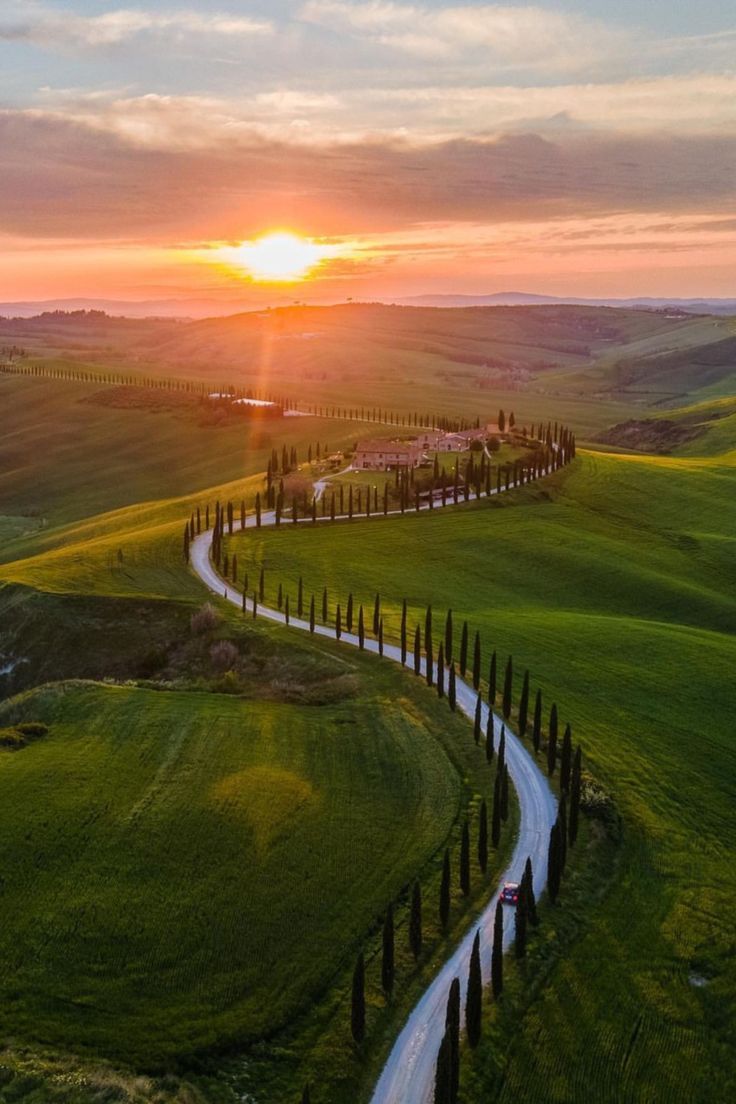
Via del Casello — the *passeggiata panoramica* — runs along the southern edge of the town on the line of the walls, and it is where the Val d'Orcia does the thing Pienza was built to frame: the whole valley falling away below, Monte Amiata closing the view, the cypress roads threading the fields. Every guide will send you here; go anyway, early or at golden hour, and then turn back into the lanes that feed it — Via dell'Amore, Via del Bacio, Via della Fortuna: Love Street, Kiss Street, Fortune Street, a cluster of romantic names that have become the town's most photographed signs. The lanes are genuine and old; the names are the charm.
The Pieve di Corsignano is the visit almost everyone skips and the one that completes the story. A short walk below the town, the twelfth-century Romanesque parish church of the old village stands where Corsignano was before Pius renamed it — and inside, on a Romanesque capital, the plain stone font in which Enea Silvio Piccolomini was baptised, and in which his nephew Pius III would be baptised after him. The ideal city begins here, in a building its creator left untouched. Half an hour, and you have both ends of the man's life within a kilometre.
The pecorino street. The main street is lined with cheese shops, and our Fiera del Cacio guide is the full treatment — ages, rinds, how to taste, the September cheese-rolling festival. The short version for this page: taste young to old, buy the stagionato for the journey home, and eat the fresco here.
Eating, getting there, and the day it fits
Lunch. Pienza's two named tables are in our day-trip restaurants guide: Sette di Vino for the pecorino-and-lardo osteria graze (no lunch reservations — arrive at opening or queue) and Latte di Luna for the roast *maialino*. Both book up or queue in season; the square's own terraces are for the view, not the food.
Getting there. Pienza sits on bus line 112 from Siena — the Val d'Orcia towns bus through San Quirico, continuing to Montepulciano — with roughly four usable weekday connections and journeys around an hour and a quarter to an hour and a half; plan the return before committing, and treat Sundays as a separate problem. By car, the town is the natural hub of the valley loop: the historic centre is pedestrian, with paid blue-line parking around the edge and a main car park on the north side of town across from the small Coop supermarket — the one to aim for.
The screen trail. Pienza's cinema record runs past Zeffirelli: Gladiator's Elysian Fields were shot on the Terrapille farm track about three kilometres south of town, and the 2026 romantic comedy *You, Me & Tuscany* used Pienza as its village hub — our set-jetting guide maps all of it and the etiquette for the farm lanes.
The day that works. Pienza is the one Val d'Orcia town that rewards the *middle* of the day — the pass's interiors absorb the flat noon light that ruins the viewpoints — so the pattern is: golden-hour pull-offs early, Pienza's square, palace and museum through the middle, lunch, the walls walk as the light lengthens, and Bagno Vignoni or Castiglione's fortresses to finish. In the first week of September the Fiera del Cacio rearranges everything; on the truffle weekends of November, the season guide applies.
How we checked these details
Checked 10 September 2026, by web research; direct page fetches are blocked in our environment, so this rests on search-surfaced material — the Pienza Città di Luce circuit's own pages, the Fondazione Musei Senesi, the town's tourism portal, the regional tourism board and UNESCO's listing — rather than pages we opened.
Verified: the village's earlier name of Corsignano and Pius II's birth there; Rossellino's rebuilding in 1459–1462 as a pupil of Alberti, the brick-and-travertine square and the four buildings around it; the renaming as Pienza and UNESCO's inscription of the historic centre in 1996 (with the Val d'Orcia landscape following in 2004); the reported *Commentaries* anecdote of Pius forgiving Rossellino's concealed overspend; the cathedral's Renaissance façade, German-inspired late-Gothic three-nave interior and four Sienese altarpieces (Giovanni di Paolo's St Anthony, Sano di Pietro's and Matteo di Giovanni's Madonnas, Vecchietta's Assumption of 1460–63); the subsidence — the crack along the floor and left wall toward the apse, the columns lowering toward the apse, and the crypt's drainage labyrinth under the apse; Palazzo Piccolomini's loggia and hanging garden and its use for the Capulet scenes of **Zeffirelli's 1968 *Romeo and Juliet*; the Diocesan Museum's Madonna di Monticchiello by Pietro Lorenzetti, Cope of Pius II from Thomas Palaiologos, the pope's staff, mitre, thurible and aspergillum, and Vecchietta's Madonna with Saints Blaise, John the Baptist, Nicholas and Florian; the Città di Luce single-circuit arrangement since 2024 with two-day validity, free audioguide in eight languages and free cathedral entry; the published hours for Palazzo Piccolomini (seasonal Tue–Sun pattern with the two closure windows) and the Diocesan Museum (2026 seasonal pattern); the Pieve di Corsignano** as twelfth-century Romanesque with the font of Pius II and Pius III; the street names and the Via del Casello panoramic walk; the paid blue-line parking and the north-side car park by the Coop; and the line 112 figures from our car-free guide.
Stated with deliberate care: the pass price (~€10) and the palace's stand-alone price (~€7), which third-party listings give as indicative — confirm at the ticket point; the exact current stand-alone arrangements now that the circuit is unified; and Monte Amiata's place in the view, which is geography rather than a checked fact. Hours change seasonally — verify your date on the circuit's site.
We have no commercial relationship with the Città di Luce circuit, Opera Laboratori, any museum, shop or restaurant named. Nothing on this page is bookable through us.
Final thoughts
Most beautiful towns are accidents that took centuries. Pienza is an argument that took four years: one man's case for what a city should look like, built with money he chose not to count, and left exactly where his death stopped it. That is why it photographs like a stage set and why it rewards a second hour — because once you know the plan, the square stops being a backdrop and becomes a drawing you are standing inside.
Read the paving, find the crack, climb to the garden the pope built his view for, walk the wall at the light's end, and then go down to the little Romanesque church where the whole thing began with a baptism. The cheese is very good too. But Pienza was never about the cheese; it was about a pope who looked at his village and decided it could be perfect — and very nearly was, for as long as the cliff allows.
Helpful summary
The short version
Pienza in full: Pius II and Rossellino’s 1459–62 ideal city, the Duomo’s famous crack, Palazzo Piccolomini, the Città di Luce pass and the walls walk.
Frequently asked
FAQ
Keep reading
Val d’Orcia Day Trip from Siena: Pienza, Montalcino & Montepulciano (2026 Guide)
The Val d’Orcia from Siena: a realistic route through Pienza, Montalcino and Montepulciano, by car or on the thin weekday bus.
7 min read · Updated 2026-07-18
Volterra: Etruscan Urns, Alabaster Dust, a Working Prison, and No Vampires
Volterra in full: Etruscan urns, the 1208 Palazzo dei Priori, Roman theatre, alabaster workshops, the Balze, the €23 card and the Twilight truth.
11 min read · Updated 2026-09-26
The Chianti Classico Towns: Greve, Castellina, Radda and Gaiole, Compared Honestly
Greve, Castellina, Radda and Gaiole compared: the square and expo, the vaulted street, the hilltop, the castles and Brolio, plus bus 125 from Siena.
11 min read · Updated 2026-09-25