San Quirico d’Orcia: The Town Everyone Drives Through, and Almost Everyone Gets Wrong
The elegant Via Francigena town at the centre of the UNESCO Val d’Orcia: Sigeric’s Collegiata, a free Renaissance garden and the lunch the coaches skip.
In this guide
- Quick answer
- Sigeric’s town: the Collegiata and the pilgrim street
- Horti Leonini: a public garden four centuries early
- Two festivals: an emperor in June, oil in December
- The postcard problem: the famous views are outside town
- Eating, getting there, and using the town properly
- How we checked these details
- Final thoughts
- FAQ
Quick answer
Every Val d'Orcia itinerary passes through San Quirico d'Orcia, and almost none of them stop properly. The tour coaches aim for Pienza and Montalcino; the road threads San Quirico's edge; and the town itself — the administrative and geographic heart of the valley UNESCO inscribed in 2004 — is left to the people who know. What they know is this: San Quirico has the valley's best Romanesque church, a free Renaissance garden built for the public four centuries before public parks existed, the region's most usable lunch stop, and the only genuinely walkable historic centre on the 112 bus line between Siena and Montepulciano.
The town's whole identity comes from one fact: it is a Via Francigena town — a stop on the Canterbury–Rome pilgrim road, recorded by Archbishop Sigeric in 990, with the pilgrim infrastructure still standing on the main street: the Collegiata that grew from the church Sigeric knew, and the Ospedale della Scala that fed and sheltered the road's travellers. Where Montalcino performs from its fortress and Pienza performs from its balcony, San Quirico simply carries on being what it always was: the town that looks after people passing through.
Give it two hours, or give it lunch — or make it the base for the whole valley. This guide covers the church and its carved portals, the garden, the two festivals, the postcard viewpoints outside town, and the practical case for stopping in the place everyone else drives through.
Sigeric’s town: the Collegiata and the pilgrim street
In 990, when the Archbishop of Canterbury walked home from Rome noting his seventy-nine overnight stops — the diary that effectively drew the Via Francigena — he recorded a halt at San Quirico. The church he saw, dedicated to the child-martyr Saint Quiricus, already had two centuries of records behind it: the first mentions of the building date to the eighth century.
What stands on the spot now is the town's masterpiece: the Collegiata dei Santi Quirico e Giulitta, rebuilt in the twelfth century and refined for five hundred years after. Its glory is its three carved portals, each from a different age — Romanesque, Gothic and Baroque — so that the church's front pages read like a history of Tuscan sculpture:
- The main portal is the one on the postcards: Lombard-style, a round-arched porch on paired sandstone columns knotted together at their centres and resting on carved lions — one of the finest Romanesque doorways in the province.
- The side portal of 1288 is attributed to Giovanni Pisano, then at work on Siena's cathedral — meaning this small pilgrim town plausibly got a doorway from the leading sculptor of his generation.
Across from the church of Santa Maria Assunta, further along the main street, stands the entrance to the Ospedale della Scala — the pilgrim hospital run under Siena's great Santa Maria della Scala, whose rural estates reached deep into the Val d'Orcia. This is the detail that makes San Quirico legible: the same institution that received pilgrims at the end of the road's Sienese stage also ran the way-station here, one day's walk south. Church, hospital, street — the complete medieval service infrastructure, still in place, still walkable in twenty minutes.
If the Via Francigena's Tuscan route interests you at all, this is its southern showcase: the official route passes through town, and walkers still come up the main street exactly as their predecessors did for a thousand years.
Horti Leonini: a public garden four centuries early
In the heart of the town sits the thing that most surprises first-time visitors: a full Renaissance Italian garden, free to enter, and conceived that way from the start.
The Horti Leonini were laid out in 1581 by Diomede Leoni, on land granted by Francesco I de' Medici, and their founding idea was genuinely radical: not a private garden for a court, but a green space open to the "comfort of wayfarers and pilgrims" — a public amenity on the pilgrim road, four centuries before the public park became a European normality. The Francigena logic again: even the town's Renaissance showpiece exists to look after people passing through.
The design is textbook Italian formal garden, and all the better for being walkable in half an hour: a lower parterre in a rhombus of triangular box-hedged beds, enclosed by walls and clipped holm oaks, with an upper level that hosts the town's events. The garden regularly doubles as an open-air gallery — Forme nel Verde, a contemporary sculpture exhibition held here — and its upper ground stages the archery contests of the town's June festival; check what is on when you visit.
Two practical notes. First, the garden is the town's best picnic and decompression stop — free, shaded, and never crowded in the way the valley's viewpoints are. Second, it is the single best argument for getting out of the car here: Pienza's fame comes with Pienza's crowds, while San Quirico's showpiece costs nothing, asks nothing, and is rarely shared with more than a handful of people.
Two festivals: an emperor in June, oil in December
San Quirico's calendar has two fixed points, at opposite ends of the year, and both are the town explaining its own history.
June: the Festa del Barbarossa. In 1155 the Holy Roman Emperor Frederick I — Barbarossa — camped in these lands on his way to meet envoys of Pope Adrian IV: empire and papacy negotiating on the pilgrim road, with San Quirico as the meeting ground. The town has re-enacted the moment every June since the mid-twentieth century — a costumed re-enactment with processions and the festival's archery contests fought on the upper ground of the Horti Leonini. The 2026 edition ran 17–21 June; if your dates land in mid-June, check the programme before planning, because the town transforms — and if you visited Buonconvento, note the symmetry the two towns' festivals commemorate: one emperor negotiating on this road in 1155, another dying on it in 1313.
December: the Festa dell'Olio. The Val d'Orcia's new-oil festival, held here every early December since 1993 — guided tastings, producers selling direct, and the year's *olio nuovo* at its sharp green best. Our olive harvest guide explains why early December is exactly when you want to be tasting it.
Between the two, the town keeps the valley's ordinary rhythm — which, in the vendemmia weeks of September and the golden October that follows, is itself the show.
The postcard problem: the famous views are outside town
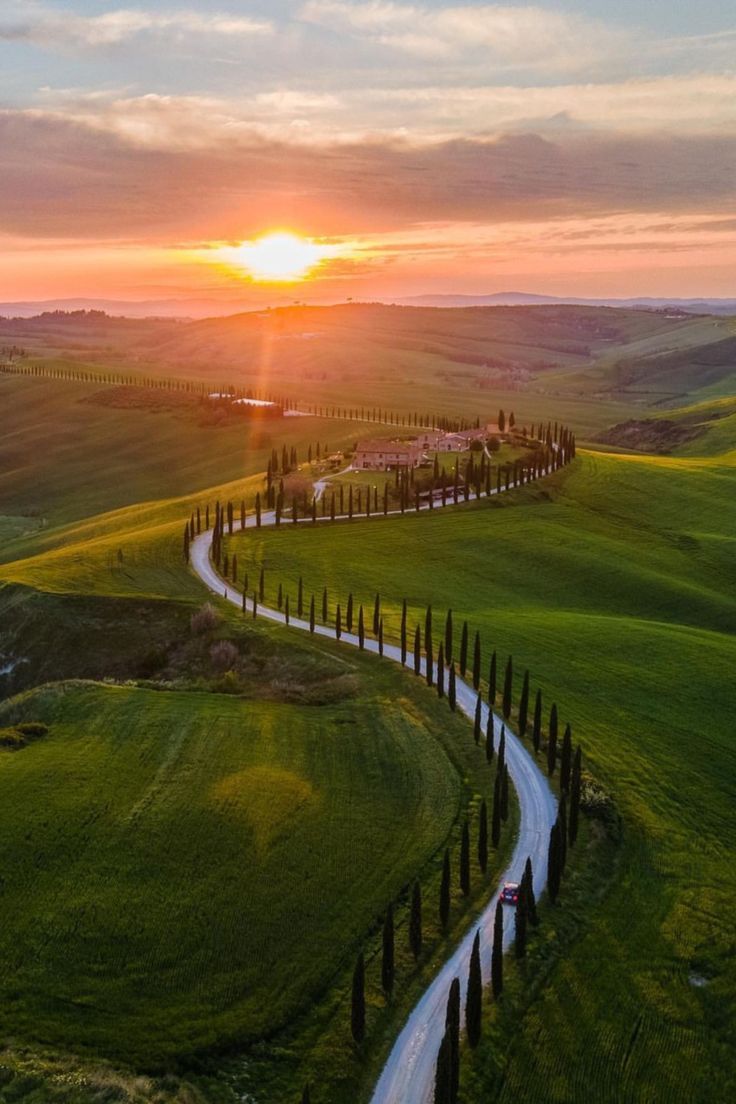
Here is the useful, slightly deflating truth about the Val d'Orcia's most photographed spots: several of the best-known — the Cappella di Vitaleta, the lone chapel on its cypress ridge, and the cypress circle — stand in the countryside around San Quirico, not in any town at all. San Quirico is the postcard country's service town: the photographs are shot from small roadside pull-offs within a few minutes' drive, and our Val d'Orcia loop guide routes them properly.
Three rules make the difference between the photograph and the disappointment:
- Go at the edges of the day. The pull-offs are small and fill quickly from mid-morning through afternoon in season; golden hour is both the emptiest and the best light. This is the same advice our driving guides give, and it matters most here.
- Respect the land. The fields around the icons are working farms. Photograph from the road and the marked paths; do not walk crops for a better angle.
- Remember why it looks like this. The valley was inscribed by UNESCO in 2004 as a cultural landscape — across the five comuni of San Quirico, Pienza, Montalcino, Castiglione d'Orcia and Radicofani — precisely because this is farmland shaped by centuries of deliberate human design, celebrated for its influence on Renaissance painters. The view is not scenery that happens to contain farms; it is farming that became scenery.
And when the light goes flat in the middle of the day — the hours when the viewpoints give least — that is exactly when the town itself, the church and the garden and the long lunch, gives most. Structure the day that way and San Quirico stops being a drive-through.
Eating, getting there, and using the town properly
Lunch is the town's superpower. Our Val d'Orcia and food guides both make the same point: San Quirico feeds you better value than the famous towns' main squares, because its trattorias still price for the valley rather than for the coaches. The local orders: pici with wild-boar or aglione sauce, Cinta Senese pork, pecorino from neighbouring Pienza without Pienza's queue. For named picks, our day-trip restaurants guide covers San Quirico's best-known table — and the town also rewards the standard method: walk the main street, pick the room with locals in it.
By bus. San Quirico sits on Autolinee Toscane's line 112 from Siena (the Val d'Orcia towns bus, continuing to Pienza and Montepulciano): about 50–55 minutes, weekdays, with only around four usable connections a day — so plan the return before committing, and treat Sundays as a different problem entirely. Among the valley's towns it is the most rewarding one to reach this way, because everything worth seeing is inside a compact, mostly level centre.
By car. The town sits just off the Via Cassia (SR2) — the Francigena's modern descendant — a drive of well under an hour south from Siena, and works either as the anchoring stop of the classic valley loop or as the first coffee of a driving day, before the pull-offs fill.
As a base. Quiet after the day visitors leave, central to everything — Pienza and Montalcino each a short drive, Bagno Vignoni's thermal square just to the south — and a calmer place to sleep than its famous neighbours. For a two-day valley visit built around light, staying in San Quirico puts both of the day's golden hours on your doorstep.
One honest caveat: the town is elegant rather than dramatic. It has no fortress to climb, no famous balcony, no single wow. Its pleasures are a doorway, a garden, a street and a table — cumulative, not instant. Travellers chasing the spectacular should day-trip through; travellers who have already done the spectacular tend to end up here, and to say afterwards it was the stop they liked best.
How we checked these details
Checked 21 August 2026, by web research; direct page fetches are blocked in our environment, so this rests on search-surfaced material — led by the regional tourism board, the comune's visitor site and the garden's heritage listings — rather than pages we opened.
Verified: Sigeric's recorded halt at San Quirico on his 990 itinerary; the eighth-century first records of the church and the twelfth-century rebuilding as the Collegiata dei Santi Quirico e Giulitta; the three portals of different eras, the Lombard main portal with knotted columns on lions, and the 1288 side portal attributed to Giovanni Pisano; the Ospedale della Scala pilgrim hospital with its entrance on the main street opposite the church of Santa Maria Assunta, and the Sienese hospital's landholdings in the valley; the Horti Leonini — laid out in 1581 by Diomede Leoni on land granted by Francesco I de' Medici, conceived as a garden open for the comfort of wayfarers and pilgrims, free to enter, with its rhombus parterre of box-hedged triangular beds, the Forme nel Verde sculpture exhibitions and the festival archery on its upper ground; the Festa del Barbarossa commemorating Frederick Barbarossa's 1155 encampment to meet Pope Adrian IV's envoys, with the 2026 edition on 17–21 June; the Festa dell'Olio held each early December since 1993; and the 2004 UNESCO inscription of the Val d'Orcia as a cultural landscape across the five comuni of San Quirico d'Orcia, Pienza, Montalcino, Castiglione d'Orcia and Radicofani, cited for its conserved agricultural landscape and its influence on Renaissance painting. Transport figures — the line 112 bus (50–55 minutes, roughly four usable weekday connections, continuing to Pienza and Montepulciano) and the driving approach on the Cassia — follow the verification in our car-free guide and Val d'Orcia loop guide.
Not established, and flagged in the text: current opening arrangements and any seasonal hours for the Collegiata's interior and the Horti Leonini's upper level (the garden is free, but hours can vary with events); the Barbarossa festival's 2027 dates; current restaurant particulars, which we deliberately do not list; and the Festa dell'Olio's 2026 dates, unpublished at our check — confirm all on the comune's official channels for your travel dates.
We have no commercial relationship with any business, event or body named. Nothing on this page is bookable through us.
Final thoughts
The Val d'Orcia teaches a strange lesson: the most famous views belong to no town, and the best town has no famous view. San Quirico is what remains when you subtract the spectacle — a thousand-year-old service town for people in motion, with the finest carved doorway on the pilgrim road, a garden built free for strangers in 1581, and a main street that still does what Sigeric's diary recorded it doing in 990.
Stop properly once and the valley reorganises itself around this town: the icons become a ten-minute drive, the crowds become someone else's problem two hills away, and lunch stops being the thing you fit between towns and becomes the reason one of them exists. Everyone drives through San Quirico. Be the one who doesn't.
Helpful summary
The short version
The elegant Via Francigena town at the centre of the UNESCO Val d’Orcia: Sigeric’s Collegiata, a free Renaissance garden and the lunch the coaches skip.
Frequently asked
FAQ
Keep reading
Colle di Val d’Elsa: The Crystal Town Between San Gimignano and Siena That Everyone Skips
Colle di Val d’Elsa: the town that makes most of Italy’s crystal, its €6 museum in the old furnaces, Arnolfo’s birthplace, the upper town and the lift.
11 min read · Updated 2026-09-24
Montalcino: The Fortress Town Where Every Doorway Pours Brunello
Montalcino in full: the 1361 Fortezza and its enoteca, the Sant’Agostino museums, the early 2026 Brunello harvest, Sant’Antimo and the 114 bus.
11 min read · Updated 2026-09-21
Montepulciano: The Steep Town, the Underground Cellars, and the Temple in the Field Below
Montepulciano in full: Piazza Grande and the tower climb, the Duomo’s Taddeo di Bartolo, the walk-in cellars, Sangallo’s San Biagio and the barrel race.
11 min read · Updated 2026-09-20