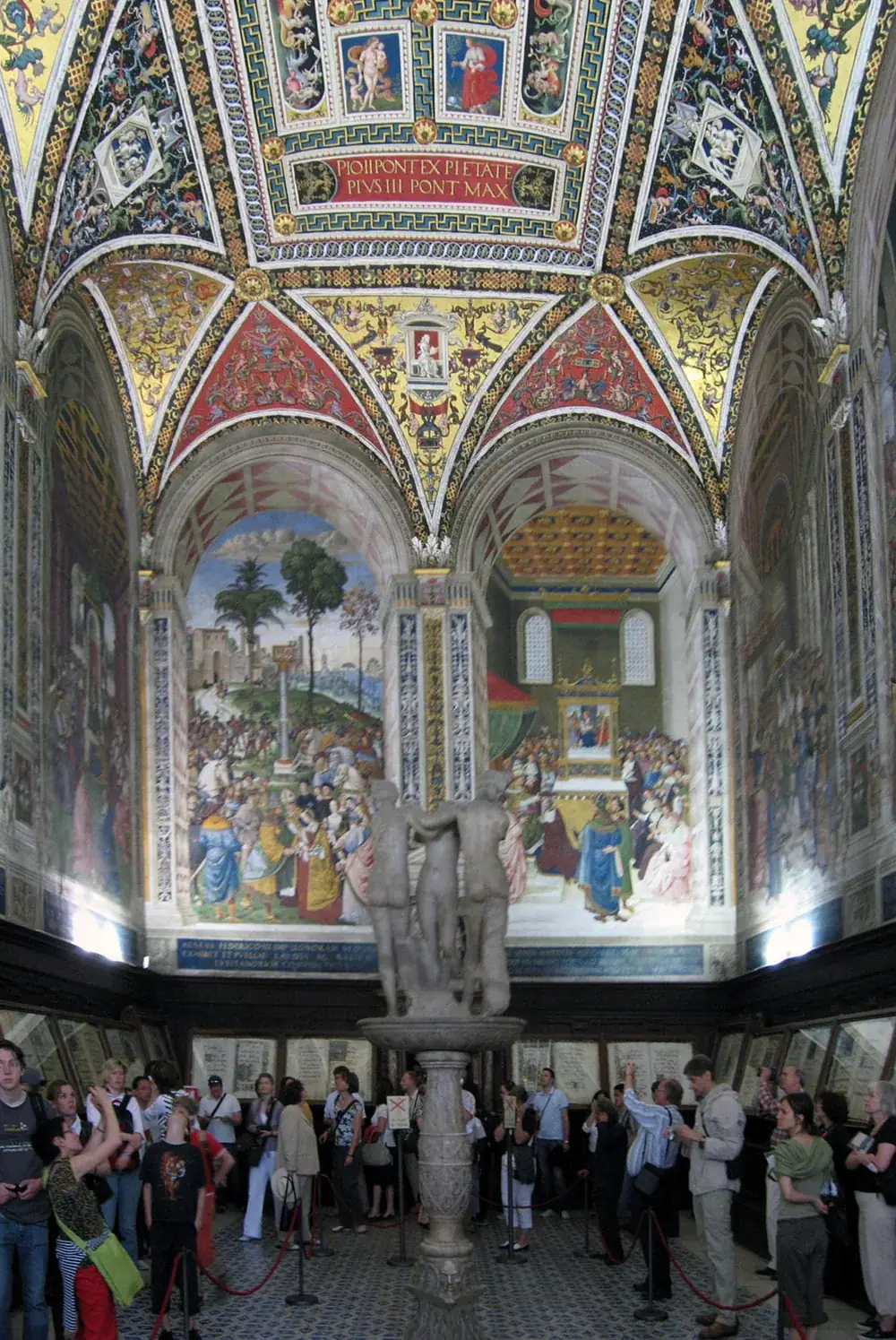
Sienese Painting: Why It Looks Like That, and Where to See It
Florence invented depth; Siena kept heaven. What the gold-ground Sienese school was, why it ended in 1348, and the three-museum route that shows it best.
In this guide
Quick answer
Most visitors meet Sienese painting by accident — a room of gold backgrounds and almond-eyed Madonnas passed through on the way to something with perspective — and file it as "before art got good". That reading is almost exactly backwards, and correcting it is the cheapest upgrade available to a Tuscan trip.
The Sienese school was not failed Florentine painting. It was a different project. Florence, from Giotto on, painted the world as a solid place — weight, depth, anatomy, the room you could walk into. Siena painted heaven as a presence — line, gold, tenderness and pattern, refined to an intensity no one else in Europe matched. One tradition led to the Renaissance and eventually to photography; the other led inward. You do not have to prefer it. You do have to see it in the city that made it, where it stayed.
The three-stop route, in story order:
- Museo dell'Opera (on the OPA SI Pass) — Duccio's Maestà, the altarpiece carried through the streets in 1311, the school's founding masterpiece.
- Museo Civico (Palazzo Pubblico) — the Lorenzetti *Good and Bad Government*, the school going secular and political.
- Pinacoteca Nazionale — the deep bench: rooms of Duccio, Simone Martini and the Lorenzetti, in a city-palace museum that almost nobody queues for.
Half a day covers all three. This article gives you the eyes first.
What Sienese painting is, in one museum room
Stand in front of any fourteenth-century Sienese panel and four things are doing the work:
Gold ground. The background is not a place; it is eternity, rendered in actual gold leaf that moved with candlelight. A Florentine background tells you where the scene happens. A Sienese background tells you it happens outside time. Calling it "primitive" is like calling an icon a failed photograph — the flatness is the theology.
Line. Sienese painting draws where Florentine painting models. Contours curve with a calligraphic, almost musical elegance — the school's inheritance from Byzantine icon painting, refined rather than rejected. Follow the outline of a Madonna's veil in a Duccio and you are watching a line think.
Tenderness. The stock subject is the Virgin and Child, and Siena's innovation was emotional: mothers who look at their children, children who grip a mother's veil. This is the City of the Virgin painting its sovereign — the Maestà is not a devotional picture that happens to be civic, it is the state portrait of Siena's queen.
Colour as luxury. Rose, ultramarine at smuggler's prices, and that gold — the palette of a banking city spending on its saints what it made on its tables.
And one more thing, which photographs never carry: the scale. Much of the school's finest work is small — panels made for side altars, bedchambers and processional carrying, meant to be looked at from the distance of prayer rather than across a gallery. Stand close. These are objects built for one viewer at a time, and a museum room full of them is really a room full of private conversations; the gold only starts working at arm's length, where it was designed to catch a candle rather than a flash.
Once you can see those five, the "old-fashioned" room becomes the most distinctive thing in Tuscan art: the last, highest moment of medieval painting, made by a city rich enough to perfect it just before the world changed.
Duccio, and the day a painting closed the city
The school's founding event has a date and eyewitnesses. In 1311, Duccio di Buoninsegna completed the Maestà — the Virgin in majesty, enthroned among saints, painted on both faces of a great altarpiece for the cathedral's high altar — and Siena shut down to walk it there. The panel was carried in procession from the painter's workshop to the Duomo, with clergy, officials and the population accompanying it through the streets.
Hold that scene: a city closing for a *painting*. Not for a relic, a king or a victory — for the delivery of an artwork, sixty years before anywhere else in Europe would have understood the gesture. It is the clearest statement in the historical record of what images meant here.
The Maestà lives today in the Museo dell'Opera del Duomo, dismantled and partly dispersed, its two faces separated — the enthroned Virgin on one side of the room, the narrative panels of Christ's Passion facing her. It is included in the OPA SI Pass, and it is, by some distance, the single greatest object in Siena. Give it twenty minutes, not two: the Passion panels reward reading like a graphic novel, scene by scene, and almost everyone walks past them to photograph the gold.
Simone Martini and the Lorenzetti: grace and government
Duccio's heirs split his inheritance between them, and the split is the school's story.
Simone Martini took the grace. His line is the school's at its most refined — courtly, sinuous, French-inflected Gothic elegance that made him famous far beyond Tuscany; he ended his career at the papal court in Avignon. In the Pinacoteca Nazionale his *Blessed Agostino Novello* altarpiece shows the register he owned: miracles rendered with an almost domestic gentleness, children falling from balconies and being caught mid-air by a saint who arrives like a thought.
The Lorenzetti brothers took the world. Pietro and Ambrogio pushed Sienese painting toward weight, space and observed life — without surrendering the line. Ambrogio's *Allegory and Effects of Good and Bad Government* (1338–1339), painted for the council room of the Nine, is the school's great secular achievement and arguably medieval Europe's: a frescoed argument about politics, with the earliest great painted landscape in the tradition — the Sienese countryside rolling away under the effects of good rule, recognisably the Crete and the hills you can still drive.
Then 1348. The plague that stopped the city is generally believed to have killed both Lorenzetti brothers, and the school's golden age died with them. Sienese painting continued for two centuries — conservative, beautiful, increasingly out of step — but the trajectory that might have rivalled Florence's ended in the plague pits. When people say Siena's art is "frozen in time", this is the freezer: the school did not fall behind, it was cut off mid-stride.
The Pinacoteca: the best queue-free museum in Tuscany
The Pinacoteca Nazionale, on Via San Pietro a few minutes south of the Campo, holds the world's most significant collection of Sienese school painting — room after room of gold-ground panels tracing the tradition from its origins through the fifteenth century — and it is reliably, almost eerily, uncrowded. In a region where the headline galleries need sold-out survival guides, Siena's principal art museum can be walked into on a summer afternoon.
Practicalities, from third-party listings rather than the museum's own page — check before you build a day on them: hours around 10:00–18:00, admission around €8. The setting is part of the point: the collection hangs in Palazzo Buonsignori, a Gothic city palace — whose name, at the least, echoes the Bonsignori of the Gran Tavola; painting bought with banking money now hangs under a banker's name either way.
How to visit it without drowning: gold-ground rooms defeat completists. Pick three works and give them ten minutes each — the *Blessed Agostino Novello* for Martini's line, a Duccio Madonna for the school's tenderness, and any Lorenzetti for the world creeping in. Twenty panels at thirty seconds each teaches nothing; three at ten minutes recalibrates your eyes for the rest of the trip — which is the actual return on this museum, and why it belongs before the Uffizi in an itinerary, not after it.
The half-day plan, priced
The three museums sit within a twenty-minute walk of one another, and the order matters more than the pace.
Morning, from opening: start at the Museo dell'Opera on the OPA SI Pass — €13, or €15 while the cathedral floor is uncovered — and give the Maestà the first, freshest twenty minutes of your attention. The pass is valid three consecutive days, so the rest of the cathedral complex does not have to happen today; that flexibility is the whole trick of this plan.
Late morning: down to the Palazzo Pubblico for the Museo Civico at €10 (€15 combined with the Torre, with its no-booking rules) and the Lorenzetti frescoes — best before the midday tour-group pulse reaches the Campo.
After lunch: the Pinacoteca on Via San Pietro, around €8 by third-party listings, in the emptiest early-afternoon hours when the headline sights are at their fullest. Three works, ten minutes each, then stop.
The arithmetic: roughly €31–33 total for the greatest concentration of Sienese painting on earth — about the price of a single Uffizi advance ticket and a coffee. And the crowd arithmetic is better still: of the three, only the Museo Civico ever feels busy.
If you have only an hour, spend all of it with the Maestà and walk past everything else without guilt. One masterpiece properly seen outweighs three museums skimmed — and the Maestà is the one object in Siena that repays a visit all by itself.
When it rains, this plan is the city's best day rather than its consolation: all three museums are interiors, and together with Santa Maria della Scala across from the cathedral they make a full wet-weather circuit — the same rescue our walking route reaches for when the weather closes the tower.
How we checked these details
Checked 16 August 2026, by web research; direct page fetches are blocked in our environment, so this rests on search-surfaced material rather than pages we opened.
Verified: the Pinacoteca Nazionale's standing as the world's most significant collection of Sienese school painting, its location in Palazzo Buonsignori on Via San Pietro, and the presence of works by Duccio, Simone Martini and Ambrogio Lorenzetti, including Duccio's *Madonna dei Francescani* and Martini's *Blessed Agostino Novello*; the completion of Duccio's Maestà in 1311 and its procession through the city to the cathedral, as carried in our cathedral guide's verification; the Maestà's present home in the Museo dell'Opera and its inclusion in the OPA SI Pass; Ambrogio Lorenzetti's *Allegory and Effects of Good and Bad Government* of 1338–1339 in the Palazzo Pubblico's Sala dei Nove, as verified for our Campo guide; and Simone Martini's later career at the papal court in Avignon, as standard biography.
Stated as third-party figures rather than official: the Pinacoteca's hours (around 10:00–18:00) and admission (around €8), which come from visitor listings rather than the museum's own published page — treat both as indicative. Stated as scholarly belief rather than documented fact: the deaths of both Lorenzetti brothers in the 1348 plague, which is the general presumption. Deliberately avoided: attribution controversies, including the Guidoriccio fresco question, which deserve more space than a visitor guide can give them; and a claimed genealogical identity between the Palazzo Buonsignori and the Bonsignori banking family, which we could not confirm and therefore describe only as an echo of names.
We have no commercial relationship with any museum named. No booking made from this page pays us anything.
Final thoughts
Art history, as usually taught, is a road that runs through Florence, and Sienese painting appears in it as the scenic turn-off the main road bypassed. Spend half a day with the school in its own city and the metaphor reverses: this was not a road to somewhere else. It was a destination that stopped being built.
The gold grounds were never naïve. They were a choice, made by the richest and most confident city of its age, renewed right up until the year the painters died with everyone else. Florence teaches you how painting learned to show the world. Siena shows you what painting was for before that seemed like the point — and it does so in three museums you can walk between in twenty minutes, one of which you will have nearly to yourself.
Helpful summary
The short version
Florence invented depth; Siena kept heaven. What the gold-ground Sienese school was, why it ended in 1348, and the three-museum route that shows it best.
Frequently asked
FAQ
Keep reading
The Oldest Bank in the World Is a Sienese Charity That Refused to Die
Siena invented big banking, lost it in Europe’s first crash, then founded a 1472 charity that became the world’s oldest bank. It is still on its square.
10 min read · Updated 2026-09-07
The Bottini: Siena’s Underground Aqueduct and the River That Never Was
Siena’s bottini: the 25km medieval aqueduct under the city — what it is, the phantom river it replaced, and how visits actually work.
6 min read · Updated 2026-08-18
Catherine of Siena: The Dyer’s Daughter Who Moved the Papacy
A dyer’s daughter from Siena talked the papacy into leaving Avignon. Her house, her church and her head are all still here — and all free to visit.
10 min read · Updated 2026-09-06