What to Buy in Tuscany: Souvenirs Worth Suitcase Space (and Where)
What to buy in Tuscany, honestly: the oil, saffron, sweets, wine and crafts that are really from here, where to buy each — and the traps to skip.
In this guide
- Quick answer
- The one rule: buy at the source
- The tin of oil: Tuscany’s best-value edible souvenir
- Saffron, panforte and the sweets with a home town
- Wine: bottles, shipping and the labels that matter
- The living crafts: leather, marbled paper, alabaster
- Wearables, the saldi, and when fashion shopping makes sense
- What not to buy: the five traps
- Getting it all home
- The quick map: what to buy where
- How we checked these details
- Final thoughts
- FAQ
Quick answer
The best Tuscan souvenirs share one property: they are actually from here, and better here than anywhere else you will ever buy them. The shortlist we would carry home ourselves: a tin of olive oil from the mill that pressed it; a jar of Zafferano di San Gimignano DOP saffron; a whole panforte and a box of ricciarelli from a Sienese pasticceria; a wedge of pecorino di Pienza; a bottle each of Brunello, Vino Nobile or Chianti Classico — shipped by the producer if your luggage disagrees; and one piece of the region’s living crafts — Florentine leather or marbled paper from the Oltrarno’s workshops, or Volterra alabaster carved on the town that has worked it since the Etruscans. The rule underneath every entry: buy the thing where it is made, from the people who made it — and the traps section below covers what to leave on the shelf, including the counterfeit “bargains” Italian law fines *buyers* for.
The one rule: buy at the source
Tuscany punishes generic souvenir shopping and rewards provenance like nowhere else. The same €15 can buy a mass-produced “Tuscan” trinket assembled elsewhere, or a kilo of pecorino aged by the family that milked the sheep — and the second one is usually *cheaper* at the farm than its lookalike is at the airport.
The pattern this article repeats deliberately: every category has a place of origin you can stand in — the frantoio for oil, the pasticceria for panforte, the enoteca or cellar for wine, the bottega for leather and paper, the town of Volterra for alabaster — and buying there gets you three things at once: the genuine article, the better price, and the story that makes a souvenir worth its suitcase space. It also puts your money into the exact workshops and farms whose survival keeps Tuscany worth visiting, which is the closest thing travel shopping has to a moral dimension.
The practical consequence for planning: souvenir shopping in Tuscany is an itinerary feature, not an errand. The buying happens *on* the day trips this site already maps — which is why each entry below names its territory.
The tin of oil: Tuscany’s best-value edible souvenir
We have called it this before and stand by it: a tin of extra-virgin olive oil bought at the frantoio or farm that pressed it is the single best-value gastronomic souvenir the region sells. In the harvest season — late October onward — that means the year’s olio nuovo at its green, peppery peak; the rest of the year, the current vintage from the same producers.
Buying rules that survive contact with a market stall, from our olive-harvest guide’s label section: prefer tins or dark glass over clear bottles; insist on a stated harvest year; understand the marks — Toscano IGP for region-wide assurance, the tighter DOP names (Chianti Classico, Terre di Siena, Seggiano, Lucca) for territory; and treat a bargain-priced “Tuscan style” bottle as exactly what the phrase admits. Real hand-picked early-harvest oil costs real money because it costs real money to make.
Logistics: oil flies in checked luggage only — a sealed tin, wrapped in clothing, travels indestructibly — and larger purchases ship: most serious producers arrange it routinely. Size advice from experience: the 3- or 5-litre tin feels excessive at the mill and prescient by February.
Saffron, panforte and the sweets with a home town
Zafferano di San Gimignano DOP is the connoisseur’s pick of the whole list: a spice grown only within one municipality, protected since 2005, hand-picked at dawn in the autumn crocus harvest, with a trade pedigree the town’s medieval ledgers document. A small jar of threads weighs nothing, survives any journey, and is — as our San Gimignano guide put it — the one souvenir there that is genuinely *of* that place. Buy it in town, from local producers, in thread form rather than powder.
Siena’s counterpart is edible architecture: a whole panforte — dense, spiced, medieval, and a famously robust traveller — and ricciarelli, the soft almond biscuits, both bought from a city pasticceria rather than a souvenir shelf. December is their true season, but they are made and sold year-round, and a panforte carried home whole and served in thin slices is the closest a suitcase gets to importing Siena.
Round out the edible category with pecorino di Pienza from its home town’s shops (vacuum-sealing for travel is routine — ask), cantucci with vin santo as the classic pairing gift, and dried porcini in autumn. All of it fits the food calendar’s seasonal logic: buy what the season just delivered.
Wine: bottles, shipping and the labels that matter
The wine souvenir has a hierarchy of ambition. The modest version: a bottle or three of Chianti Classico, Vernaccia di San Gimignano (Italy’s first DOC, from 1966) or Rosso di Montalcino, wrapped in knitwear in the checked bag. The serious version: Brunello di Montalcino or Vino Nobile di Montepulciano bought at the cellar after a booked tasting — and here the smart move is usually not to carry at all: most producers arrange shipping routinely, it removes every airline variable, and it converts the purchase into a delivery that arrives home just as the holiday fades.
Buying wisdom the enotecas themselves will confirm: buy what you actually tasted rather than what the label’s reputation suggests; the mid-range of a great producer usually beats the entry level of a famous name; and vin santo with cantucci makes the best wine-adjacent gift for non-collectors — distinctive, affordable, and unmistakably Tuscan.
One warning transplanted from the harvest guide: if you are carrying rather than shipping, remember that bottles fly checked-only, and that a dedicated padded wine sleeve costs less than one broken Brunello.
The living crafts: leather, marbled paper, alabaster
Tuscany’s craft souvenirs divide into two economies — workshop and stall — and only one of them is worth your money.
Florentine leather is the famous case. The tradition is real and centuries deep, and its honest home is the Oltrarno — the San Frediano, Santo Spirito and San Niccolò quarters whose botteghe form one of Europe’s densest concentrations of working artisans. A belt, bag or notebook bought from a workshop where you can see the bench beats anything from the stall economy around the famous squares, where “leather” spans every quality and origin the word can legally stretch to.
Marbled paper — carta marmorizzata — is Florence’s quieter signature: a technique that reached the city on fifteenth-century trade routes and survives in generational workshops. Notebooks, boxes and sheets of hand-marbled paper are light, flat, inexpensive and unmistakably Florentine — the traveller’s ideal craft souvenir.
Volterra alabaster completes the set: the town has carved its translucent stone since Etruscan times and remains Italy’s one significant centre still working it traditionally. Buy in Volterra itself — the real one, no vampires — from workshops rather than generic gift shops; our Volterra guide has the workshops and the ecomuseum.
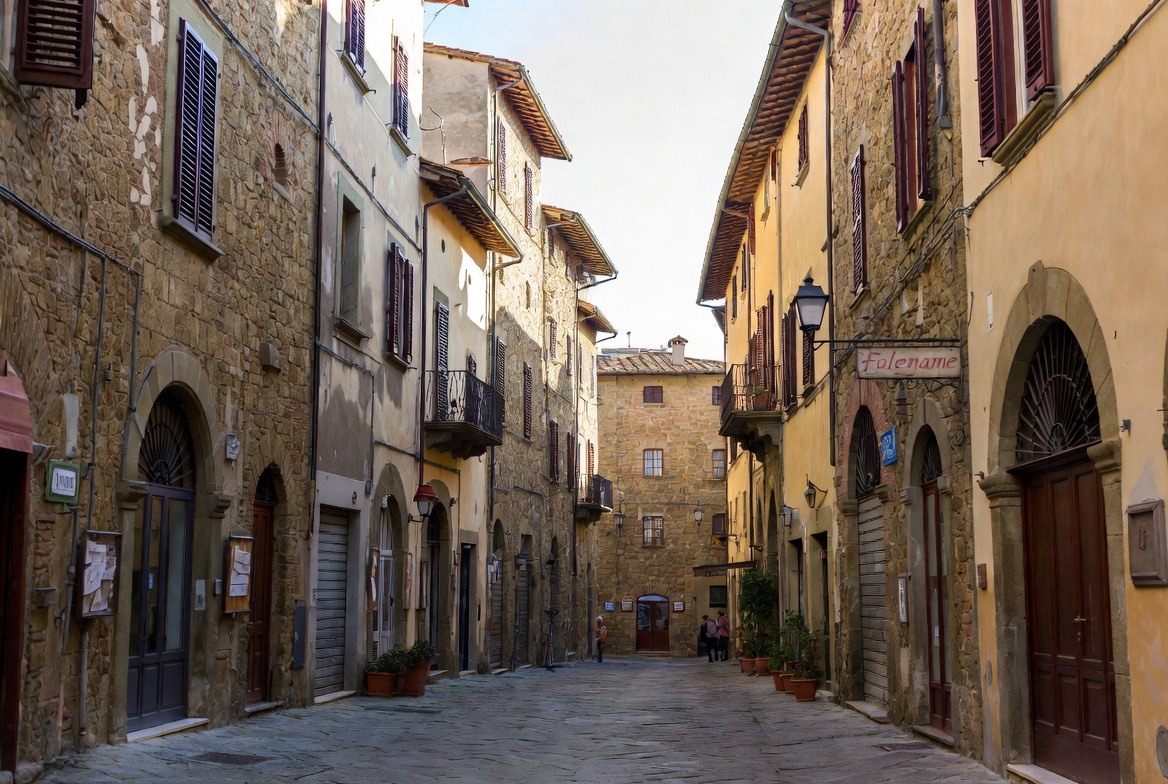
*The Oltrarno’s botteghe: the difference between a souvenir and a stall trinket is a workbench you can see.*
Wearables, the saldi, and when fashion shopping makes sense
Tuscany’s wearable shopping runs from artisan to industrial, and timing changes the mathematics. Florence remains a serious fashion city — the streets around Via Tornabuoni for the headline names, the Oltrarno for made-to-last leather goods — and the regulated winter saldi turn January and February into the year’s buying window, with genuine storewide discounts under a rule-bound national system rather than perpetual fake “sales”.
The honest guidance by budget: at the artisan end, buy the thing you watched being finished; at the fashion end, buy in the saldi or accept full boutique price with grace; and at the stall end — the €20 “cashmere” scarf, the €40 “leather” jacket — apply the counterfeit section below before parting with anything.
The sleeper wearable souvenir nobody plans and everybody uses: proper Italian-made gloves, scarves or knitwear from ordinary good shops in Florence or Siena — the kind residents buy — which outlast novelty purchases by years and carry the quieter kind of provenance. In winter months, buying them mid-trip doubles as weather strategy — and years later, the pair of Florentine gloves that outlived three winters will have quietly become the most-used souvenir of the entire trip, which is its own definition of value.
What not to buy: the five traps
1. Counterfeits — the trap with a fine attached. Italian law targets the *buyer* of fake designer goods, not just the seller: purchases from street vendors can draw fines reported at up to €7,000, with enforcement active in tourist shopping areas, precisely to protect the artisan economy this article keeps pointing you toward. However friendly the price of the “Gucci” on the blanket, the transaction is illegal on your side of it too.
2. “Tuscan-style” oil. The phrase is a confession. If the label names no producer, no harvest year and no place, it is a bottle of marketing — the label rules take ten seconds to apply.
3. Most “truffle oil”. The cheap ubiquitous version is typically aroma-compound flavouring that never met a truffle. In truffle season, buy preserved truffle products from the market dealers or eat the real thing instead.
4. Beach souvenirs that are the beach. Sand, shells and stones from protected coasts are prohibited to remove and penalised — the postcard costs less than the fine.
5. The made-elsewhere shelf. Fridge magnets, aprons and “Italian” ceramics with suspiciously global supply chains — harmless, but they spend the same euros a bottega was hoping for. When in doubt, apply the article’s rule: can you stand where it was made?
Getting it all home
The logistics, condensed. Liquids — oil, wine, vin santo — travel in checked luggage under standard airline liquid rules, wrapped in the centre of the bag; tins beat bottles, padded sleeves beat optimism, and above two or three bottles the producer-shipping conversation beats everything. Cheese travels happily vacuum-sealed (ask the shop — it is routine) and survives a day of transit without refrigeration in all but high summer. Panforte is the suitcase’s most forgiving passenger; ricciarelli want a tin against crushing. Saffron, dried porcini, marbled paper — weightless, crushproof at the top of the bag.
Crafts: leather needs nothing; alabaster wants clothing-wrap and a spot away from the wheels; anything genuinely fragile is a shipping conversation at purchase, not a packing problem at midnight.
Customs sense: within the EU, movement is free for personal quantities. Beyond it — UK, US, Australia especially — check your own country’s food-import rules before flying: cured meats are commonly restricted, hard aged cheese and sealed commercial products usually travel legitimately, and declaring honestly costs minutes while gambling costs the ricciarelli. Rules differ by country and change — verify yours close to travel.
The quick map: what to buy where
Siena — panforte and ricciarelli from a pasticceria; pici and local pecorino from the food shops; Terre di Siena DOP oil; wine from an enoteca after tasting. Peak occasion: the Mercato nel Campo’s December weekend.
Florence — Oltrarno leather and marbled paper from working botteghe; fashion in the saldi window; food-market treats from the market halls.
San Gimignano — saffron threads (DOP) and Vernaccia, both genuinely of the town.
Pienza and the Val d’Orcia — pecorino at its source; Brunello and Vino Nobile at the cellars; oil at the farm gates.
Volterra — alabaster from the workshops of its only traditional home.
The countryside mills and farms — the oil tin, in season above all, plus honey, dried herbs and the farm-gate extras that never reach shops.
The pattern holds everywhere: the town’s *thing*, bought in the town, from its makers. Plan the shopping *into* the day trips rather than around them — the frantoio purchase happens on the harvest morning, the saffron jar on the San Gimignano day, the alabaster on the Volterra detour — and the suitcase fills itself without a single hour spent “souvenir shopping” as an activity, which is exactly how the region intends it.
How we checked these details
Checked in August 2026: the craft traditions — the Oltrarno’s standing as one of Europe’s densest working-artisan quarters with its leather, marbled-paper, gilding and bookbinding lineages; Florentine paper marbling’s fifteenth-century arrival via trade routes; and Volterra’s position as Italy’s one significant centre still working alabaster traditionally, on an Etruscan-era lineage — against Tuscan tourism and craft-heritage sources. The buyer-side counterfeit penalties (fines reported up to €7,000, with active enforcement in tourist shopping areas) reflect Italy’s anti-counterfeiting framework as described in current travel-law reporting — the principle is settled even where individual penalty amounts vary by case. Food and wine provenance facts (saffron DOP, oil labels, first-DOC Vernaccia, harvest seasons) carry over from the primary-source checks documented in the linked guides. Customs allowances differ by destination country — verify your own rules close to travel. We have no affiliate relationship with any shop, producer, workshop or platform; recommendations are editorial, and no individual businesses are named by design.
Final thoughts
The souvenir question is really the trip question in miniature: did you visit Tuscany, or a gift-shop rendering of it? Every entry on this list answers the same way — the oil from the press, the saffron from the one town on earth entitled to the name, the paper from the bench where it was combed into pattern, the cake that has outlived every empire since it was first pressed. Pack light on the way out, buy where you can shake the maker’s hand, ship what deserves shipping — and months from now, when the tin runs low and the panforte is a memory, you will discover the real function of a proper souvenir: it is not a reminder of the trip. It is the argument for the next one.
Helpful summary
The short version
What to buy in Tuscany, honestly: the oil, saffron, sweets, wine and crafts that are really from here, where to buy each — and the traps to skip.
Frequently asked
FAQ
Keep reading

All Saints’ Weekend in Tuscany 2026: A Free-Museum Sunday, a Holiday, and the Monday Everything Closes
Ognissanti 2026 falls on Sunday 1 November — a first Sunday, so state museums are free — then the Uffizi and Pitti close on Monday. The plan that works.
11 min read · Updated 2026-09-23

Florence or Siena: Which Should You Visit in 2026? An Honest Comparison
Florence or Siena in 2026? An honest comparison: first trips, bases, art, food, budgets, seasons — and how to combine both in one itinerary.
12 min read · Updated 2026-08-03
Florence’s New Tourist Rules 2026: What Actually Changed (and What’s Recycled News)
Florence’s real 2026 rules, verified: the outdoor-dining overhaul, the e-scooter rental ban, keybox and rental restrictions — and the recycled myths.
11 min read · Updated 2026-08-01